The Golden Rule and Eye For An Eye Will Get You Hurt—Do This Instead

The Golden Rule and Eye For An Eye Will Get You Hurt—Do This Instead
“Do unto others as you would have them do unto you.”
That’s the Golden Rule for navigating how you treat others, and you could do far worse than living your life by this code—at least in theory.
The reality is that people have always gotten out of pocket and tried to bully, intimidate, discriminate, or dominate others for various selfish reasons, regardless of how you treat them.
That’s how it is, how it always was, and how—as long as humans exist in a world of finite resources—it always will be.
Like Avon Barksdale says to Stringer Bell about their rival Marlo Stanfield in The Wire, “There’s always gonna be a Marlo, man. No Marlo, no game.”
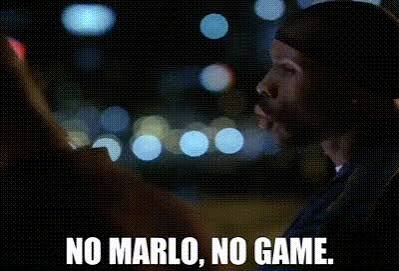 Or, if you’re not a fan of the best show that HBO ever produced, I’ll give it to you in more clichéd terms—as long as there’s light, there’s gonna be darkness.
But just because the darkness is inevitable doesn’t mean you have to live your life passively accepting the sociological equivalent of getting your power shut off.
As long as one group of cavemen was trying to take what the other cavemen had, humans have been devising all types of strategies for dealing with the assholes of the world, with some more effective than others.
In my last essay, I discussed the interplay between two of those strategies—big stick policy and Tit for Tat—and some of your guys’ responses in the comments were interesting and got me thinking:
Are the Tit for Tat and Big Stick Policy really the best strategies for dealing with antagonistic aggression, or are they only applicable in certain situations?
Is there a method that comes with a bigger “bang for your buck” when it comes to dealing with the habitual line steppers of the world that won’t also land you in the emergency room or the morgue?
If you’re new, you can watch my previous video on Tit for Tat and Big Stick Policy—you can watch it here or read it here—but here’s a quick refresher.
Watch this essay here
A Quick Primer On Big Stick Policy and Game Theory
The Big Stick Policy was the United States’ foreign policy under President Theodore Roosevelt.
The idea of the policy was, in the words of President Roosevelt himself, “the exercise of intelligent forethought and decisive action sufficiently far in advance of any likely crisis.”
You come to the negotiating table peacefully and try to reach a diplomatic solution, but if it doesn’t work out, you have more than enough might to hold your own in a fight—and the knowledge of that capacity for force should make any opponent more reasonable in negotiations.
I think of this as the Fleece Johnson, “we can do this the easy way, or we can do this the hard way” style of negotiation.
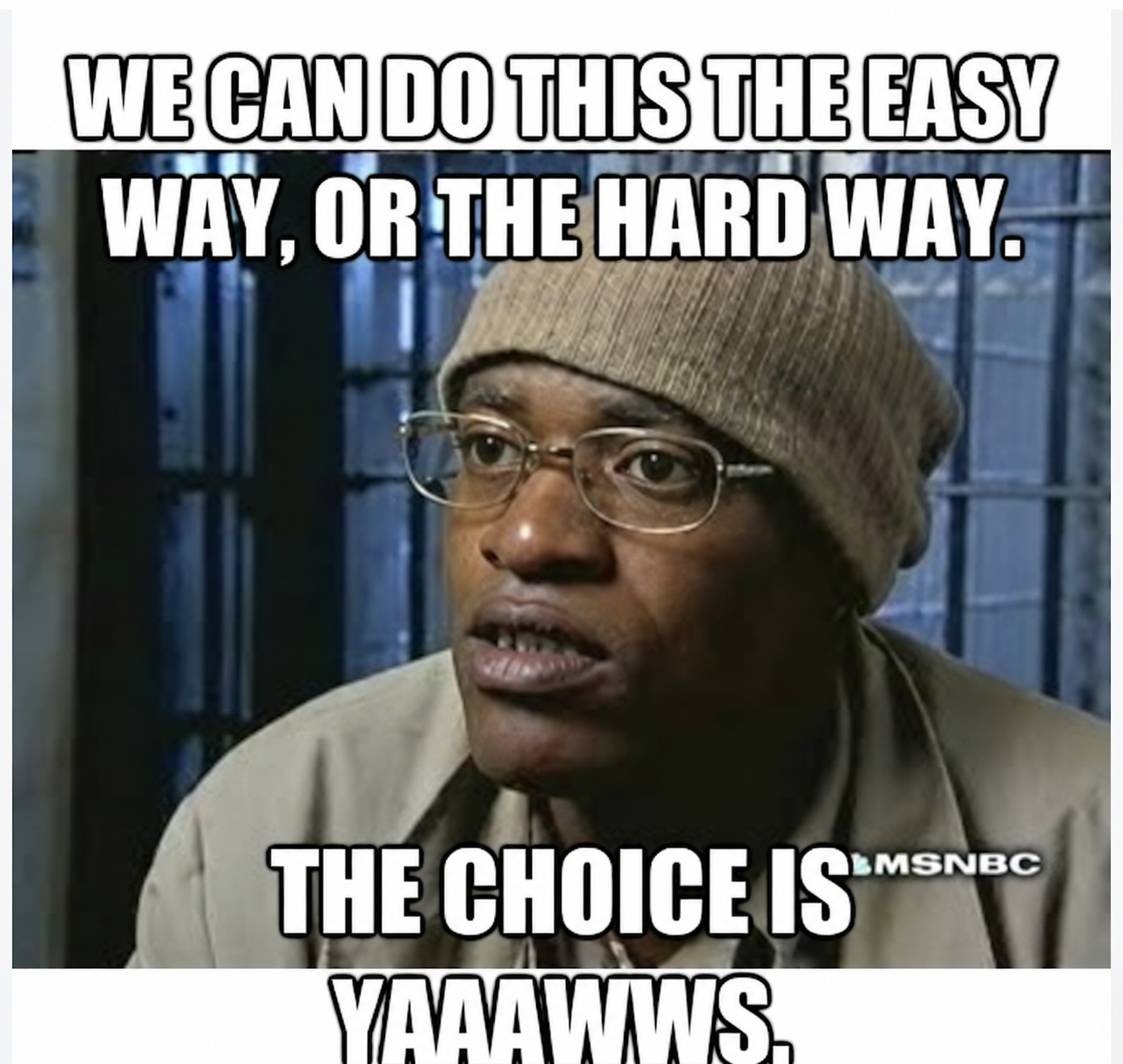 And if you didn’t get that reference, think of it as a less murdery version of Pablo Escobar’s style of doing things, a man who was famous for offering “plata o plomo”—you take the money, or you take a bullet.
Tit for Tat was a solution to one of Game Theory’s most famous problems, The Prisoner’s Dilemma.
Despite the name, it has enormous applicability for ordinary civilian interactions.
The TL;DR version is that the optimal solution is to lead with cooperation, swiftly retaliate when you’re crossed, and be forgiving once the other person starts playing nice again.
The idea uniting both strategies is this:
I’m cool as long as you’re cool, but if you wanna take it there, I’m gonna take it there with you, but not to such an extreme that we can’t get back to being on good terms if you start acting right.
When people talk about the Golden Rule, they conveniently forget that “doing unto others as they would have done unto you” also comes with the possibility of being forced to slap the shit out of someone every now and then, both literally and metaphorically.
How do we deal with them?
The main limitation of Tit for Tat is that it works great in situations where you’re going to deal with someone repeatedly. You can really just think of it as establishing and enforcing boundaries with the people you’re forced to deal with on a daily basis.
But it won’t always be that way.
Many interactions you have with people will be one-offs or so short in duration, or will be explicitly competitive—or, at the very least, they will be zero-sum interactions where only one person can occupy an ultimate position, say two guys pursuing the same girl.
This is when Tit for Tat becomes woefully ineffective.
Tit for Tat is designed to correct behavior under the pretense that you’ll need to have a relationship with this person. The idea is that you don’t burn the whole thing to the ground in retaliation.
But sometimes, you aren’t dealing with a confused friend, an inconsiderate coworker, or a spouse who momentarily lost her mind. Sometimes the person has already decided that your interests are secondary, mutually exclusive to theirs, and they are coming in heavy.
So you have to do the same thing.
In that kind of interaction, going blow for blow won’t be enough. In fact, your adversary may be counting on it and has already accepted that it’s the cost of doing business.
Today’s Sponsor: Prism Potion
 And since we’re talking about overwhelming force, let me tell you about one area where more isn’t always better: caffeine.
A lot of pre-workouts try to beat fatigue into submission with massive doses of stimulants.
Prism Potion takes a smarter approach.
Each serving gives you 80 milligrams of caffeine from low-acid organic arabica coffee—enough to sharpen your focus and increase your energy without making you feel like your heart is trying to escape your chest.
You also get two grams of PeakO2, a six-mushroom performance blend studied for its potential effects on oxygen utilization and exercise performance, along with MCT powder, ashwagandha, and rhodiola.
I use Prism Potion when I want steady energy for training or deep work without getting overstimulated.
When It’s Not Enough To Just Hit Back
If someone decides to bully you, but they have a gang of people on their side ready to ride, then even if you get a few licks in, it ain’t gonna mean much in the end.
This is why, in all confrontations—physical or otherwise—the worst type of opponent is one with nothing to lose.
You can’t take the moral high ground against a degenerate.
Something I learned in high school that I carry with me to this very day is that when someone is already dirty—or likes to be dirty—then you can’t sling mud back at them; i.e., the rumor mill is a bad place to be if the person who starts the rumors is already a scumbag.
In any of these cases, Tit for Tat is ineffective, and they’ve already shown that they aren’t afraid of your Big Stick.
Now you must throw down, and there are three ways to do it.
“If they pull a knife, you pull a gun.”
The first way is with overwhelming retaliation.
There’s a great line in The Untouchables—great classic movie if you haven’t seen it—where Jim Malone, played by the legendary Sean Connery, says, “If they pull a knife, you pull a gun. If he sends one of yours to the hospital, you send one of his to the morgue.”
 This is obviously quite different from Tit for Tat.
Tit for Tat is backward-looking. It bases your response on what already happened in an attempt to dial things back.
On the other hand, overwhelming retaliation is forward-looking and sends a clear message: the cost of attacking me will exceed the value you gain from doing so.
And it sends a message to anyone who is looking at you from the sidelines as a potential victim.
This is easy to imagine in a violent scenario, but what does this look like in civilized society with rules and laws?
A countersuit is the clearest example.
Someone files a BS lawsuit against you, expecting you to settle because of the money and trouble it would take for you to defend yourself.
A Tit-for-Tat response would be purely defensive: hire a lawyer and fight it in court. Maybe you win, maybe you lose.
Overwhelming retaliation is different.
You file a countersuit for the harm their actions caused: legal expenses, lost income, reputational damage, breach of contract, defamation, abuse of the legal process, and whatever else you can find.
Oh, and just for good measure, you seek sanctions and reimbursement for your expenses.
I once met a particular internet personality known for peddling numerology bullshit online (if you know, you know) for a few games of chess in a coffee shop—not my home, because the dude is sketchy AF.
He decided to go on X and tell everyone that I was dirt poor and moving to Portugal because I can’t afford to live in America.
Like dawg, my wife is Portuguese. That’s why we moved there.
And do you know that moving abroad is not exactly what poor people do? Anyway, it was annoying, and I kept blocking him, but he kept making different screen names.
So finally, with my bigger social media presence, I told everyone that he gave off kiddie diddler vibes—because he does—and that he was actually living in an RV (which was true, btw).
That got his attention, and he decided to message me to squash the beef.
Now, this was not my best moment, but he decided to make stories up about me because I wouldn’t sign up for his weird cult.
I’m not saying his name or giving him any shine, but I’ve said enough already that if you know, you know.
But it worked.
He insulted my finances to get attention. I responded with something far more damaging, delivered it to a much larger audience, and suddenly it was no more fun once the rabbit had the gun.
But what if he hadn’t backed down?
That’s a general strategic hypothetical because, in reality, I probably would have just kept blocking him until he got bored.
But hypothetically, what if he had information that could embarrass me, or had a bigger platform or deeper pockets to initiate what would probably have been a very winnable lawsuit?
Let’s See If You Can Survive When I Take It To The Extreme
Overwhelming retaliation assumes that once you raise the cost, the other person will make the rational choice and retreat, but humans—especially ones prone to behavior like this—aren’t exactly known for their rational choices.
These are the types of people who, as the proverb goes, cut off their noses to spite their faces.
Now you’re both raising the stakes, each response more destructive than the one before it, until you don’t even remember what the original conflict was even about.
That brings us to the second method: escalation dominance.
Overwhelming retaliation means hitting harder than the opponent hit you. Escalation dominance means being able to win if he decides to hit back even harder.
And the idea is simple:
No matter what you come at me with, I’m going to come back at you harder. You will have to kill me, because backing down is not an option.
Ok, maybe that’s a bit dramatic, but it captures the general idea. But there are a few problems with escalation dominance that always get people into trouble when they pursue this path.
You may discover that you are simply not capable of winning the war that you’ve found yourself in.
Let’s revisit our lawsuit example.
You threaten someone with a lawsuit only to have them call your bluff, but they have more than enough resources to keep you tied up in court until you’re bankrupt.
Or, in a more interpersonal conflict, you try to embarrass someone online, but you find out they have a bigger platform, more dirt on you, they don’t depend on their platform to earn money (but you do), and they have way fewer ethical boundaries than you previously thought.
Anyone familiar with influencer downfalls can easily see how this goes bad fast.
This is also why, as a general rule, you need to do as little dirt as possible. Plenty of people have fallen victim to blackmail because someone did a little digging and found a leverage point.
And if you insist on still doing dirt that can be used against you, just own it.
Be like Eminem in the final battle of 8 Mile and own all your flaws and shortcomings so that when someone comes sideways at you, you can just toss them the mic and say “here, tell these people something they don’t know about me.”

Escalation dominance requires more than the ability to cause damage. It requires the resources, leverage, alliances, evidence, discipline, and endurance to remain stronger at every level the conflict could reasonably reach.
In a workplace dispute, that might mean having documentation, credible witnesses, a clean performance record, and the financial ability to walk away.
In a legal dispute, it might mean having both a legitimate claim and enough money to survive a long fight.
In a public conflict, it might mean having greater reach, stronger credibility, better receipts, and fewer secrets the other person can expose.
The ideal outcome is that you never need to do battle because your opponent recognizes the severe imbalance between you and decides that it’s just not worth it.
But what if the person you’re beefing with recognizes the imbalance, knows that you have significant advantages, and still doesn’t care?
Some people would rather lose through their own foolishness than survive by prudent assessment of the situation.
Others are too emotional, desperate, obsessive, or detached from reality to accurately calculate the consequences. In conflicts that require ideas like the ones expressed in this essay, you often find that the aggressor is only thinking one move ahead—and they never make the right move anyway.
You can’t deter someone who doesn’t care what happens to him, and you can’t reason with someone who has made destroying you more important than protecting himself.
Against this type of person, Tit for Tat, the Big Stick Policy, overwhelming retaliation, and escalation dominance make for a war of attrition. If you win, it will be a Pyrrhic victory.
It will become a situation where, referencing Eminem again—this time from his song Toy Soldiers—”we spent so much energy on it I’m exhausted, and even though the battle is won we feel like we lost it.”
Hitting back harder—or at all, really—is no longer the smartest move. But neither is turning the other cheek.
This is why I’m not a fan of eye for an eye.
The problem with that approach is that if you are using it as a response to aggression, then you will go blind before the one who struck first.
You either need to come back harder, not come back at all, or take the final option: threat neutralization.
Sometimes The Best Way To Win Is To Make Sure Your Opponent Can’t Engage With You
The objective is no longer to punish the aggressor, frighten him, or convince him to behave rationally.
You’re way past words, retaliation, and escalation.
Your only goal is to remove his access, opportunity, resources, or capacity to continue threatening you.
This is easy to visualize in a physical confrontation.
You put the attacker in a headlock, run, or call the police.
In civilized society, it is far less dramatic and usually more effective:
Blocking someone on social media, blocking their phone number, not hanging out in person, firing them, or severing the relationship.
While all the other tactics ultimately depend on the other person learning their lesson and acting right, neutralization does not.
A locked door works whether the thief respects your property or not.
A revoked password works whether the disgruntled employee has calmed down or not.
A restraining order backed by enforcement does not require an obsessive ex to suddenly develop emotional maturity.
You’re past the point of changing their behavior. You’re now changing what they can do with that behavior.
Let’s return to my numerology stalker.
Trading insults was overwhelming retaliation. Having the larger audience gave was escalation dominance. But neither of those things guaranteed that he would stop making new accounts and coming back.
Threat neutralization would mean documenting the harassment, reporting every account for ban evasion, tightening my privacy settings, denying him access to me, and—if he crossed the relevant legal line—having an attorney send the appropriate notice or pursuing legal protection.
While this isn’t nearly as emotionally satisfying as publicly humiliating him, it solves the actual problem.
It’s a mindset shift from making someone suffer to making them irrelevant. But when you do this, you can’t half-ass it, because I’ve learned that bad attention scratches an itch while no intention infects it.
What I mean by that is that people tend to become angrier and more persistent if you cut them off than if you had kept trading blows (metaphorical or literal) or even just ignored them.
In my 41 years on this planet, I’ve only had to block two people from ever being able to call or text me.
This was because I had blocked them on every social media platform and in my email, but they wouldn’t give up. The crazy part is that one was mad I wouldn’t join in his slander of someone else, and the other was trying to recruit me into his MLM scheme.
People don’t like neutralization because they often confuse disengagement with surrender since both involve leaving the conflict.
But surrender means the other person forced you to capitulate or leave something of value behind. Disengagement is something different.
When you think of neutralization as strategic disengagement, that becomes clear.
Strategic disengagement means you recognized that the battle was not worth fighting, but you still could not just lay down, so you removed yourself from the battlefield entirely. You denied the opponent any further access to your time, attention, or peace.
If someone’s only weapon is provoking you into retaliating, then your most powerful weapon is to remove their access to you.