The Relay App Will Help You Quit Porn Addiction

Relay is an app-based program designed to help men quit porn addiction for good. I tried out the Relay app, and in this article, I take you inside and share my honest opinion.
What if I told you that you didn’t have a porn problem, but a pain problem?
That’s how the CEO of Relay, Chandler Rogers, describes porn addiction—and based on the research we have about addiction, his observation is spot on.
He’s used that insight to design a potent idea: an online porn addiction support group that operates within an app. Writing this review was an interesting challenge because Relay is so unique that there isn’t a single word or phrase to describe it.
At its core, Relay is a platform that provides live meetings for men who struggle with porn addiction.
There’s a community of men who participate in structured accountability check-ins. Oh, and there’s also an education component with courses taught by licensed therapists and psychiatrists who specialize in recovery.
The entire system is designed not only to help you stop watching pornography, but also to help you heal and understand why you can’t stop despite any emotional, sexual, relational, or—in some cases—physical damage that you have endured as a result.
This review will explore all of the features of Relay and give you an in-depth, behind-the-scenes look at the app.
Whether you found this article looking for a review of the Relay app or you were just searching for an online porn addiction support group to help you get your habits under control, you’ll learn about how Relay can potentially help you.
But before we get into the features of Relay, there’s one thing that Relay is not, and we have to cover that first.
Disclosure of conflict of interest and affiliate compensation:
I write content for Relay and received a discount code to try the app. While I am committed to leaving an honest review that highlights both the positives and negatives of Relay—the app isn’t all candy and roses—it’s important that you know about my connections and affiliations.
If you sign up for Relay through any links on this page, I may receive a commission.
Relay Is Not A Porn-Blocking App

Before we get into the features, we need to clear up the biggest misunderstanding people have about Relay.
Relay is not a porn-blocking app. In fact, they promote other porn blocking apps on their website.
It doesn’t lock your phone down, blacklist websites, or install digital handcuffs on your browser. It doesn’t even monitor your traffic.
If you’re looking for something like Covenant Eyes, Canopy, or Freedom—tools that restrict access and monitor activity—Relay isn’t trying to compete in that lane.
And that’s not because blockers are useless.
Restriction can absolutely help, especially early on. If you’re in a fragile stage of quitting, putting speed bumps between you and temptation is not only a smart move, but sometimes it’s a necessary one as well.
Porn blocking software can keep you in check and prevent impulsive relapses from happening during moments when you feel the urge to watch porn. Blockers buy you valuable time to regain control when you feel like you’re losing it.
But what happens when your sex drive comes roaring back? Blockers don’t fix the thing that keeps making you want porn in the first place.
Porn blockers treat porn addiction like a technology problem—“If we just block the websites, the behavior stops.” But compulsive porn use isn’t fueled by access. It’s fueled by pain, stress, loneliness, boredom, anxiety, shame, and whatever else you’ve trained porn to solve for you.
That’s why a lot of guys “fail” with blockers even when the software works perfectly.
They hit a stressful week. They get into a fight with their partner. They feel rejected. They have a bad day. They’re tired. They’re alone. The urge spikes, and the brain now seeks relief.
If porn has been your go-to relief valve for years, you will find a workaround, a loophole, a new source, or a device without the blocker—not because you’re weak, but because your nervous system is trying to regulate itself with the only tool it knows.
Blockers can slow you down. They can’t teach you what to do with the urge when it shows up.
Relay is designed to get to the root of the problem, rather than just addressing the symptoms. Relay’s goal isn’t to create a world where porn is inaccessible—it’s to create a life where porn is unnecessary.
That’s why Relay functions more like a rehab center in your pocket than a set of parental controls.
Instead of focusing on what you can’t do, it focuses on what you can do when the craving hits—who you talk to, how you interrupt the loop, how you handle the pain underneath it, and how you rebuild the parts of your life that porn quietly eroded.
This is also why Relay is hard to describe with one neat label. It’s not “software.” It’s a support system: live meetings, peer accountability, structured check-ins, and professional education. All of this is designed to replace secrecy with connection and compulsive coping with healthier outlets.
Porn blockers try to win by controlling your environment. Relay tries to win by changing how you interact with it.
Now that that’s out of the way, we can talk about what Relay actually offers. Let’s walk through the app, starting at the sign-up page.
Relay addiction app sign-up process
Upon signing up, you’re immediately greeted by a video message from Chandler Rogers, the founder of Relay. I’ve tried out a lot of apps designed to help men quit porn, and I’ve never been greeted with a video message upon starting.
That alone gives you a glimpse into the level of care that has gone into Relay and the sincerity of the mission.
Relay prides itself on showing that there is a team of real people behind the app—people who have struggled and know what it’s like. Unlike other apps and most programs, at Relay, you work with real clinicians and therapists on a clinical program that blends human empathy and hard science.
No other apps welcome you aboard with reassurance that “you don’t have a porn problem, a masturbation problem, an infidelity problem, or whatever it is you’re dealing with. You have a pain problem.”
When I initially started my journey through addiction recovery—both with alcohol and pornography—I never put much stock into the idea of underlying issues. To me, it was always more important to stop the behavior and figure out the “why” afterwards.
With that said, the further along in my sobriety and recovery journey I go, the more I see how much my underlying issues and past traumas have played a role in leading me to where I am today.
Knowing that Relay takes this approach so seriously—that the founder delivers a video message about it when you sign up—immediately puts Relay at the top of porn recovery and porn blocking apps and programs.
Rogers concludes the video message with, “We’re not just here to help you quit a behavior, but to help you become a healthier, whole version of yourself.”
These words are not just fluff, as you’ll soon see.
A debatable issue about the Relay sign-up process
I told you this review would be honest, and that includes any negative impressions I have. Well, it’s time for the first one.
Right after Chandler’s welcome message, you’re prompted to leave a 5-star rating. I have mixed feelings about asking people to rate the app before they even use it.
On the one hand, as someone who has created online content for over a decade and has appeared on well over 300 podcasts, I understand how important reviews are.
Reviews not only make people feel confident about the product, service, or show, but they also help others discover it because good (and many) reviews trigger the algorithm to show your product in the top results in the category you service.
Not only that, but people forget to leave reviews, and they are less likely to leave a positive review than a negative one—especially the more satisfied and engaged they are with the app.
I call this “The Lineman Principle.”
In American football, the only time you hear a lineman’s name announced is when he does something wrong. For people not familiar with the sport or non-Americans, “The Goalie Principle” works as well.
If Relay wants to gain more reviews—especially positive ones—it makes the most sense to ask for them upfront and specifically request 5-star reviews.
With that said, some people might reason—and rightfully so—that asking for a review before the product is actually used is a bit dishonest.
At the very least, potentially inaccurate. I know the app is great because I’ve used it and been behind the scenes as well, but someone who signs up after a Google search or reading an interview with the founder or a profile on the company does not know that.
To offset this possibility, you can always change your review. Also, Relay offers a free 30-day trial, so these are fair trade-offs. I suppose this isn’t so much a negative as it was surprising, but given that you aren’t married to whatever review you leave AND you get to try before you buy, most users—myself included—won’t mind.
Faith vs. Science: Choose Your Path In Relay
After signing up, you fill out a questionnaire. The purpose of this questionnaire is to determine the best approach for you once you are inside the app.
All of the questions are the standard information you’d put down when trying to change a bad habit. how long you’ve been struggling, when your last relapse was, the longest you’ve been able to refrain from using pornography, and they even ask if you’re currently working with a therapist or have tried in the past.
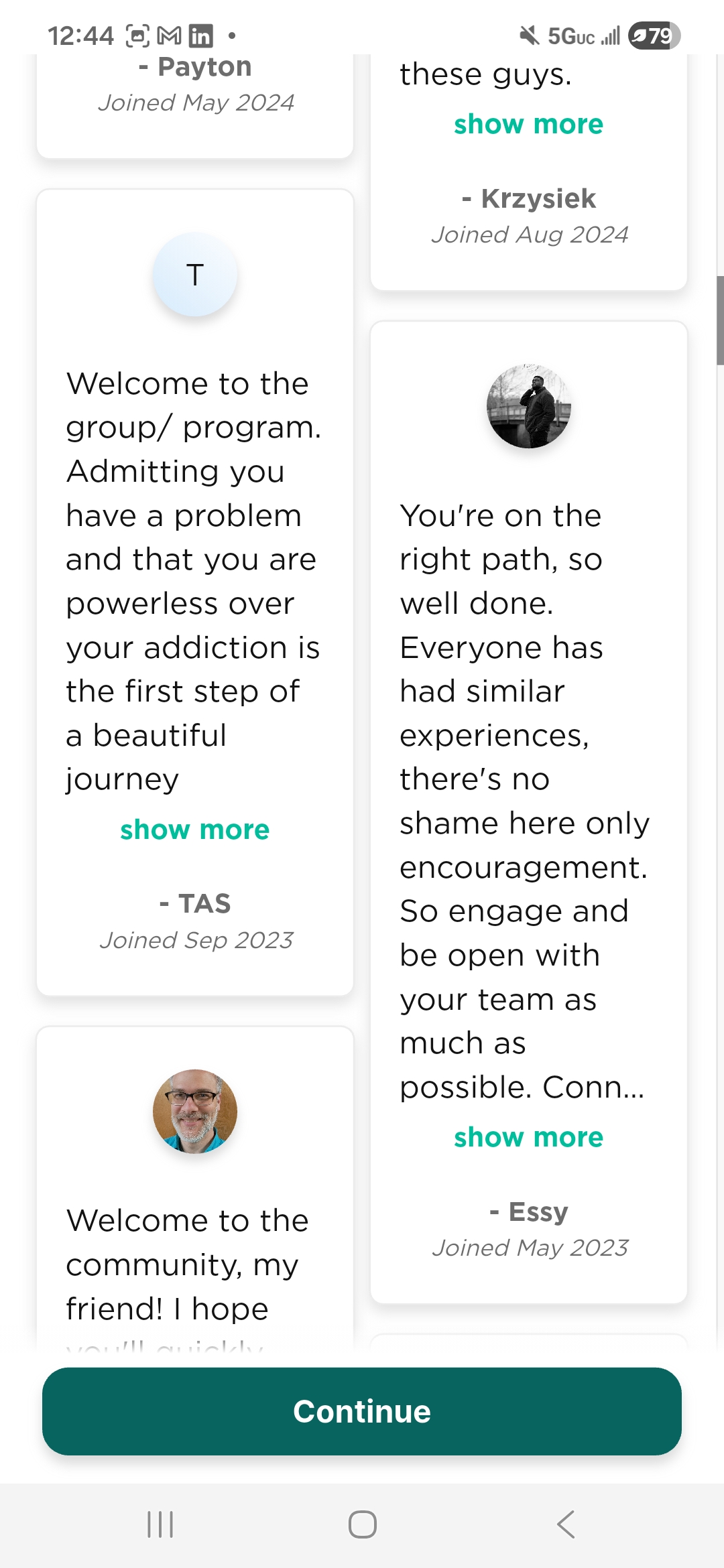
Along the way, they sprinkle in stellar reviews of Relay and the results members have achieved, which motivates you. When you see someone who has already had success, that gives you faith you’ll be able to do the same, and it’s important to get off to the right start.
 One thing that immediately stood out to me is the question, “Is a faith-based approach important to you?” You’re then presented with three options: “Yes, I’d prefer a faith + psychology-based approach,” “No, I’d prefer psychology only,” and “I don’t care either way.”
This signals two important things about Relay.
First, Relay recognizes that pornography addiction is an issue that affects people regardless of their religious affiliation. That might sound obvious, but it’s a distinction many recovery programs still fail to make.
Too often, help is packaged in a way that assumes belief first and healing second, which quietly filters out people who are already struggling and hesitant to ask for help.
When I wrote my book Sober Letters to My Drunken Self—a book about my emotional journey through sobriety—I wanted a recovery framework that could be accessed by anyone: Christian, agnostic, atheist, or somewhere in between. Addiction doesn’t check your worldview before it takes hold.
People don’t start watching porn because they lack theology; they start because they’re lonely, stressed, bored, anxious, or trying to escape something. If the doorway to recovery requires a specific belief system, many people will never walk through it.
By explicitly offering a psychology-only option, Relay removes that unnecessary barrier. It communicates, “You don’t have to agree with us about God to get help here.” That matters, because shame already keeps people silent—adding ideological friction on top of that only ensures more people stay stuck.
In that sense, this isn’t a concession. It’s an act of practicality and compassion, and it immediately makes the app usable for a far wider range of people who genuinely want to change.
Second, Relay does not offer a “faith-only” approach. This is a practical and realistic decision because, regardless of how strong one’s faith may be, faith alone does not accomplish everything. Research-backed methods tend to perform best when they are integrated with proven psychological and behavioral tools—not when they attempt to replace them (Kelly et al., 2020).
Research on recovery consistently shows that outcomes improve when people have both a coherent meaning system—which faith can provide—and structured, repeatable interventions that address behavior, cognition, and environment (Captari et al., 2018).
Faith can meaningfully support recovery, but it works most reliably when paired with evidence-based methods such as behavioral tracking, cognitive restructuring, accountability systems, and habit-change frameworks. Relay’s refusal to offer a “faith-only” path reflects an understanding that belief without structure leaves too much to chance, while structure without meaning often fails to sustain long-term change.
While Relay’s founder is a member of the Church of Jesus Christ of the Latter-day Saints, and that clearly influences his perspective, Relay appears to have intentionally “split the difference,” so to speak. Science-based recovery is the foundation, while faith is offered as an optional layer rather than a requirement.
By offering a science-first approach that does not exclude faith—but does not require it either—Relay presents a path that is accessible to the widest possible audience and most likely to help users break destructive habits and rebuild their lives.
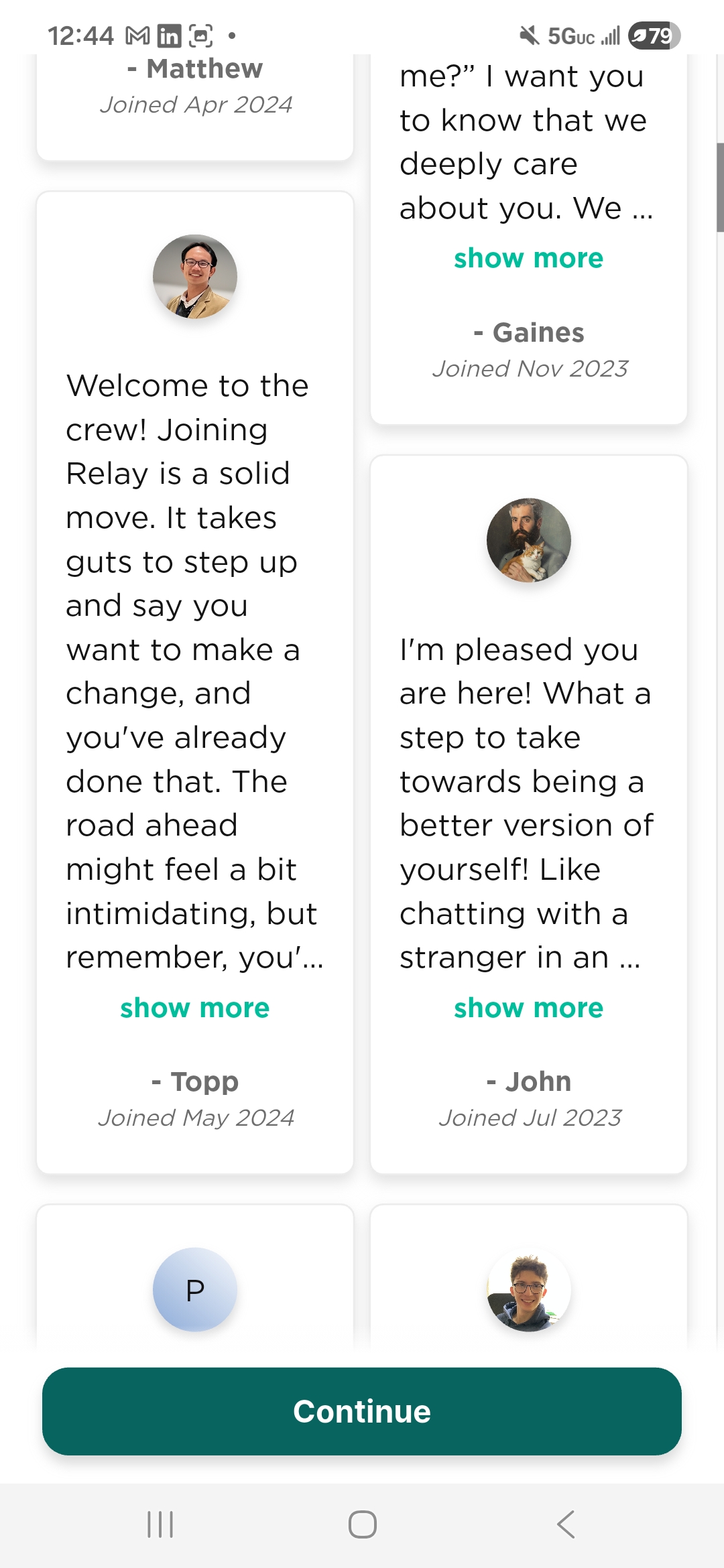
Once you complete the initial onboarding, you’re shown messages from members about their struggles and how Relay has helped them. You then select a check-in time in the app using a feature we’ll discuss shortly.
 Inside the Relay App
After you complete the onboarding process, you’re taken into the app itself.
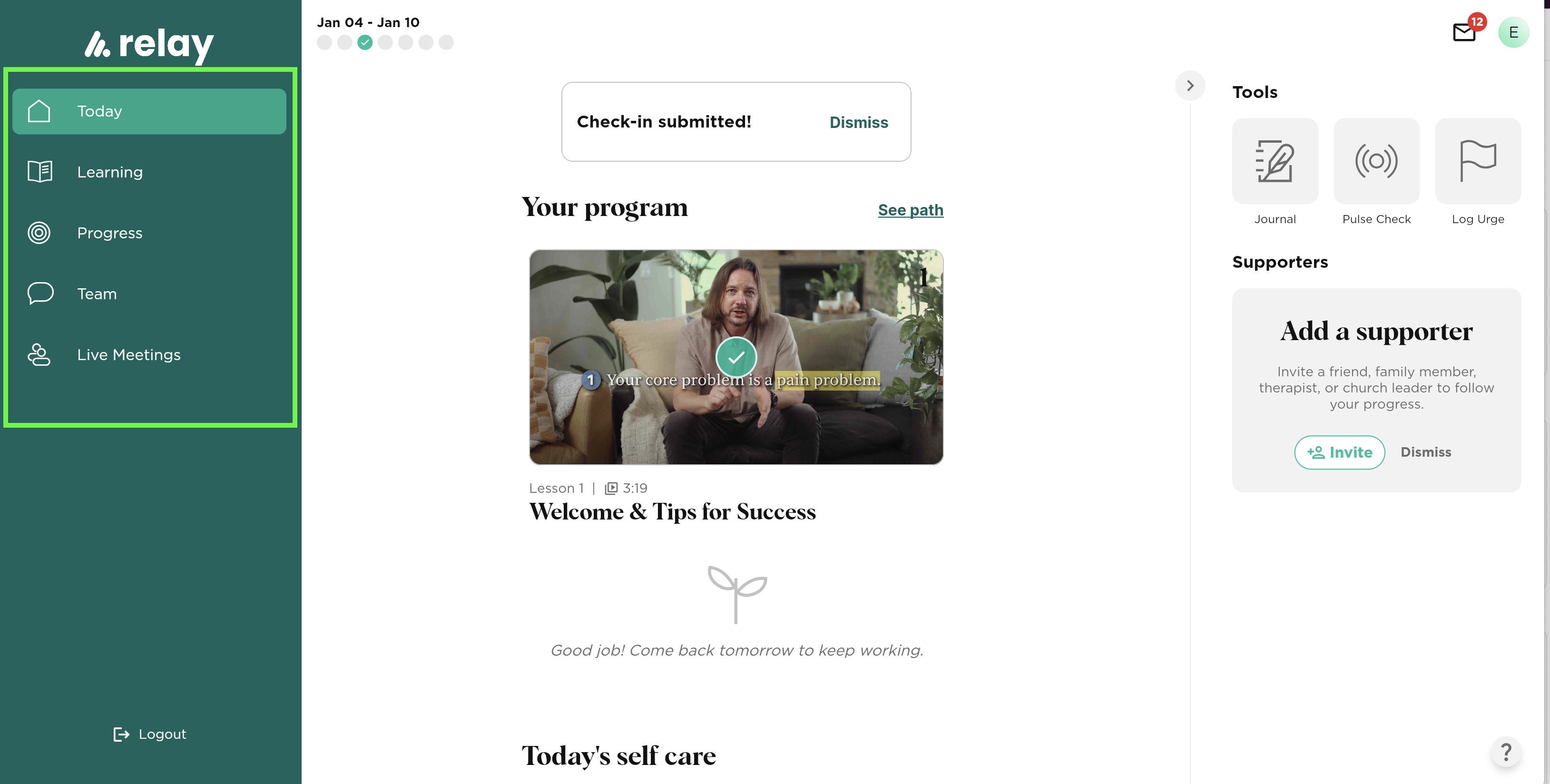
The dashboard is clean and simple, with five main options. I’ll walk through each one so you know what to expect and can see how they function in practice, along with my thoughts on each.
 Today
Today
This is the dashboard you’ll see each time you log in to Relay. It prompts you to complete your check-ins, which are crucial for tracking your progress.
Along the side, you’ll see tools for journaling, pulse checks, and logging urges.
Two of these are self-explanatory. “Journaling” is where you go to write and reflect, and “urge log” is where you go to log any urges you have to watch porn.
The “pulse check” isn’t quite as obvious, but it’s simply a place to log your current mood and reflect on what you’re feeling—especially what you’re feeling good about in that moment.
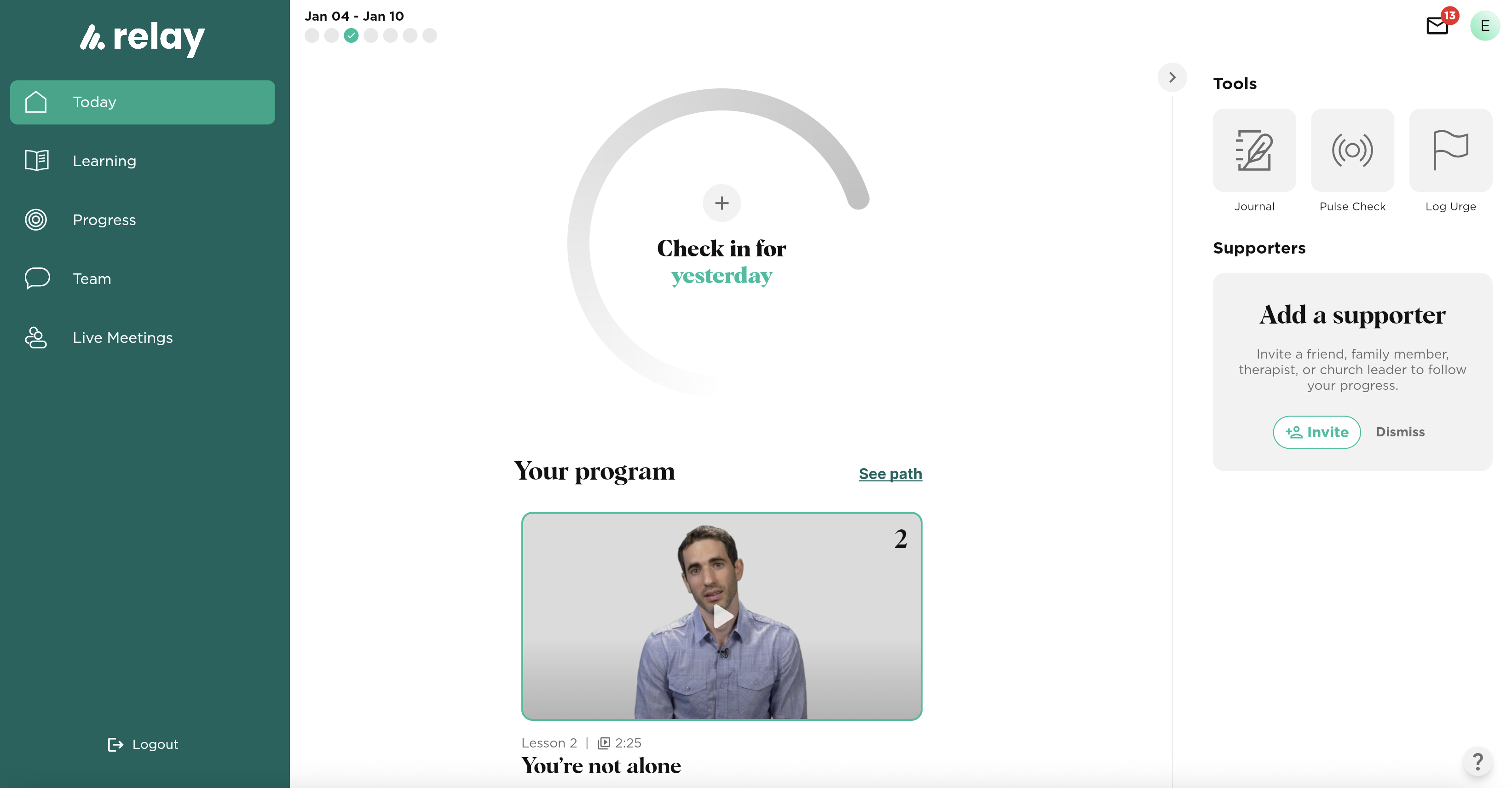
Warnings and systems are helpful, but recovery also requires celebrating the good things happening in your life. Writing those wins down—and being able to revisit them later—can serve as a powerful source of motivation.
I also want to note that as part of the pulse check, you can “throw a red flag in the chat” if you’re feeling down, overwhelmed, or stressed and worried that it might affect your recovery or put your streak at risk. When you do, other team members can step in to talk with you and help you work through it.
That sense of camaraderie is one of the most valuable aspects of Relay and, by itself, is worth the price. But there’s more.
Team
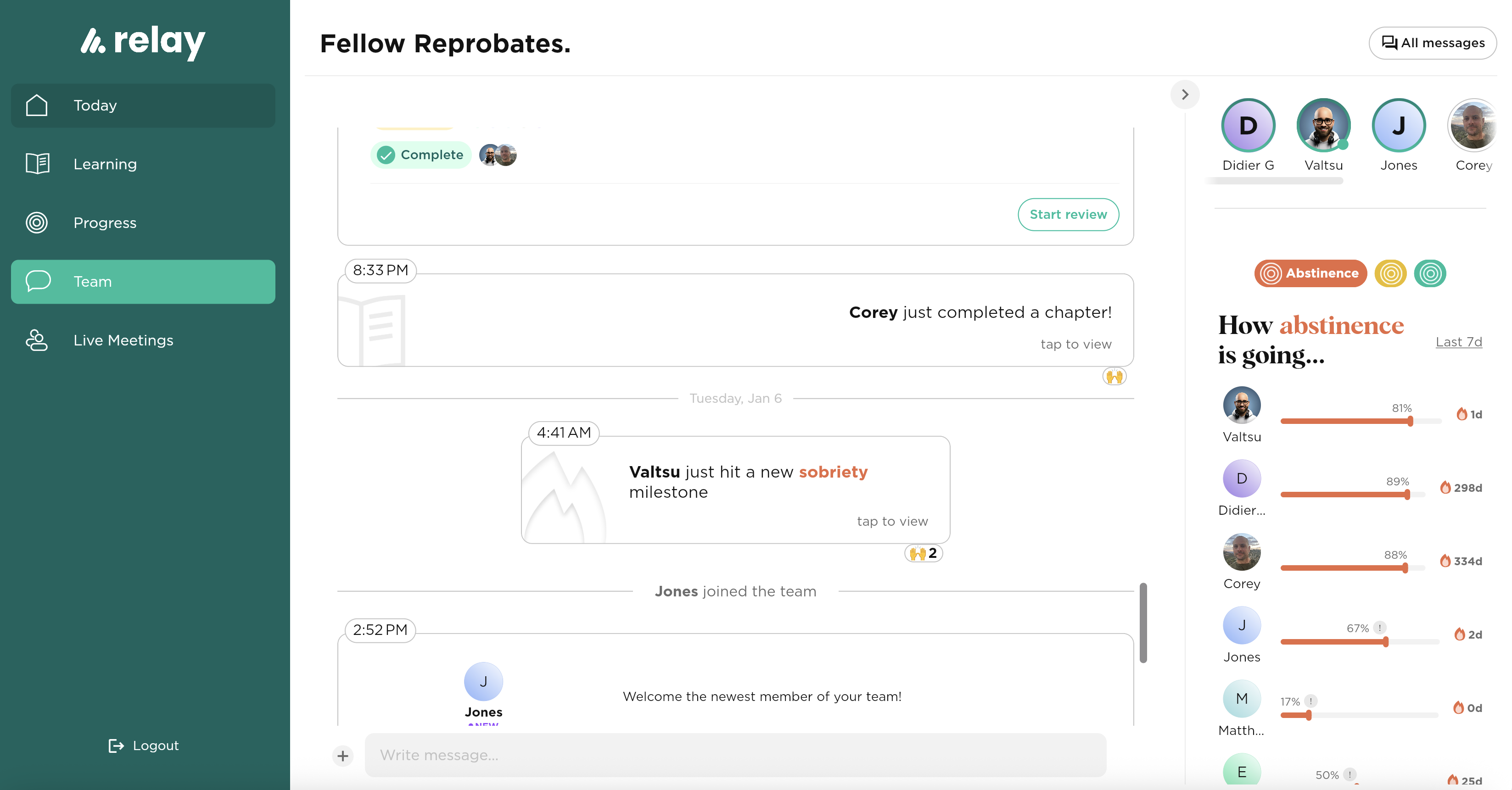
Remember the question Relay asks during onboarding—whether you prefer a faith-plus-science recovery path or a science-only approach? Relay uses that information to form teams, and the people you see here are the individuals you’ll be grouped with.
The community is where the real magic happens. In my own work helping men who struggle with pornography addiction, the community has consistently been the most transformative element of recovery.
That initially surprised me—but given everything we know about the healing and protective power of human connection and relationships, it probably shouldn’t have.
As Johann Hari famously said, “The opposite of addiction is connection.” The specific addiction doesn’t really matter. Compulsive behaviors of all kinds tend to be diminished, offset, or even neutralized when people experience genuine connection.
Live Relay Meetings
Relay has live meetings run by peer facilitators who are veteran members of the community (similar to other peer recovery models).
These are people who have been down the road of recovery and help create that environment for others coming in.
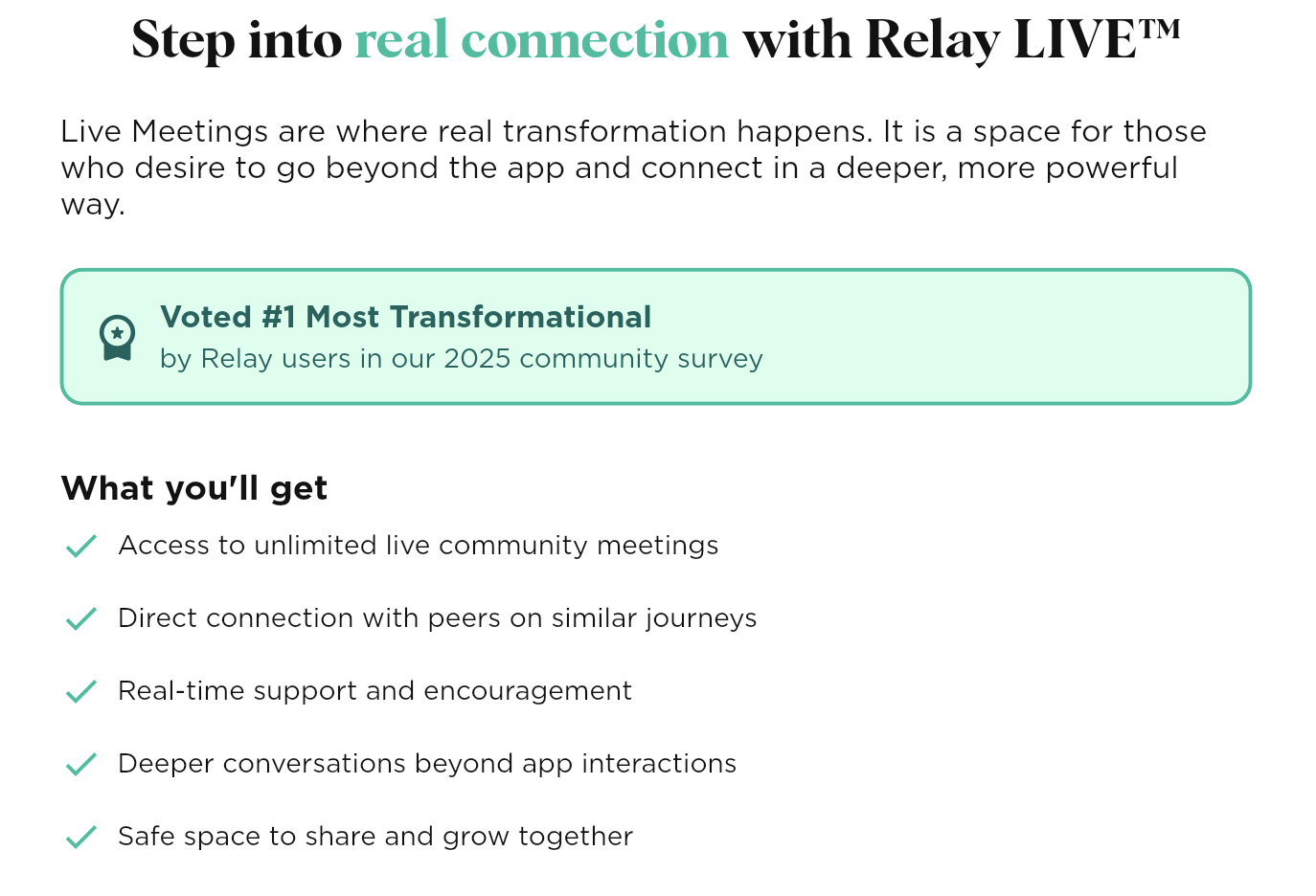
I like this approach because the last thing a person in recovery needs to feel is judgment.
While qualified professionals with degrees and credentials obviously know their stuff, there is still a feeling of talking to an outsider who doesn’t get it.
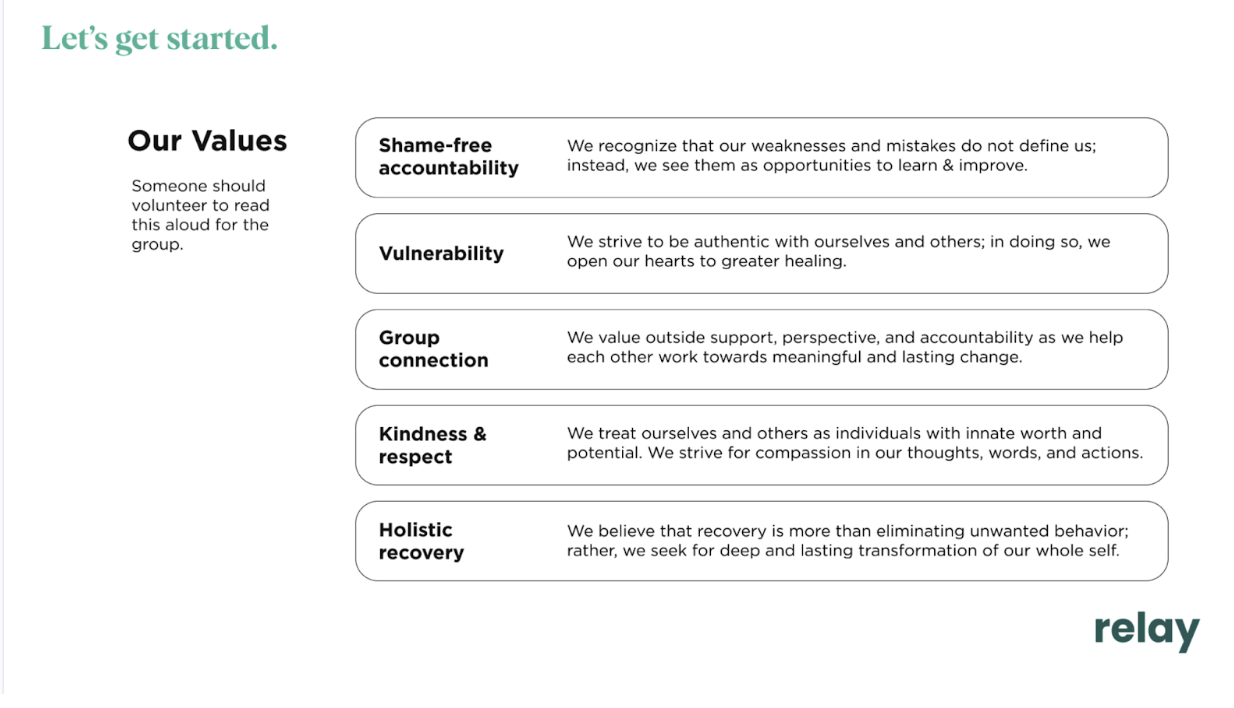
If you’ve ever been to an AA meeting, the same principle is at work. While AA tends to focus more on sharing than education, members with more time in sobriety often become the default—or, in some cases, official—leaders. Relay works in a similar way, but with clearer structure and designation.
There are seven meetings each week to accommodate different time zones, and because of the sensitive nature of addiction, Relay allows you to decide how anonymous you want to be. You can keep your camera off and simply observe, or turn it on and actively participate.
The ability to remain anonymous is a major advantage, especially since it’s something in-person meetings can’t really accommodate. I’m not deeply familiar with other apps or online support groups in this space, but this setup makes Relay a strong alternative to in-person AA and NA meetings.
Interestingly, before Relay pivoted to focus entirely on porn addiction, they also worked with substance abuse recovery, so this may be a useful carryover from their earlier iteration.
That said, it’s worth keeping in mind that anonymity comes with a trade-off: it can limit the depth of connection you’re able to build. There are still significant benefits to participating in live group meetings, but this is something to be aware of. Either way, the choice is yours—and having that option is what matters most.
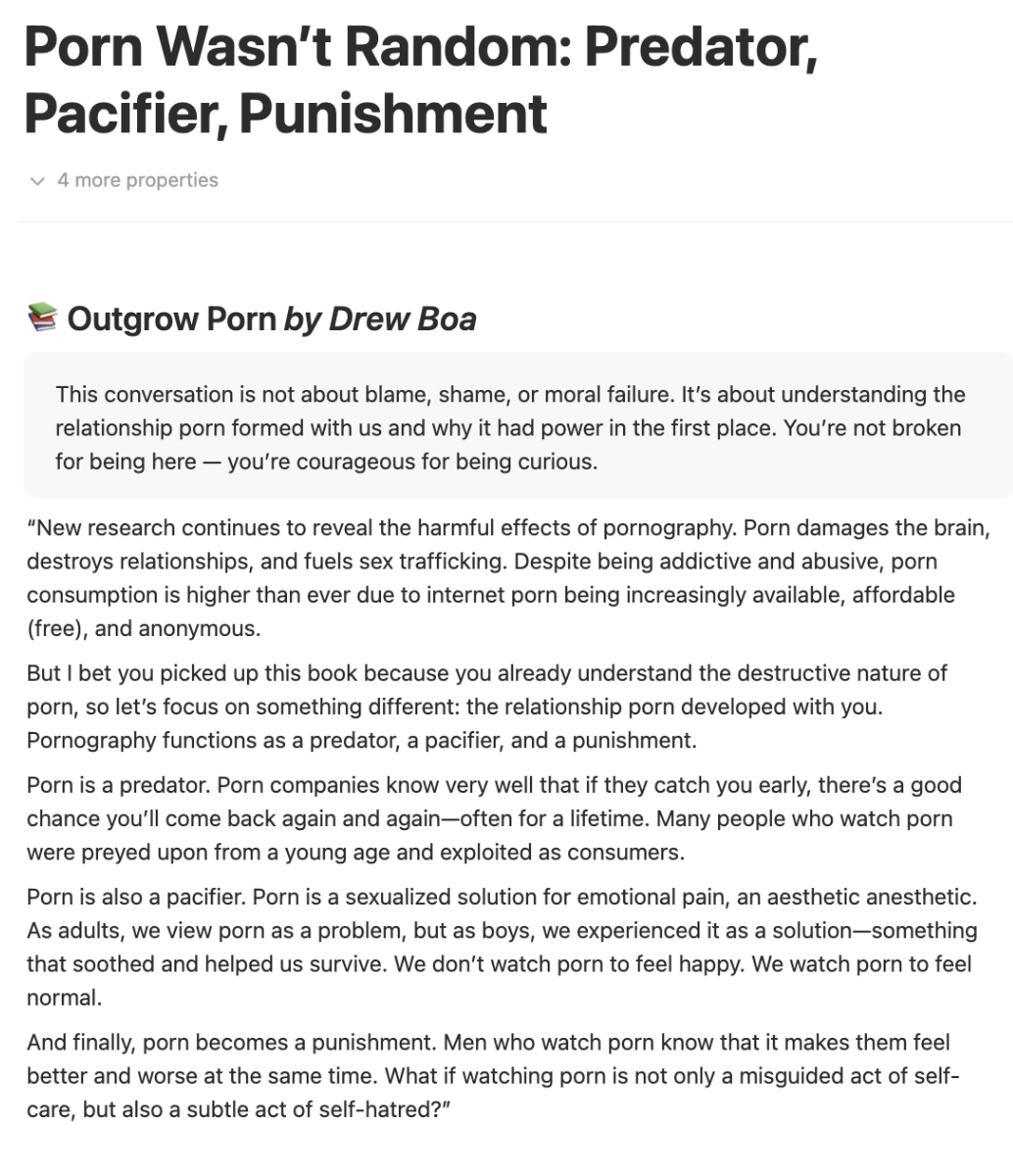
The meetings themselves are well-structured and respectful, and you’re not just there to talk and share. Each week includes assigned readings and journaling prompts to guide discussion. For example, during the week I was working on this review, the featured reading was titled “Porn Wasn’t Random: Predator, Pacifier, Punishment.”
 Paying for the Relay Live Meetings
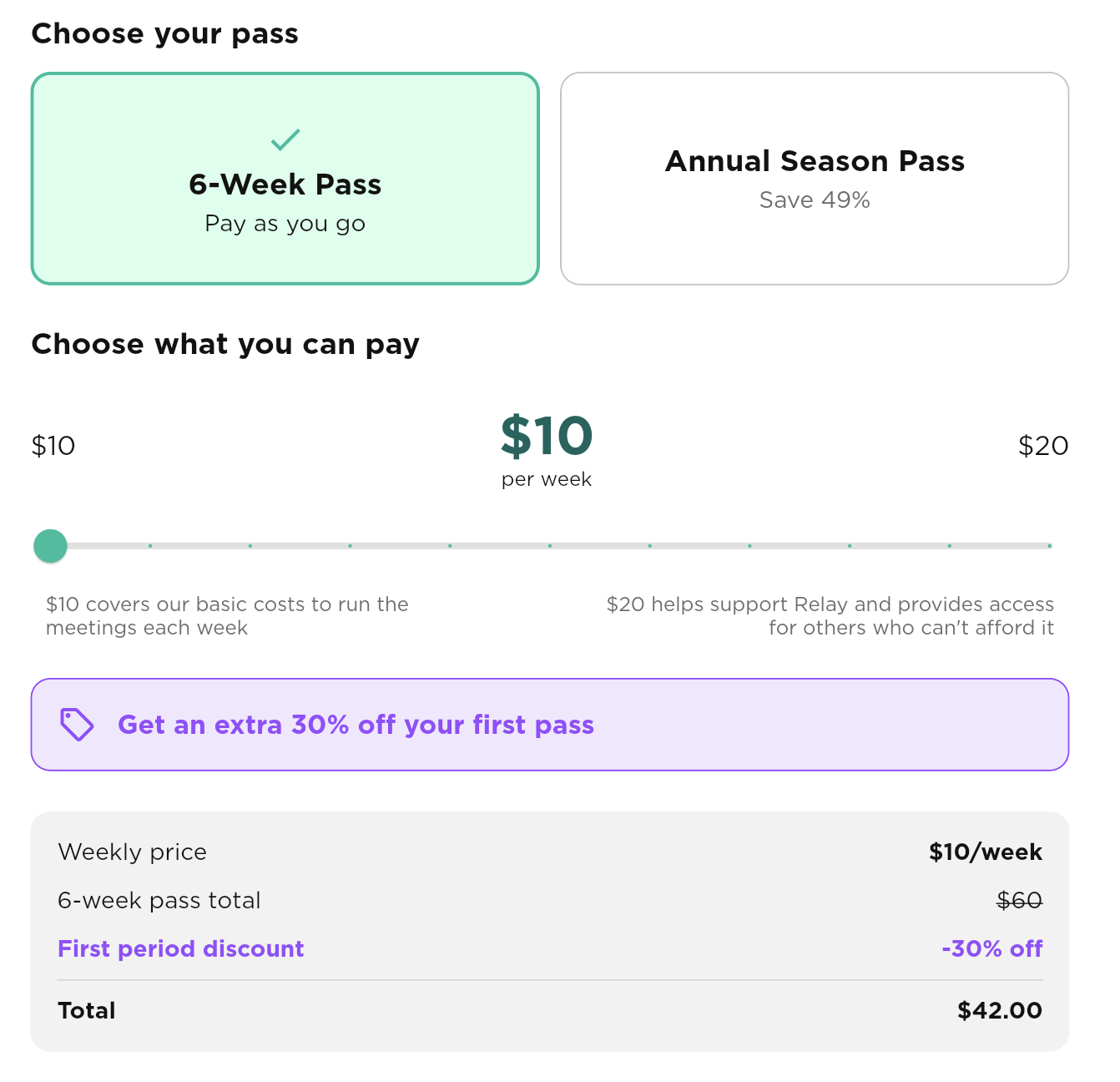
Despite paying to join the Relay program, you still have to pay separately, in-app, to participate in the live meetings. That said, the cost isn’t exorbitant—and based on the numbers, they may even be operating at a loss.
There are two payment options: a six-week pass and an annual pass. Both provide unlimited access to live meetings for the duration of the pass.
The six-week option uses a “choose what you can pay” model, with a minimum of $42 and a maximum of $84. The annual pass costs $399.
This pricing covers the cost of running the meetings. My initial reaction was some surprise, since many people would reasonably expect meeting attendance to be included in the base program fee. However, after thinking it through, the price struck me as fair—and arguably a significant discount for what you’re getting.
While the meetings aren’t billed like private sessions with licensed professionals, the people facilitating them still need to be compensated for their time. Based on everything I know about what it takes to run a program like this, that money is doing real work.
If you’re skeptical, the math helps put things into perspective.
Meetings are held six days a week. Let’s assume you attend just one meeting per week and pay the maximum $84 for the six-week pass.
Under that option, you’re paying $14 per live meeting.
With the annual pass, the cost comes out to roughly $7.60 per meeting.
Compared to the going rate for group therapy, this is a significant discount.
I don’t know Relay’s exact accounting structure, but they’re clearly not making a killing from hosting these meetings—especially when I’d imagine that the different peer recovery specialists are also being paid for their time per meeting.
It’s still a bit annoying to join a $150/yr recovery program and then, when you get to one of the most crucial parts of the recovery process—group meetings—to have to pay again. It surprised me, so I’m sure other customers aren’t alone.
If I were Relay, I’d just include that cost in the initial membership.
However, I can also make an educated guess about their reasoning. The live meetings require a live human to lead them and deliver the lessons. It’s a lot easier to plan and schedule if you know how many attend based on who put their money behind their commitment.
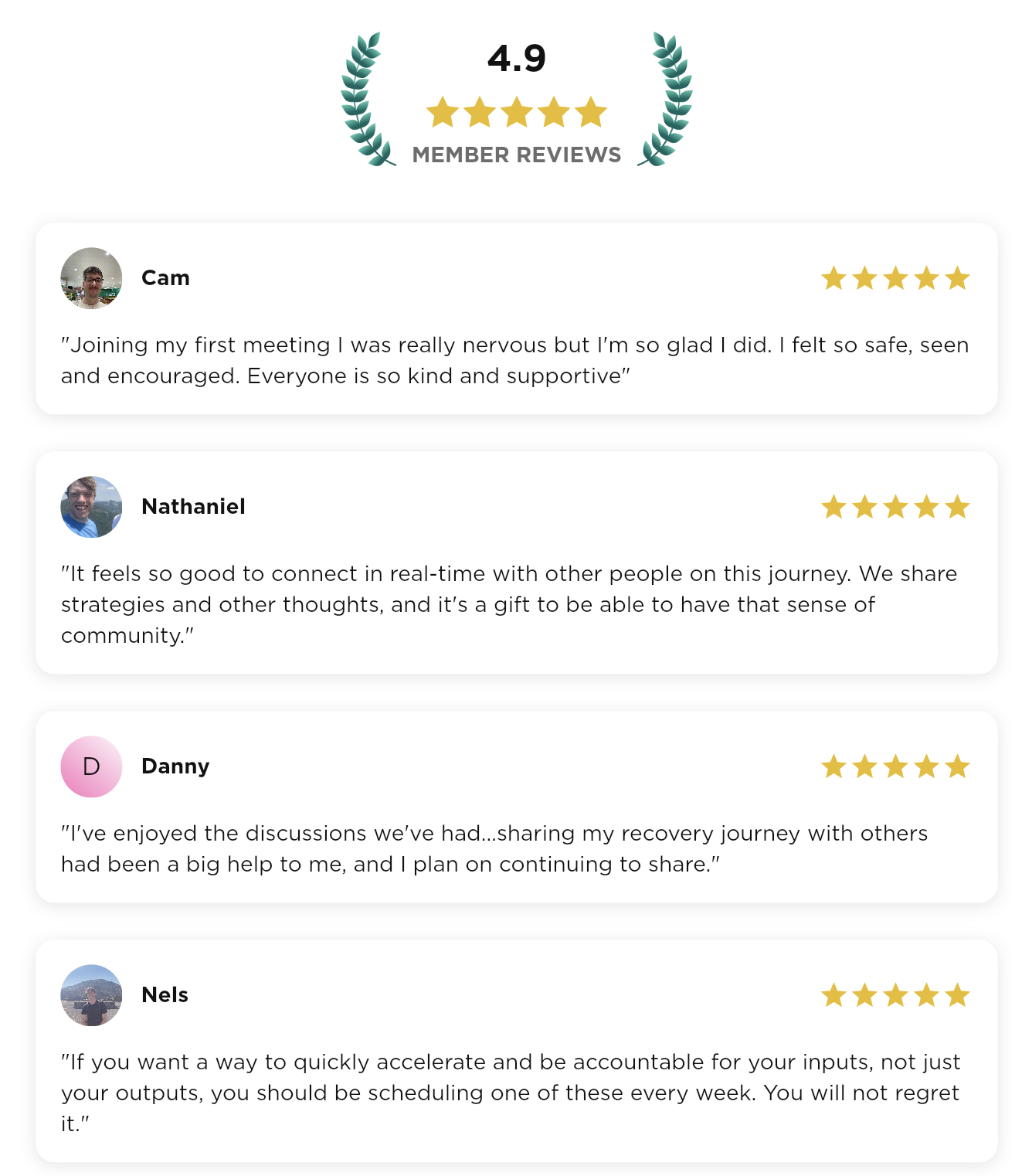
It also ensures that you take the meetings seriously and do the required work because you paid a little more to attend. Based on the reviews of Relay’s Live Meetings, it seems to be worth it.
 Relay Tracks Your Progress
On the Progress tab, you check in and get a clear view of how things are going. This is part of the self-accountability Relay emphasizes to help you stay off porn without relying solely on blockers.
Relay uses a system called “Recovery Zones” to create a roadmap for your recovery. There are three zones. The inner circle is abstinence and represents the behaviors you want to avoid entirely.
The middle circle is called boundaries. These are behaviors that carry risk and tend to lead toward the things you’re trying to avoid, such as watching porn. The final, outer circle is self-care. This zone covers the positive behaviors meant to replace the negative ones you’re working to change.
You define your personal behaviors for each zone when you first enter the Progress tab.
Relay explains this framework using a simple cliff analogy. Abstinence behaviors are the cliff you want to stay far away from. Risky behaviors are the border around the cliff’s edge—if you get too close, it becomes dangerous. Self-care behaviors are the things that make you uninterested in the cliff altogether because you’re busy building a healthier life elsewhere.
Learning About Addiction
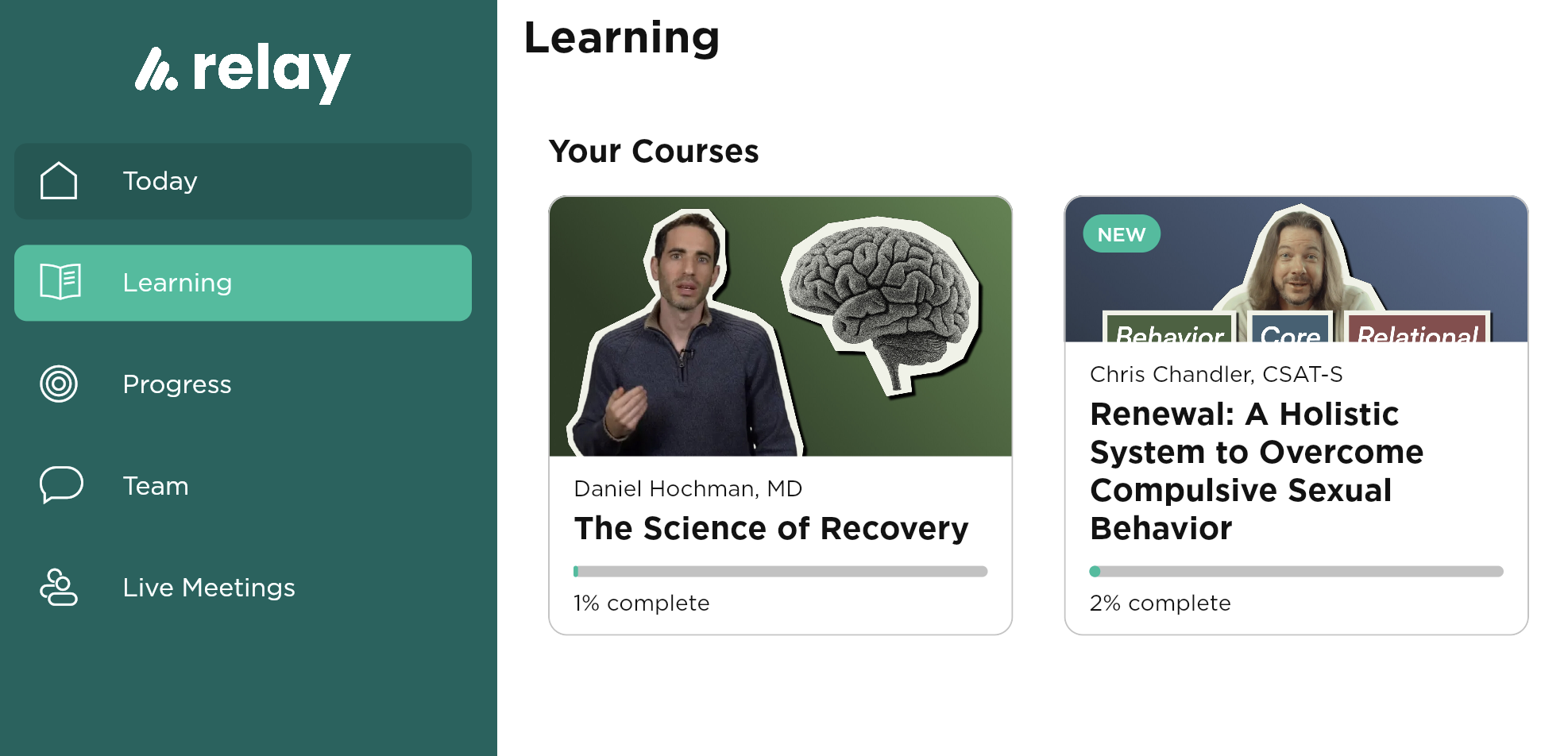
The learning tab starts with two in-depth courses to help you understand what the problem is and to arm you with the tools to combat it:
The Science of Recovery by Daniel Hochman, MD, a psychiatrist with years of experience working with consulting rehab facilities, detox centers, the military, and outpatient clinics. He currently has a holistic private practice.
Renewal: A Holistic System to Overcome Compulsive Sexual Behavior by Chris Chandler (LMHC, CSAT) with over 20 years of experience as a licensed clinical counselor running addiction recovery groups, trained by Dr. Patrick Carnes, a pioneer in the world of addiction recovery.
Relay does not allow you to skip ahead to any part of the course you want—sorta.
We’ll get to that shortly, but there is a good reason that Relay does it this way. At least, this is my thought on why Relay does it this way.
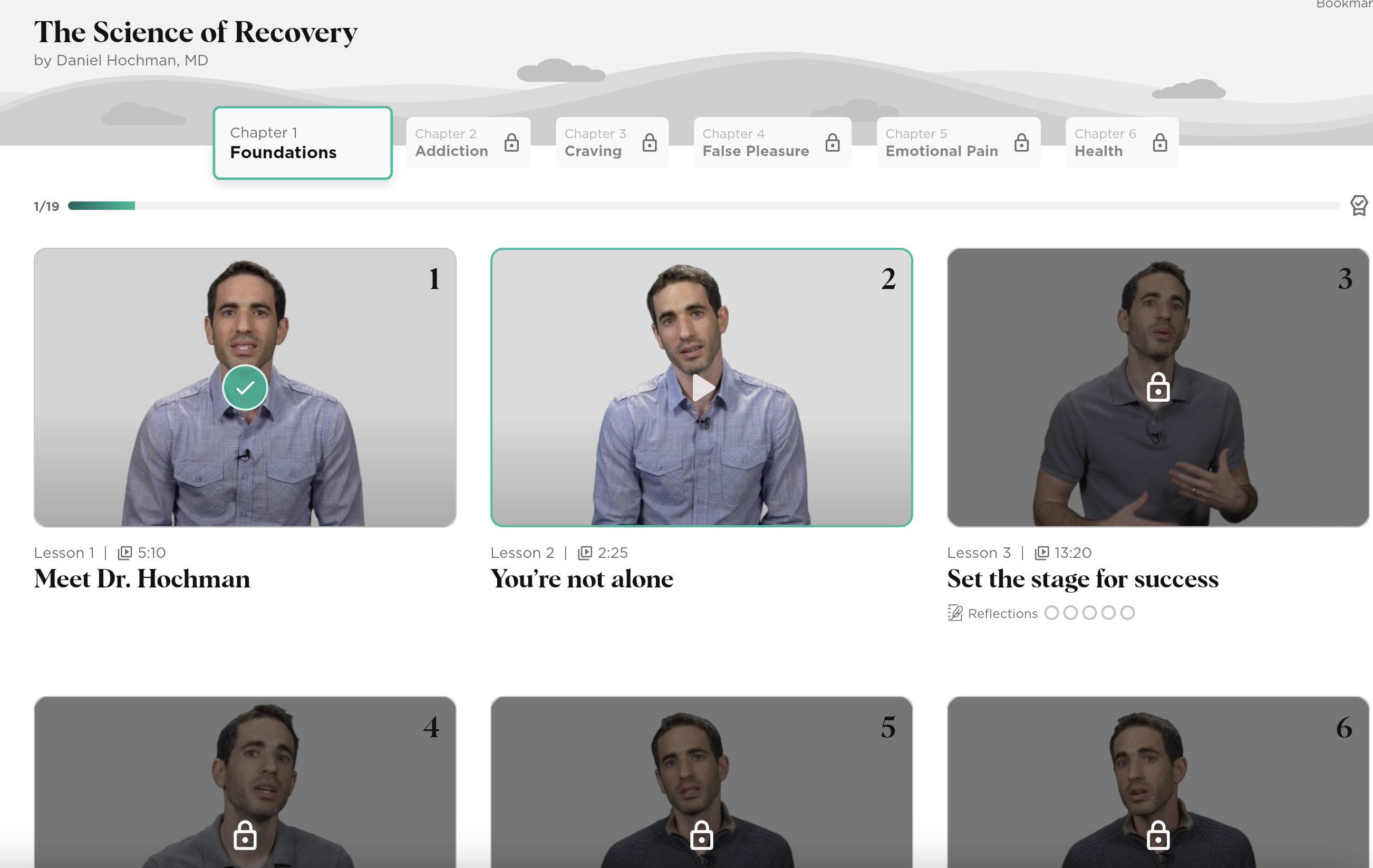
If these courses were purely informational, I’d understand the complaint and probably agree with it.
However, as Chris Chandler says in the first video of the Renewal course, “Information does not equal transformation. Information plus application equals transformation.”
The goal of these courses isn’t passive learning—it’s real progress. That means doing the work and following the steps instead of rushing ahead.
This approach doesn’t imply that you’ve mastered every lesson before moving on. Rather, it forces you to slow down, be deliberate, and actually get your money’s worth by applying what you’re learning instead of just consuming it.
Often, the best way to help someone is to push them to do what they don’t want to do and hear what they’d rather avoid. Relay has taken what I see as a positive—and fairly uncommon—step in today’s instant-gratification world by requiring you to slow down and digest the material.
If you’re serious about recovering from porn addiction—and I’m assuming you are, otherwise you wouldn’t be reading this—then requiring sequential course completion isn’t an annoying bug. It’s a necessary feature.
That said, if you really want to, you can simply mark each video as complete and skip ahead.
Without giving away the content itself, here’s what I can share from my experience with the course so far.
You’ll begin to understand not only which forces in your early life shaped your compulsive behavior, but why you’ve struggled to get things under control despite genuinely wanting to change.
I initially planned to skip this course and offer a more detached review. But then Chris Chandler shared an analogy about a tree and drilling holes in it—one that stopped me in my tracks and made me keep watching.
I’ve long been interested in the role trauma plays in addiction. I’ve even made a YouTube video based on my own research into how growing up with abuse and poverty in the projects contributed to my later alcoholism. Seeing those ideas reflected in the course made me pause and go deeper instead of moving on.
How Relay Tracks Progress
On the Progress tab, you check in and get a clear sense of how things are going.
This is part of the self-accountability Relay emphasizes to help you stay off porn, rather than relying solely on blockers.
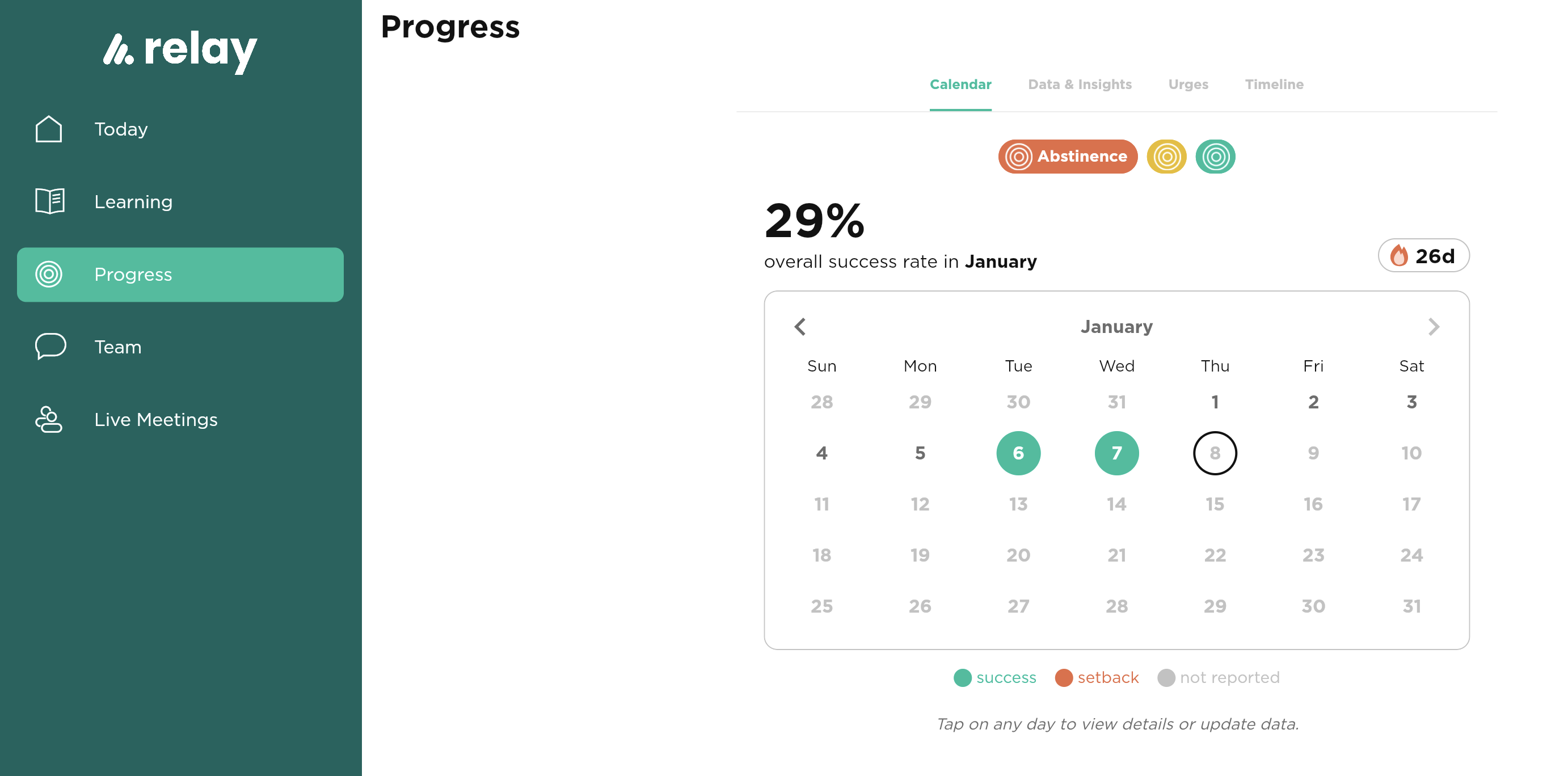
Relay uses a system called “Recovery Zones” to create a roadmap for your recovery. There are three zones.
The inner circle is abstinence. It represents the behaviors you want to avoid entirely. The middle circle is called boundaries. These are behaviors that carry risk and tend to lead toward relapse, such as watching porn.
The final, outer circle is self-care. This zone includes the positive behaviors meant to replace the negative ones you’re working to change.
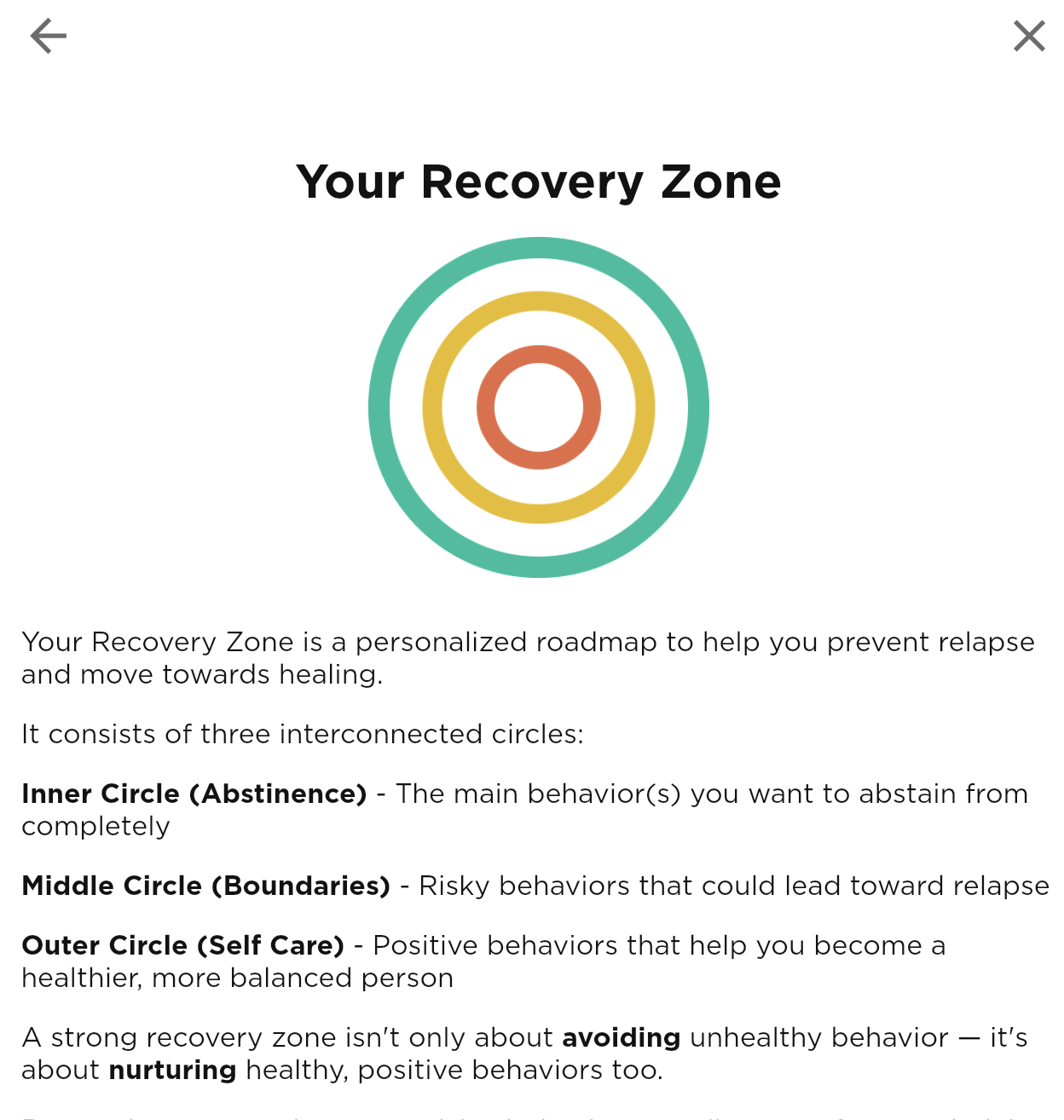
You set your personal behaviors for each zone when you first enter the Progress tab.
Relay explains this framework using a cliff analogy.
- Abstinence behaviors are the cliff you want to stay far away from.
- Risky behaviors form the border around the cliff’s edge—if you get too close, it becomes dangerous.
- Self-care behaviors are the ones that make the cliff irrelevant altogether, because you’re occupied with healthier, more constructive activities.
The idea is that each day, you check in—either by going directly to the Progress tab or by accessing it from the Today screen on the dashboard.
My Final Thoughts on the Relay App
Relay has built a comprehensive support program for men who want to change their lives—not just stop a single behavior.
As long as you understand that Relay isn’t designed to physically prevent you from watching porn, you’ll be in the right mindset to take full advantage of the tools it offers. Those tools are what actually drive long-term change.
I do wish the live meetings were included in the base price, but I also understand why they aren’t. Compared to what similar meetings cost outside the app, the value you’re getting is more than fair.
If you go into Relay fully aware that live meetings require an additional fee—and don’t mind being asked to leave a positive review early on—there really aren’t many meaningful downsides.
I’ve also reviewed the Quittr app, which aims to solve a similar problem. However, Quittr lacks the educational depth and doesn’t offer live meetings. It functions more like a porn blocker with a few extra features layered on top.
I recommend Relay if you want to do more than just block porn. With Relay, you get structured courses created by addiction professionals, support from a group of men on a similar recovery path, and ongoing accountability through both the community and live meetings.
If that sounds like the kind of support you need to finally break free from porn, you can start with Relay’s 30-day free trial by signing up through my link here and use code EDLATI.
There’s no special discount if you do, but I recieve a small commission at no extra cost to you. Think of it as a way of saying “thanks” for writing this review.
References
Captari, L. E., Hook, J. N., Hoyt, W., Davis, D. E., McElroy-Heltzel, S. E., & Worthington, E. L. (2018). Integrating clients’ religion and spirituality within psychotherapy: A comprehensive meta-analysis. Journal of Clinical Psychology, 74(11), 1938–1951.
https://doi.org/10.1002/jclp.22681
PMID: 29749009
Kelly, J. F., Humphreys, K., & Ferri, M. (2020). Alcoholics Anonymous and other 12-step programs for alcohol use disorder. Cochrane Database of Systematic Reviews, 2020(3), CD012880.
https://doi.org/10.1002/14651858.CD012880.pub2
PMID: 32159293

Written by
Ed Latimore
Ed Latimore is a best-selling author, professional heavyweight boxer, and physicist. He writes about self-improvement, sobriety, fighting, and the lessons he learned growing up in the projects of Pittsburgh.
Follow @EdLatimore