Outty: The non-alcoholic drink that gives you a buzz

I’ve been sober since 12/23/13. So, as of this writing, I’ve got over 12 years of sobriety.
When I first stopped drinking, the only real alcohol alternatives were O’Douls and coffee. Most places didn’t carry O’Douls, and if I was out in the evening, drinking coffee was a no-go.
So for the first few years, my options were water and Diet Coke. If it were a special occasion, I’d have lemonade, but never any soda because I think soda is disgusting.
A few years into sobriety, alcohol companies read the writing on the wall that more people were waking up to a sober lifestyle, and so there were more non-alcoholic beers offered.
Today, I don’t think there is a single beer brand that doesn’t have an NA or 0% alcohol version of its flagship beer.
Also, “mocktails” have become a popular offering, and now it seems like every restaurant has a few specialty alcohol-free drinks.
With so many more people choosing not to drink alcohol—including record numbers of Gen-Z—the market has responded. Now there are so many non-alcoholic options for consumption that you will never have a problem going out without alcohol.
But a segment of the market remains unaddressed.
There are people who drink because it helps them relax, open up, and be social. For these people, removing alcohol is healthier and safer, but it removes the very reason why they chose to drink.
These are the people who drink responsibly and the women who aren’t pregnant. They’re the people who don’t have a health issue, but want to stop drinking to ensure they don’t have one in the future.
These people drink because it helps them open up and be social, and it’s not just the placebo effect. While I don’t drink any alcohol at all, I recognize that a small amount can help someone struggling with the ability to socialize, converse, and be outgoing.
Those people have not been served by the availability of more non-alcoholic options.
Until now…
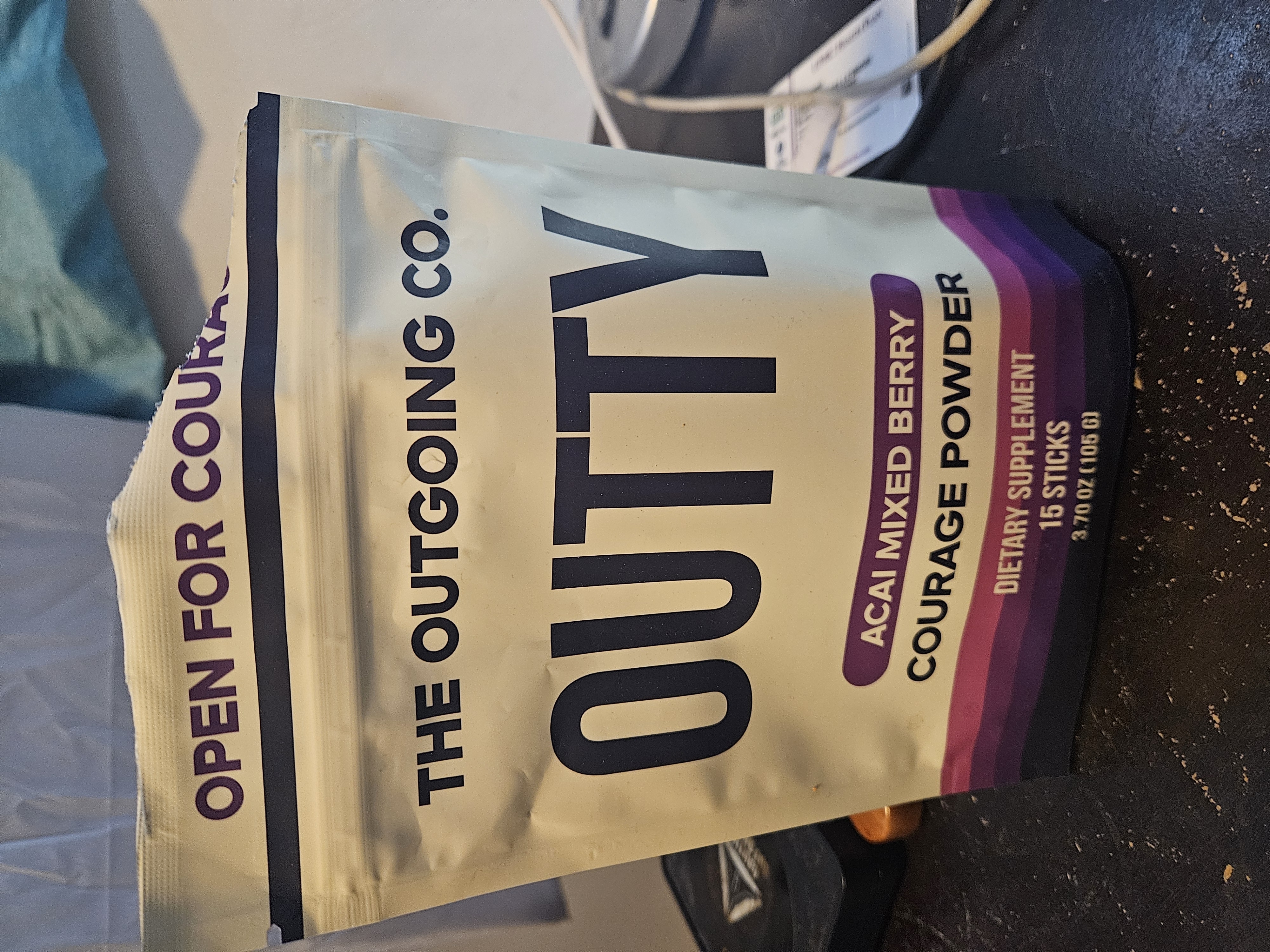
The Outgoing Co.has an interesting alcohol alternative that is designed not only to be an alcohol alternative in taste but also in function.
By mixing a unique blend of adaptogens and nootropics, Outty has created a drink that gives you the best of both worlds—a delicious alcohol substitute that rivals any cocktail on the planet, but makes you more outgoing.
It improves focus and verbal ability while keeping you aware of your surroundings without making you feel self-conscious or stuck in your head.
All of this probably sounds too good to be true, so let me walk you through the ingredients and my experience drinking Outty, and you can decide for yourself.
What’s special about Outty
A large quantity of alcohol is bad for you. Even a moderate amount is destructive. But a small amount of social drinking helps people open up, socialize, and get out of their shells.
Have you ever stopped to ask yourself how alcohol does that? Specifically, what effect does it have on the brain that makes it so good at making people less inhibited?
The prefrontal cortex takes a break
The first major target of alcohol is the prefrontal cortex, the area right behind your forehead, responsible for executive function. This region governs:
- Self-control
- Long-term planning
- Moral judgment
- Social filtering
- Impulse inhibition
It’s the part of you that runs a quick simulation of consequences before you act.
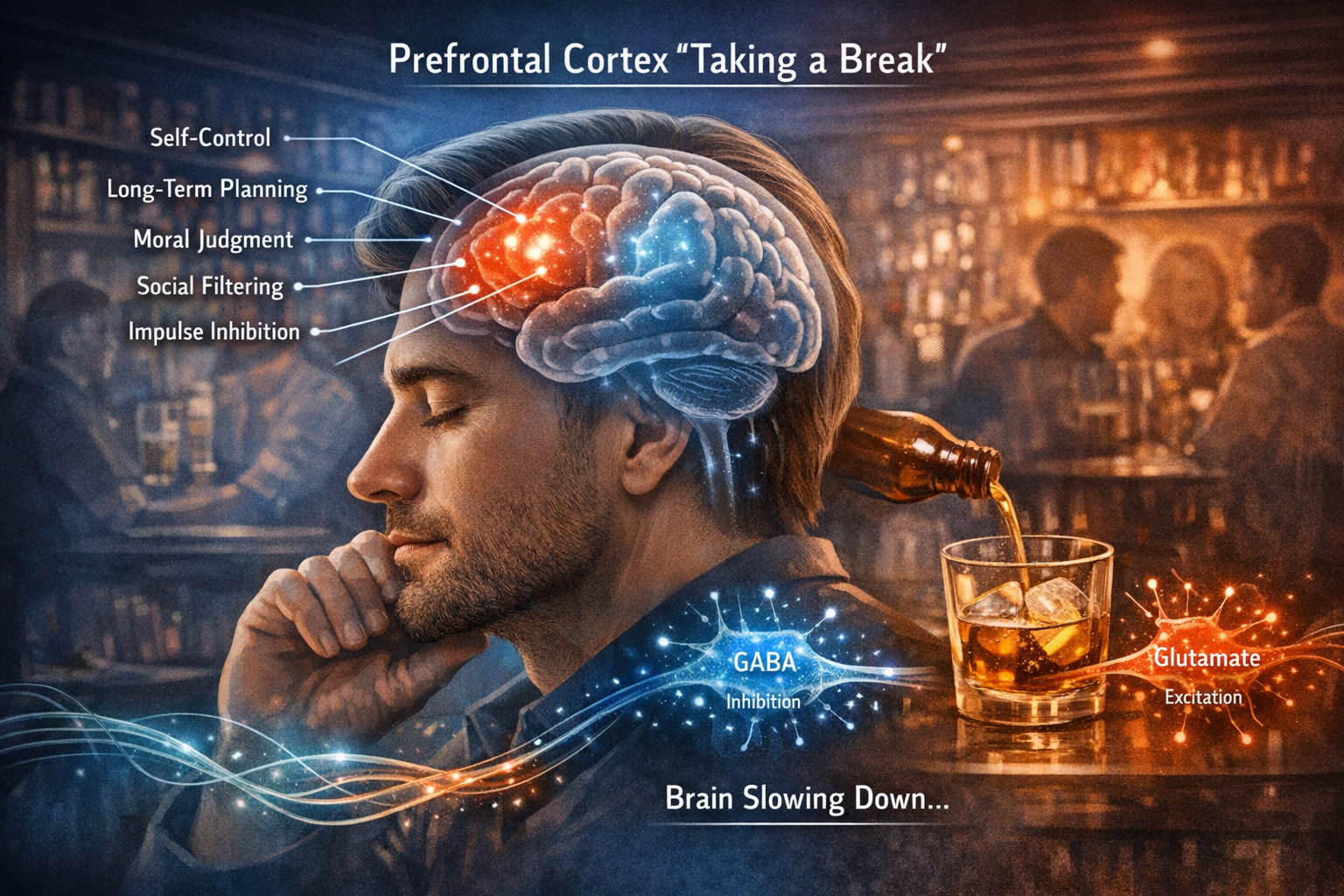
Alcohol enhances the activity of GABA (gamma-aminobutyric acid), the brain’s primary inhibitory neurotransmitter. GABA reduces neuronal firing. At the same time, alcohol suppresses glutamate, which normally excites neurons and increases activity.
This dual action — increasing inhibition while decreasing excitation — slows down neural communication. Higher-order control centers, such as the prefrontal cortex, are particularly sensitive to this suppression.
That’s why the first drink often feels like relief.
You don’t suddenly become more interesting or confident. The neurological systems responsible for self-restraint simply quiet down. It becomes easier to open up and express. That brief window is what people experience as “loosening up.”
Amygdala chills out
Alcohol also dampens activity in the amygdala, a key structure in the limbic system that processes fear and threat, including social threats.
The amygdala constantly scans your environment for danger. In modern life, that danger often isn’t physical; it’s social:
- Am I being judged?
- Did I say something stupid?
- Do I look awkward?
For socially anxious individuals, this system can always be on and ready to go. Even the most harmless and neutral social cues can feel like rejection.
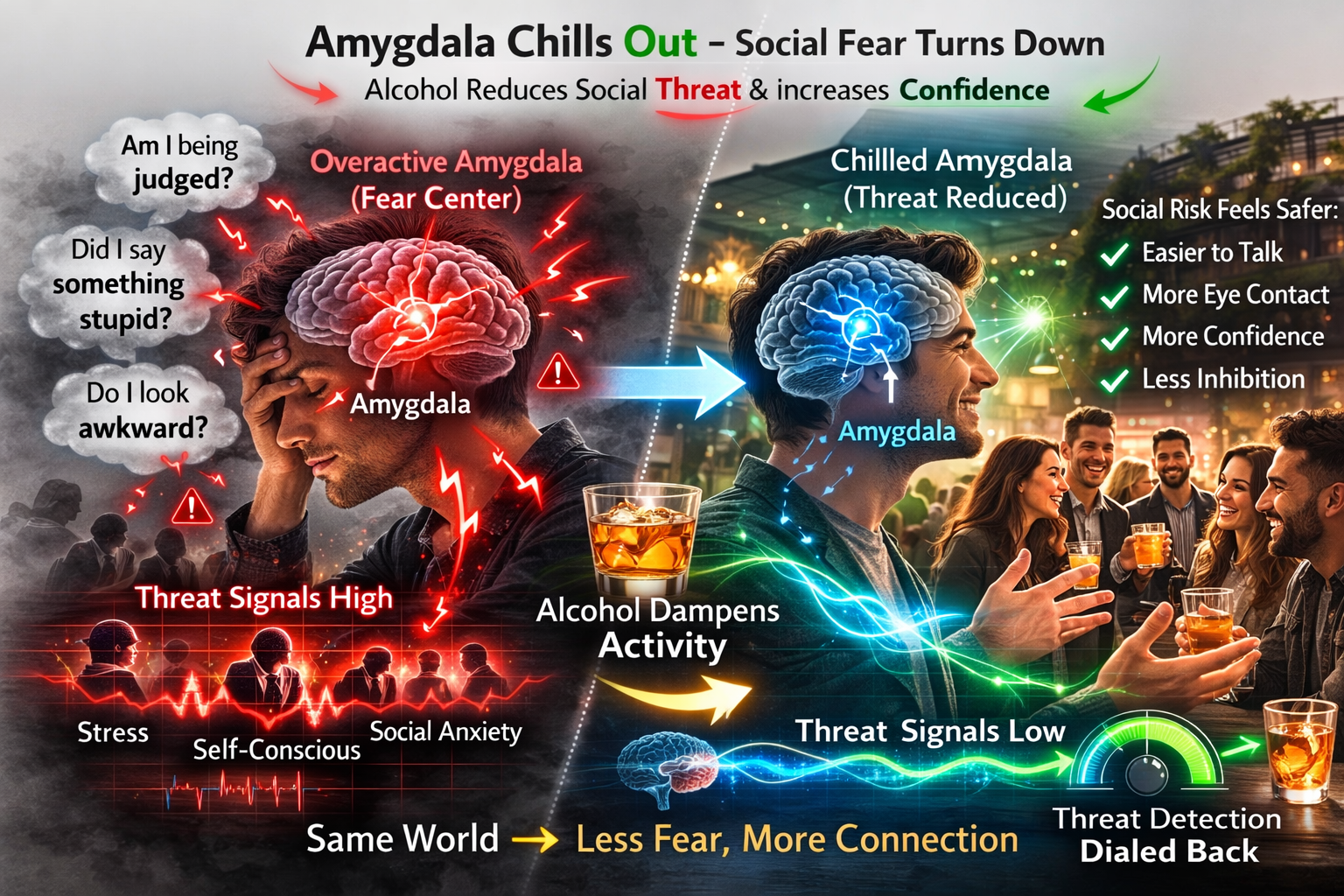
Alcohol dials down the amygdala reactivity. Functional brain imaging studies show decreased activation in this region under even moderate intoxication. When the threat signal is muted, social risk feels way less significant.
Approaching people and starting a conversation feels easier.
Speaking your mind spontaneously feels safer.
You have no problem making eye contact with people.
But nothing about the world is any different. The only thing that changed is that your brain’s threat detection system has been dialed back.
Dopamine dials up
Alcohol also increases dopamine release in the brain’s mesolimbic reward pathway, particularly in the nucleus accumbens, with input from the ventral tegmental area (VTA).
Dopamine is often called the “pleasure chemical,” but more accurately, it is the reinforcement and motivation signal. It marks experiences as worth repeating.
When alcohol reduces anxiety, and you have a positive social interaction, dopamine binds those two events together:
Drink → feel calmer → social interaction goes well → dopamine spike.
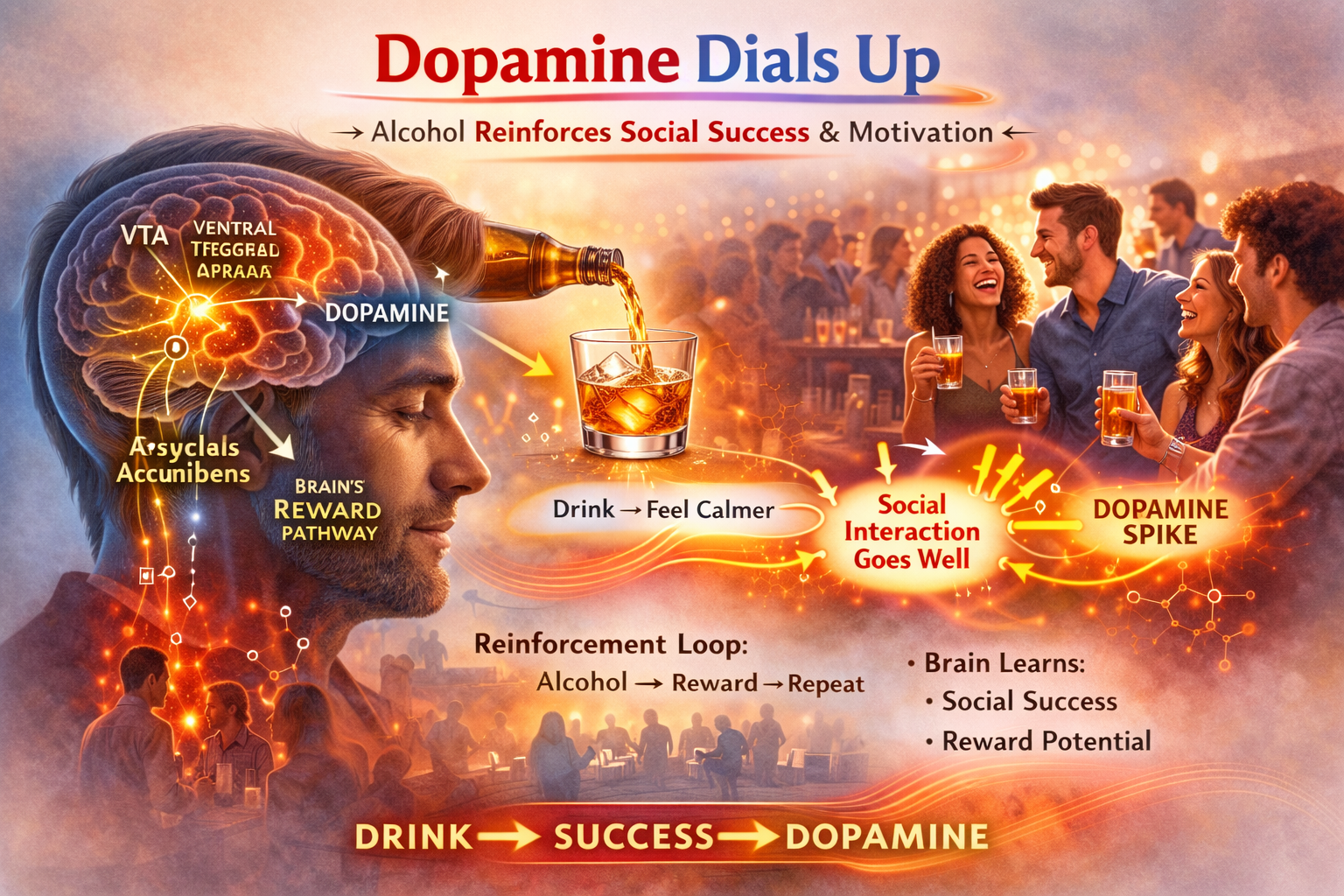
Your brain learns that alcohol is associated with social success. Even if the success came from reduced fear rather than increased skill.
Over time, this reinforcement loop strengthens. The brain begins to anticipate reward in social contexts where alcohol is present.
You don’t need a lot of alcohol to experience these effects. The problem is that these effects can be addictive, and many people don’t know how to stop after one or two drinks, even though those are the exact effects they were drinking to experience, and not the uglier side of drinking. .
But now that we understand exactly how alcohol loosens you up, we can talk about what Outty has created and why it’s a game-changer for people who use alcohol as a social lubricant but want to step away from drinking.
How Outty makes you more outgoing
If you look at the neurochemical effects that alcohol has on the brain, then it becomes pretty clear how it makes you more social and outgoing. Alcohol:
- Enhances inhibitory GABA signaling and suppresses excitatory glutamate transmission, particularly in the prefrontal cortex. As executive control weakens, inhibition falls, and you feel more uninhibited.
- Dampens your amygdala, making social situations feel less stressful and terrifying. You’re not worried about being judged for starting a conversation or taking a social risk and approaching someone. And you also aren’t worried about sounding stupid if you talk, so you’re more verbal and expressive.
- Makes you more motivated to engage in social activity, as dopamine pairs with the activity you did under the influence.
But what if you could get all of these benefits from a non-alcoholic source?
Outty’s ingredient profile is perfect for getting all of the social benefits of alcohol without any of the damaging health and safety issues.
The difference between Outty and alcohol is that instead of globally depressing your nervous system, it selectively supports the aspects that matter for social ease: inhibition, anxiety regulation, and reward signaling.
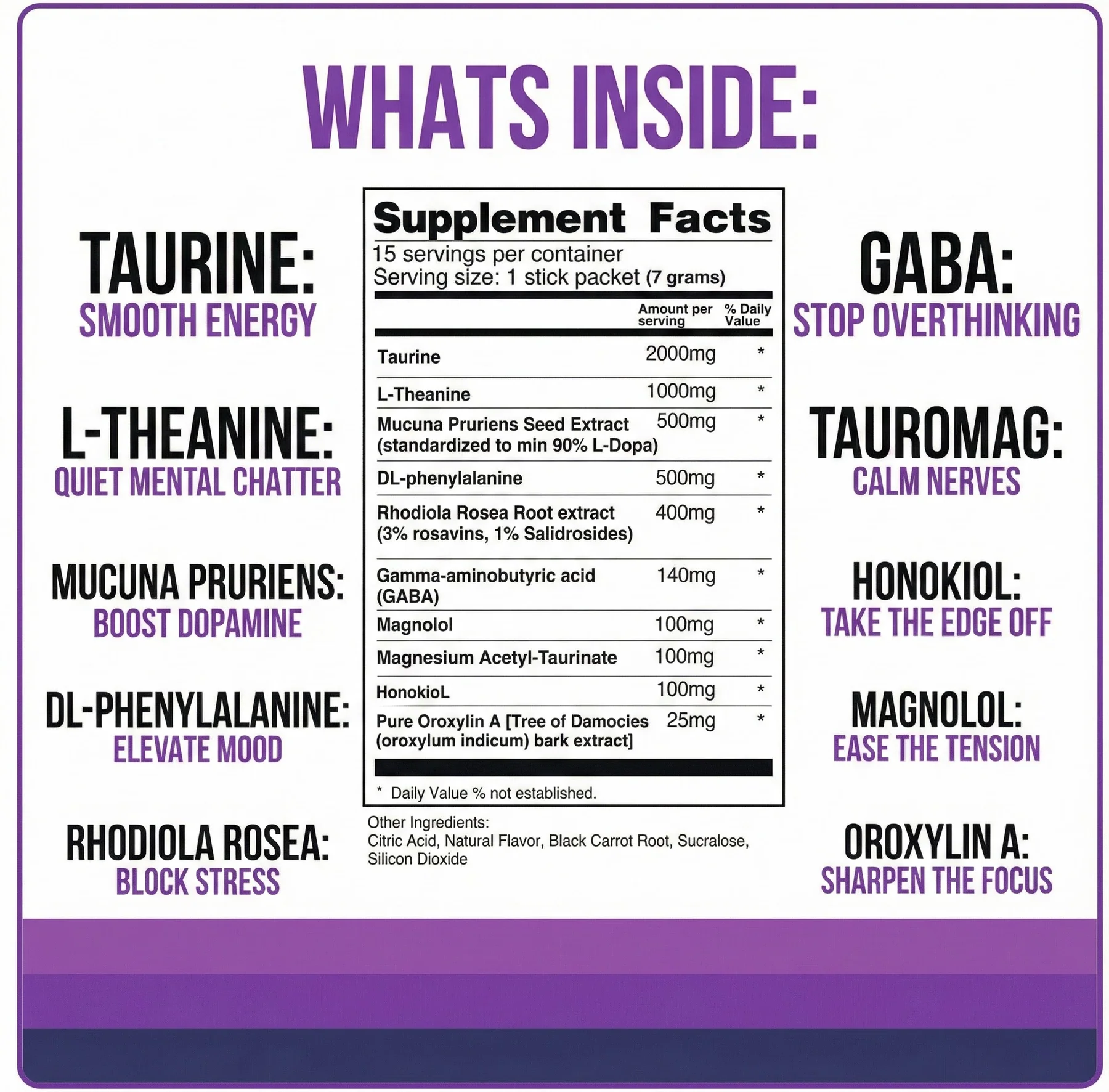
Outty activates and relaxes by activating the GABA
First, look at the GABA axis.
Outty contains GABA (140 mg), but more importantly, it contains multiple ingredients that support calming inhibitory tone without blunt sedation:
- Taurine (2000 mg)
- Magnesium acetyl-taurate (100 mg)
- Honokiol (100 mg)
- Magnolol (100 mg)
Taurine interacts with GABA-A receptors and glycine receptors, promoting calm without heavy sedation. Magnesium supports GABAergic tone and reduces excessive neuronal excitability. Honokiol and magnolol — bioactive compounds from magnolia bark — have been shown to interact with GABA-A receptors as well, contributing to anxiolytic effects.
While alcohol floods the system and suppresses the prefrontal cortex broadly, Outty supports inhibitory balance without shutting down executive function.
As a result, you feel calmer but not desensitized to the world.
Outty quiets the cognitive noise
Now look at glutamate and cognitive noise.
Alcohol suppresses glutamate, which contributes to its disinhibiting effects but also impairs memory and cognition at higher doses.
Outty approaches this more subtly and without the stupifying side effects.
Outty uses L-Theanine (1000 mg), which increases alpha brain wave activity and modulates glutamate transmission, smoothing excitatory signaling rather than crushing it. This is why people describe it as “quieting mental chatter” instead of making them sleepy.
Instead of lowering intelligence, it reduces cognitive friction.
You’re still sharp, but you’re more in control of how your brain works.
Outty takes a non-addictive approach to increasing dopamine
Alcohol increases dopamine release in the mesolimbic pathway, reinforcing social behavior and making interactions feel rewarding.
Outty supports dopamine production and motivation through:
- Mucuna pruriens (500 mg, standardized for L-DOPA)
- DL-Phenylalanine (500 mg)
- Oroxylin A (25 mg)
Mucuna provides L-DOPA, a direct precursor to dopamine. DL-Phenylalanine supports catecholamine synthesis upstream. Oroxylin A has dopaminergic and pro-cognitive effects that may support alertness and engagement.
This isn’t a dopamine spike like alcohol, but rather it’s substrate support.
Instead of forcing dopamine release and then crashing, you’re supplying the building blocks for stable motivation and drive.
That’s a fundamentally different strategy that’s safer and is far less likely lead to any addictive behaviors.
How Outty handles social stress
Now consider stress physiology.
Alcohol dampens the amygdala, but it does so by depressing overall neural activity.
Outty includes Rhodiola rosea (400 mg standardized extract), an adaptogen known to help regulate stress response systems, including cortisol signaling and fatigue under pressure.
Rhodiola doesn’t numb the threat system.
It improves resilience to it.
That means you’re less overwhelmed rather than less aware.
How this all comes together
Put it all together, and you see the architecture:
Alcohol:
- Broad CNS depression
- Impaired executive control
- Artificial dopamine spike
- Cognitive and motor impairment
Outty:
- GABAergic support without sedation
- Glutamate modulation without memory loss
- Dopamine precursor support without forced release
- Adaptogenic stress regulation
- Maintained executive function
How much does Outty cost?
A bag with 15 pouches: Outty is $59.99 for a one-time purchase, or $35.99 for a monthly subscription. Since you can cancel the subscription at anytime, it doesn’t really make sense for you to only purchase a bag for almost double the price.
For your money, you get fifteen pouches of Outty to mix with cold water and enjoy. At that price, it works out to $3.99 a drink with the $59.99 option, or $2.39 a drink on the subscription plan.
At either price point, that’s cheaper than what you’d pay for a drink at the bar or, in many cases, at home. So ultimately, you end up saving quite a bit of money replacing your drinking with Outty.
How does Outty taste?
I like Outty. I’ve described it as a non-alcoholic wine with slightly more tang. It’s not sweet, but it’s not sour either. It’s a good flavor that mirrors what you’d expect from a mixed drink if you could somehow remove the alcohol while keeping the flavor.
It’s important that you get the right mix of water if you want the flavor to really pop. When I first started mixing my Outty, I made the mistake of adding too much water.
The package recommends mixing 12 to 18 ounces, but I can tell you that, ideally, it’s closer to 12 than to 18.
With that said, everyone has their own tastes and preferences. I enjoy mine with a little less water and a bit more flavor.
Then again, I also enjoy mine mixed with sugar free red-bull, so there’s that.
Does Outty work?
I’ve been sober since 12/23/13. As of this writing, that’s over 12 years. In those 12 years, I’ve learned to be social, so I can’t tell you if Outty is going to completely cure that self-conscious feeling that all new drinkers have.
Because it’s been so long since I’ve had a drink, I can’t tell you how Outty makes me feel in comparison to alcohol. But I can tell you how it makes me feel in comparison to coffee, which is has been my go-to option when others are drinking. Many other drinkers will be able to relate to switching to coffee.
Coffee definitely wires you up and makes you feel like moving around, but I would never describe that feeling as a need to be social. Just a need to not be in one place.
There is a playground at the mall where I take my son. Rather than have a coffee—my usual drink–I decided to have some Outty before I went. Normally, I keep to myself and don’t really talk to other parents, but I will say I didn’t feel much resistance when I talked to them.
I phrased it that way to try to limit the possibility that the placebo effect might influence my experience. I wasn’t expecting it to magically make me want to have a conversation with a fellow mom and dad, and I knew I’d still have to make the move to chat anyway. Talking was a good time, though.
More importantly, the conversations, I didn’t feel the jitters and restlessness of drinking coffee while watching my kid play. I always have a decent amount of work to do, and sometimes I feel like my time could be better spent working. It usually annoys me, but Outty did a pretty good job of toning things down.
I gave some to my wife, who didn’t mind it. She’s not a big drinker at all, but she enjoyed the taste and did mention that had a relaxing but energizing effect. Not that it made her feel drunk, by any means, but like a subtle energy drink.
That’s basically how I’d describe Outty. It’s quiet energy that makes you feel excited and capable. I think a lot of people who drink to experience social liberation are going to find Outty to be a wonderful product, and it’s probably going to lead to an even greater decrease in the numbers of people who are drinking.
If you decide to try some, you can grab a bag at this link or any link through the article. If you do, I’ll earn a small commission at no extra charge to you.
Think of it as a way of saying thank you for this review and helping you make a sound buying decision.
Written by
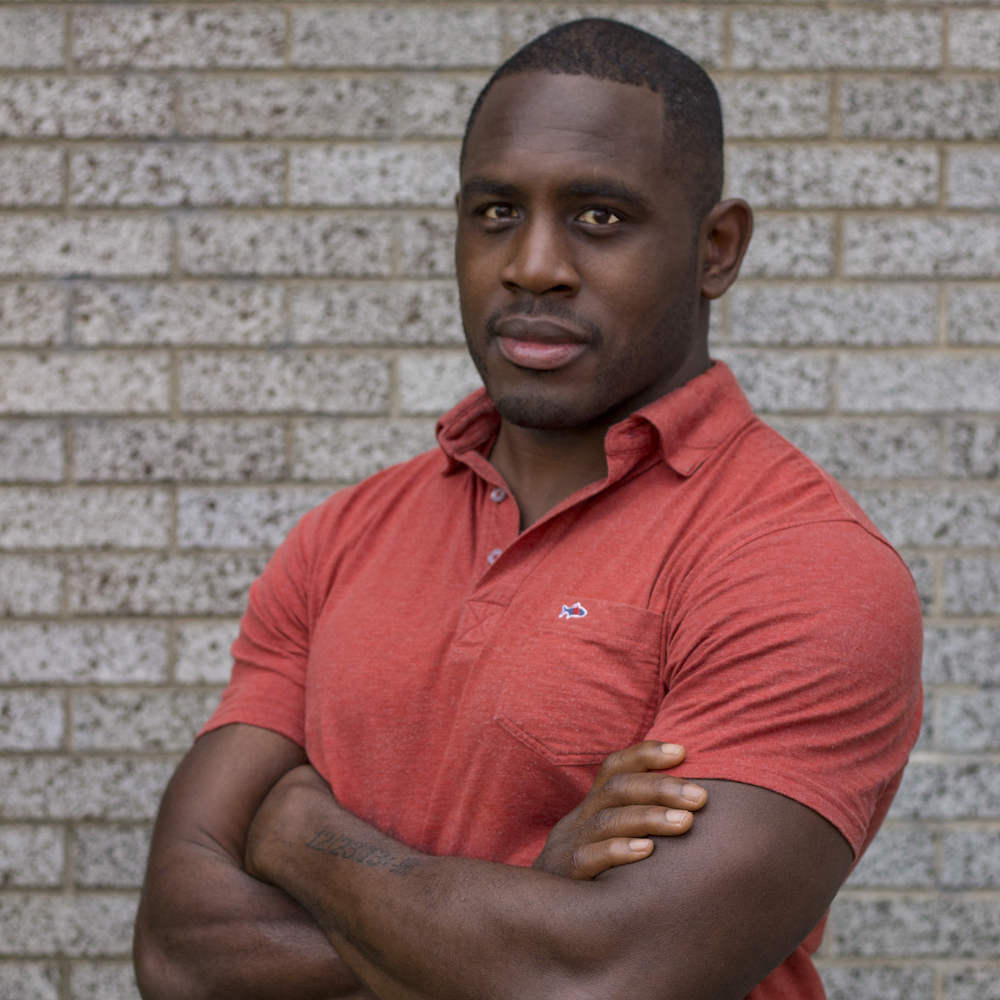
Ed Latimore
Ed Latimore is a best-selling author, professional heavyweight boxer, and physicist. He writes about self-improvement, sobriety, fighting, and the lessons he learned growing up in the projects of Pittsburgh.
Follow @EdLatimore