Antifragility And Why You Get Weak When Life Gets Easy

Antifragility And Why You Get Weak When Life Gets Easy
Life isn’t easy.
Most of the time, it’s not even fun.
Most of life is hard, but that doesn’t mean something is wrong. On the contrary, it’s part of what makes life so beautiful.
Making it through those challenging moments—when it feels like the whole world is against us and we can’t catch a break—is the only sustainable path to joy.
And we chase that joy like a fiend after a fix because it gives our lives meaning.
Imagine, for a moment, a world without hardship, where it was just all fun and games. No responsibility, no unexpected bills, and no expectations.
At first glance, that seems wonderful. There is a line in The Matrix where Agent Smith says, “Did you know that the first Matrix was designed to be a perfect human world? Where none suffered, where everyone would be happy.”
It sounds great, but then Agent Smith continues:
“Some believed we lacked the programming language to describe your perfect world. But I believe that, as a species, human beings define their reality through suffering and misery.”
Now I know that’s a quote from a movie, but multiple disciplines—like biology, economics, immunology, physics, and even psychology—all converge on the idea that the human entity is not only designed to face hardship, but we become worse when we avoid it.
This is not to suggest that you need to endure pain and discomfort just for kicks, nor does it imply that every hardship you go through has some type of meaning to make you better.
Sometimes your life is hard because you made stupid decisions, but it’s amazing how many of those decisions stem from a desire to avoid life’s unpleasant parts.
Watch/listen here
Seeking A Life Of Pleasure Is A Delusion
A short while ago, the following tweet came across my feed:
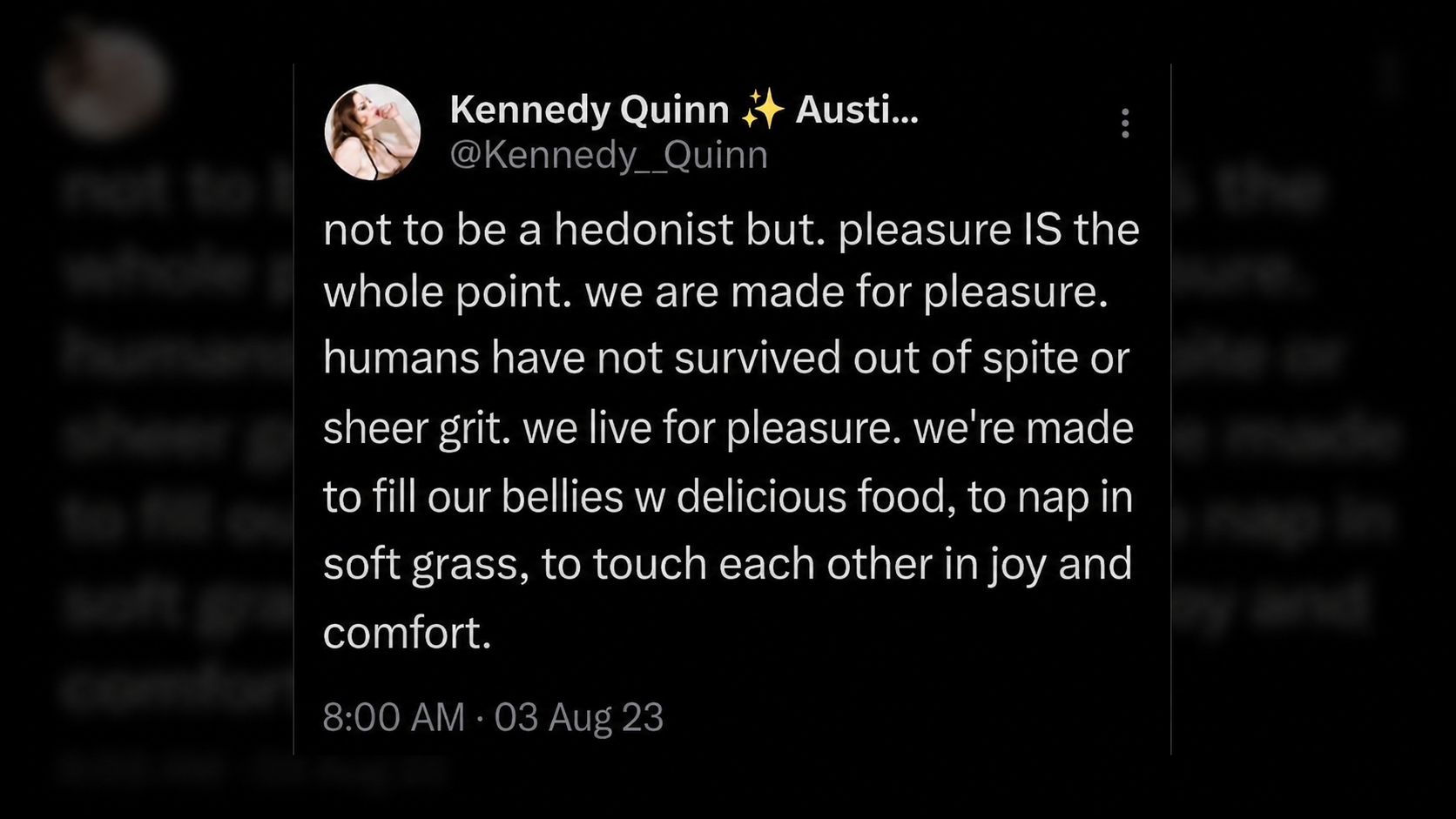 “Not to be a hedonist, but pleasure is the whole point. We are made for pleasure. Humans have not survived out of spite or sheer grit. We live for pleasure. We’re made to fill our bellies with food, to nap in soft grass, to touch each other in joy and comfort.”
It’s crazy how many people think life is supposed to be this way—all sunshine, rainbows, and whatever other happiness you can think of.
I’m convinced that these people don’t live in reality.
At the very least, they are unable to cope with life’s challenges, so they shun anything that even looks remotely difficult, not realizing that the best and worst parts of life walk side by side.
You can’t avoid the bad things without forfeiting your opportunity to enjoy the good ones.
You can’t get in shape without the pain of training and not consuming calorie-dense ultraprocessed food.
You’ll spend the rest of your life lonely if you’re afraid to get hurt.
And don’t even get me started on the ability to live in a safe place and have your daily needs met if you don’t put in the work to get a decent-paying job. I’m not even talking about balling out of control. Just enough to be in your 30s, without a roommate, with reliable transportation, and not live paycheck to paycheck.
When I read that tweet, I immediately responded:
“This is why 43% of Americans are obese, all the top causes of death are related to metabolic syndrome, most can’t even cover a $1,000 emergency, and the stats on antidepressant use—don’t even get me started.”
This riled some people up.
Whenever you suggest that comfort might have negative consequences, people assume you want to abolish modern medicine, take away their air conditioning, and send children back into the coal mines.
That is not my argument.
I don’t believe poverty is noble, suffering is inherently virtuous, or trauma automatically makes people stronger. I grew up in the projects and dealt with all those things in heavy doses for almost 2 decades.
I’ve experienced enough hardship to know that much of it is pointless, destructive, and entirely worth escaping.
But that environment also taught me something that modern upper and middle-class life makes it easy to forget:
Human beings need resistance.
We need physical resistance to develop strength. We need intellectual resistance to develop intelligence. We need emotional resistance to develop composure. We need social resistance to develop confidence.
Remove every obstacle, inconvenience, risk, and unpleasant emotion from a person’s life, and you don’t create a permanently happy person.
You create a person who has no idea how to function in the face of even mild adversity.
Here is a hill that I will die on:
Humans are antifragile creatures. If we never experience and overcome discomfort, we become unable to tolerate it—and increasingly dependent on safe spaces, medication, and temporary distractions whose costs far exceed their value.
Break For Today’s Sponsor: Jeff Lundeen
 Although I’ve spent my life facing challenges, I still get stuck and need help. And most recently, it came from the most surprising place. My relationship with today’s sponsor is an interesting one that traces its origins all the way back to X, the platform formerly known as Twitter.
Jeff Lundeen is a hypnotist who typically works with high-performing founders and entrepreneurs. When Jeff reached out to me, you’d think I’d be flattered to be part of that exclusive club, but I actually hate the adjective “high performer” almost as much as I hate the nouns “influencer” and “personal brand.” Yes, I’m aware of my apparent lack of self-awareness in that disdain.
That aside, I was never actively curious about hypnosis—it always seemed kind of like pseudoscience to me—but he offered a free session, and if I got value from it, I’d share the good word with my audience. Also, if it doesn’t violate the laws of physics, who am I to say it doesn’t work?
If you’ve experienced hypnosis before, you already know what I’m about to say. If you haven’t, then let me tell you:
It is nothing like how it’s portrayed in the movies or in a stage trick. You don’t get suggestions implanted that you act on unconsciously like a cue. You’re fully conscious the entire time.
You’re able to focus and be guided in a way that helps you change the emotional meaning you draw from past events, optimize the present, and—pardon my “Secret-esque” language here—create a better future for yourself.
I’m not blowing smoke up your ass. I’ve done two sessions since my initial, and from those I figured out the root of my alcoholism, forgave my parents, closed two writing deals, and made the jump into using graphics in my videos. Long-time viewers of my channel can see this is the first video that is more than just me talking for 20 minutes.
Jeff put together a free training that shows you how to discover and deal with the hidden beliefs running your life. You can watch it here.
Now back to Antifragility
The General Idea of Antifragility
The word “antifragile” was coined by Nassim Nicolas Taleb to describe systems that improve after disruption.
The title of the bestselling book in which the term gained popularity is “Antifragile: Things That Gain From Disorder.” The basic idea is that there are three levels of response to stress:
- Fragile. The system breaks under stress. A glass is fragile because it breaks easily when you drop it.
- Robust. The system resists stress. A plastic cup is robust because, while it’s possible to break it, it will take much more than just hitting the ground.
- Antifragile. The system comes back strong after being stressed. Lift weights, get sore from the damage, and come back stronger when you’re healed.
Your body is antifragile. Expose it to the right amount of stress, give it time to recover, and it returns more capable of handling that stress than before. You become more capable.
Your bones work the same way.
Yes, it’s possible to break a bone. Bones break all the time. But an appropriate amount of force applied to a bone, below its breakpoint, will cause the bone to adapt and be better able to resist future stress.
After we get sick, we develop resistance—and, in many cases, outright immunity—against the strain of pathogen, but only if it isn’t too devastating
And to any immunologist, I know that is a gross oversimplification of immunity, but it is correct enough to make useful predictions. Anyone born in the 80s or earlier who’s watching this remembers chickenpox parties.
This idea would only be an academic theory and exercise in mental masturbation if there weren’t real-world examples and applications. The antifragile model also predicts what happens if an antifragile system is NOT exposed to stress.
This is why astronauts lose bone density and muscle mass during extended periods in space. Their bodies aren’t broken. Their bodies are adapting perfectly to an environment where gravity no longer creates the same demands.
This is also why patients confined to a hospital bed can lose enough strength that they must relearn how to walk. Their bodies receive no evidence that walking is currently necessary, so maintaining the tissue required for walking becomes an unnecessary expense.
The body does not care about your future plans. It does not preserve abilities just in case they might be useful someday.
It adapts to what you repeatedly ask it to do.
If you lift heavy things, your body receives the message that strength is necessary. If you regularly run, your body receives the message that cardiovascular efficiency is necessary.
If you spend your days sitting, eating, and avoiding physical exertion, your body receives that message as well, and it adapts accordingly.
Your body is always adapting, but you are not necessarily improving.
Our physiology is antifragile, and we start there because if you understand how this concept works in the physical, tangible world, then you can see it play out in all aspects of life.
Life Is Easier Today Than It’s Ever Been
Life is hard and full of unpleasantness. The idea that it should be easy or fun is a relatively new notion in human history.
Consider the following timeline, and in doing so, let’s focus on mainstream archaeology (shoutout to my Graham Hancock fans—IYKYK):
- Homo sapiens, the species of human that you and I belong to, evolved roughly 300,000 years ago.
- The last ice age ended about 12,000-10,000 years ago.
- Farming began shortly after, estimated between 9000 and 10,000 years ago.
Before farming, humans ate by hunting, fishing, and foraging. They weren’t going to the refrigerator to grab a pack of steaks to thaw, nor were they going to the field to collect that year’s harvest of corn and potatoes for stew.
Wherever they wanted to eat, they had to hunt and kill it. Anyone who’s hunted or fished knows how long it can take, and that’s with modern firepower and technology.
For 97% of the 300,000 years of existence, our days consisted mainly of tracking, catching, killing, and preparing our sustenance. I’m sure there was something to do for “fun,” but it was likely reserved for children. Let’s continue.
- Navigation by sea didn’t start until 4000 years ago.
- The first roads seem to be built around 4500 years ago
- Evidence of wheeled vehicles (carts and wagons) doesn’t emerge until 3500 years ago
If you wanted to go anywhere, you were walking.
A nice walk in the park or a stroll after dinner is relaxing and fun, but most of us wouldn’t consider walking double- or triple-digit miles as enjoyable.
People have this deluded idea that life should be fun and easy—or, at the very least, shouldn’t be hard—but life has always been hard. That’s only changed recently. Consider some things that we take for granted:
- The first automobile (using gas) wasn’t invented until 1885. (It’s a common myth that Henry Ford invented it later, but he merely created an assembly line)
- The first home refrigerators weren’t sold until 1913.
- The first commercial flight didn’t fly until 1914
- The television was invented in 1927
- Penicillin wasn’t discovered until 1928 and didn’t become widely available for another decade.
- The microwave was invented in 1945
This is all a few decades before the computer, high-speed wireless internet, and cellular phones were invented.
These inventions make life incredibly easy and fun, but we’ve only had this level of ease and comfort for less than 1% of our existence. Even the ability to cool your home with air conditioning didn’t exist until 1902.
Most of our time on this planet has been miserable, by today’s standards.
It was cold, difficult, and full of death. To put this reality into perspective, just 200 years ago the child mortality rate (deaths for age < 5) in the United States was 46%. That’s almost a coin flip.
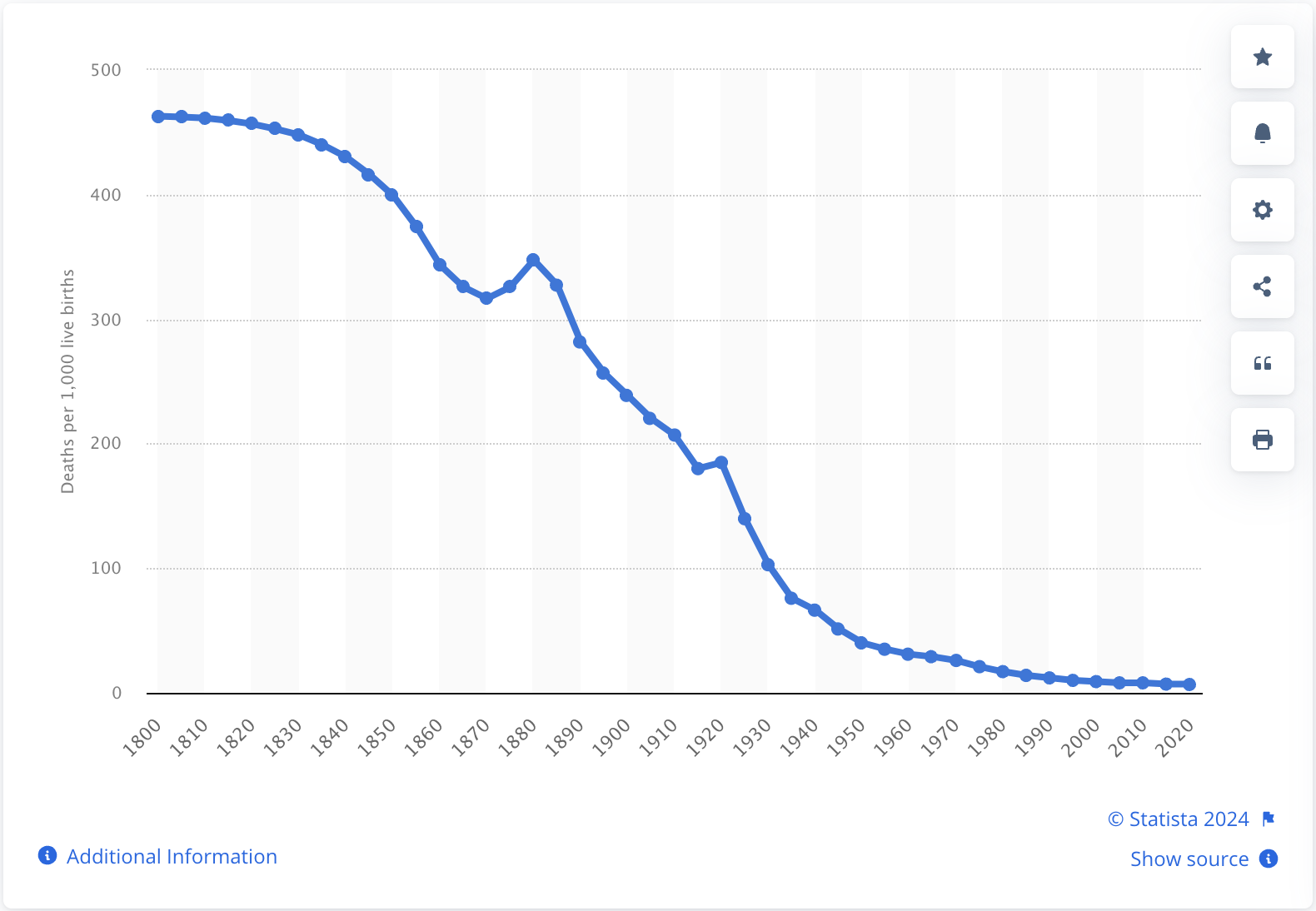
These were not happy times, but this was the state of things. We’ve eradicated so many hardships in the world that this number stands at less than 1%—and has been that way for almost 100 years.
Life is hard. Modern technology has led many people to believe it shouldn’t be, and this is a problem.
I’m not arguing that society should return to a time when survival was a full-time job and half of your children perished.
I’m only reminding you that humans evolved to deal with harsh circumstances and, now that we’ve removed many of them, we’ve become weak, entitled, and, perhaps worst of all, we’ve invented problems where there are none.
Without A Problem, We Create Them
The Epidemic of Absence also makes an interesting point about our immune system.
The author proposes that our immune system evolved in a much dirtier world. I’ve already demonstrated that most of human existence lacked antibiotics, vaccines, refrigeration, pasteurization, antiseptics, or even knowledge of germs.
Yet, we manage to survive and replicate—well, at least 46% of us, anyway.
Now that the world is incredibly clean and sanitized, the immune system isn’t sitting idle. Instead of chilling out,, it starts to attack all sorts of innocuous—or necessary—things.
Food allergies and autoimmune conditions make the list. And, to support his argument, the author shows that as a country’s GDP increases (leading to a higher quality of life), so do its rates of allergies and autoimmune diseases.
The author goes as far as flying to Mexico to infect himself with a certain type of tapeworm to treat his allergies to show that you need to get a little dirty if you want to live clean.
Just as our immune system rejects this perfect world, so does our psyche.
Objectively speaking, in any metric of quality of life (material living conditions, leisure and social interactions, economic security and safety, governance and basic rights, natural and living environment), this is the best time in history to be alive—and it’s not even debatable for most of the world.
Especially for anyone able to watch this video over their high-speed, wireless internet connection.
However, we have manufactured so many crises because we NEED something to fight against.
You see that socially, psychologically, and emotionally, the principle is at play, for better or worse.
The Biggest Signs That We Have Become Weaker
In The Coddling of the American Mind, social psychologist Jonathan Haidt and attorney Greg Lukianoff argue that the mental-health crisis afflicting Gen Z—generally defined as those born in 1997 or later—is partly the result of a culture that became obsessed with protecting children from emotional hardship, physical risk, disagreement, and failure.
And this mental health crisis is not something imagined by millennials, Gen X, and boomers. Rather, it is measurable across nearly every available indicator.
Between 2009 and 2019, the percentage of American high-school students reporting chronic sadness or hopelessness rose from 26 to 37 percent. That’s more than 1 in 3, and those are just the ones who reported.
Between 2016 and 2022, the monthly rate of antidepressants dispensed to American adolescents and young adults increased by 66 percent, with the sharpest increases occurring among adolescent girls and young women.
The percentage seriously considering suicide increased from 14 to 19 percent, while reported suicide attempts rose from 6 to 9 percent. Over the same time period, major depressive episodes increased by 52 percent among adolescents and 63 percent among young adults, with far smaller increases among older age groups.
Many people’s first reaction to these numbers is that these trends result from greater awareness or a growing willingness to discuss mental health. That is certainly possible, but a far darker number that can’t so easily be attributed is the self-deletion rate among Americans ages 10 to 24.
That increased 62 percent between 2007 and 2021, while the rate among children ages 10 to 14 more than tripled.
We also can’t blame COVID, as these numbers were already trending north before 2020, the start of the 2 years when people were locked in their homes and stock for hand sanitizer, face masks, and toilet paper went through the roof.
Something changed in the environment in which this generation grew up, and Haidt and Lukianoff believe that one important part of the answer is how society taught young people to understand safety.
Safe Spaces Make It More Dangerous For Everyone
They call this culture “safetyism”: the belief that safety is a sacred value and that people must be protected not only from physical danger, but also from ideas, experiences, and emotions that make them uncomfortable.
The core tenets of Safetyism are what Haidt and Lukianoff call the “Three Great Untruths”:
- What doesn’t kill you makes you weaker.
- Always trust your feelings.
- Life is a battle between good people and evil people.
On the surface, each of these, on its own, sounds harmless and even compassionate or beneficial to society.
However, when combined and taken to their natural conclusion, they teach young people to interpret ordinary discomfort as damage, difficult emotions as reliable descriptions of reality, and disagreement as evidence of another person’s wickedness.
All have great potential for harm, but the first untruth is the one most relevant to antifragility.
If you believe that every painful experience makes you weaker, then the logical response is to avoid pain at all costs.
In practice, here’s what this looks like:
- Parents’ intervention before their children are allowed to fail.
- Teachers removing material that might upset students.
- Institutions treating uncomfortable speech as a form of violence.
Through these well-meaning but misguided actions, young people learn to escape anything that produces fear, anxiety, embarrassment, or uncertainty.
But if you spend your life avoiding bad experiences, you never develop the ability to handle bad experiences.
Again, don’t interpret this as meaning that severe adversity is good for children.
Abuse, neglect, violence, and prolonged stress absolutely ruin a kid, especially if they don’t have dependable adult support, as is common for most kids in that environment.
Children don’t need more trauma. What they need are manageable challenges: losing, failing, being rejected, getting offended, taking reasonable risks, navigating conflict, and discovering that discomfort can be survived.
Not All Stress Is Bad
There’s a difference between toxic stress and positive stress.
Toxic stress is severe or chronic stress, like your mom kicking your ass and being sent to bed without dinner—not as a punishment, but because there was nothing to eat because crackheads robbed you and it’s still a week until the first of the month. If you know, you know.
Positive stress is brief and manageable—like competing in a boxing match or asking a girl out in person instead of in the DMs. Gen-Z, I’m looking at you.
The body activates its stress response. The child struggles. With enough support—but not immediate rescue—the child figures it out. The stress passes, the body returns to baseline, and the child comes away with evidence that he can handle more than he thought.
This process is officially called “stress inoculation.”
Just as a vaccine exposes the immune system to a sufficient threat to prepare it for a greater one, manageable stress can prepare the mind to deal with greater hardship later.
A 2010 study followed 2,398 adults and examined the relationship between lifetime adversity and mental health. The people who had experienced very high levels of adversity—growing up in the hood levels of adversity, I imagine—tended to have worse outcomes. If you’re familiar with the Adverse Childhood Experiences—or “ACEs” test—this comes as no surprise.
But the people with the best outcomes weren’t those who had experienced no adversity at all, ala your “spoiled rich kids.” The best outcomes were those in the Goldilocks Zone. Not too much, not too little, but a porridge of adversity that was just right.
Those people reported less psychological distress, fewer symptoms of post-traumatic stress, less functional impairment, and greater life satisfaction than people who had experienced either extreme adversity or none.
The healthiest people were not those who had suffered the most. But they were not those who had been protected from everything, either. They had been tested enough to know they could pass a test—and that’s important because life not only never stops testing you, but the tests become more difficult and carry greater stakes as you get older.
This is the psychological equivalent of progressive overload.
You don’t get stronger by loading up 3 plates your first time out and pushing it until you pass out, but you also don’t get stronger by pressing against air. The useful dose exists between those extremes: enough stress to force adaptation, followed by enough recovery to make that adaptation possible.
I blame the parents. Their hearts are in the right place, but the road to hell is paved with good intentions.
My son is almost four, and I like to let him fuck around and find out, as long as “finding out” won’t result in loss of life, limb, or something expensive. But this is not the trend.
A 2023 meta-analysis covering 52 articles found that overparenting was associated with greater anxiety, depression, and other internalizing problems in young adults.
Overprotection Equals Underdevelopment
Haidt argues that overprotection has fundamentally changed childhood.
Previous generations played outside unsupervised, walked home alone, settled their own conflicts, and carried house keys—all small risks that taught them to make decisions and solve problems without adult help.
A study of 8.44 million American teenagers found that, between 1976 and 2016, they became progressively less likely to go out without their parents, work, date, drive, or earn a driver’s license.
Some of these changes are great, such as less drinking and teen pregnancy, but we appear to have thrown the baby out with the bathwater.
Dating teaches young people to risk rejection, jobs teach responsibility and consequences, and unsupervised time forces independent judgment.
In trying to protect children from danger, parents may also be protecting them from the experiences that prove they can handle it.
The goal of childhood should not be the elimination of stress. It should be learning how to respond to stress without being overwhelmed by it.
Children become resilient by entering difficult situations, feeling temporarily weak, and discovering that they can still figure it out.
Avoid The Bad Means Avoiding The Good
Now we come back to the problem of avoiding bad experiences. Our psyche doesn’t do well in utopia any more than our bodies do well without exercise.
Even in this modern landscape, with all of our conveniences, humans are still human. People will hurt you, embarrass you, and sometimes, they’ll simply ignore you.
You can’t legislate away the darkness of human behavior. You can’t build “safe spaces” to protect yourself from “microaggressions.” How you feel about the world does not change the fundamentals of human nature.
You either learn to deal with life or life deals with you.
When Roosevelt said to “speak softly and carry a big stick,” he was talking about international diplomacy, but the point holds on a local personal level as well.
In other words, you need to be capable. And being capable means you have to stand up for yourself and learn to control your emotions.
And to do this, you need to do hard things.
The beauty of doing hard things is that they typically kick your ass and drag your ego through the mud. But in suffering a setback, you become tougher and more resilient.
The moment you make your priority finding the easiest, most pleasurable way to make it through any situation, you have lost the battle twice.
The first loss is immediate, when you forfeit an opportunity to get strong. This loss will feel like a victory because you won’t suffer.
The second loss you’ll suffer is the next time you face a similar (if not identical) situation. You’ll be weaker and on your back foot, meaning that even if the problem has stayed at the same level, it’s effectively gotten stronger because you have now lost the initiative and you’ve conditioned yourself to avoid it.