My Review of The Outgoing Co.’s Yapper—A Nootropic Drink

The Outgoing Co.—my favorite alcohol substitute producing company—has released a new energy drink, and it’s a bit different than what you typically expect from energy drinks. In fact, it’s probably not even accurate to call it an energy drink.
Rather, Yapper is an alcohol substitute, but it functions more like a lightweight energy drink crossed with a unique nootropical blend that also calms you down without slowing you down.
I reviewed their flagship product “Outty” in this article, and while I love Outty (I’ve gone through 4 bags at this point), I think Yapper is a significant step up, not just in terms of taste, but also presentation and dollar-for-dollar value.
I’ll get into all of that in this review, but first I have to give a light mention of the ingredients Yapper uses that make it almost an energy drink, but not quite—and why that’s a good thing.
Yapper uses a combination of Lion’s Mane, alpha GPC, panax ginseng, and a low dose of caffeine to get you in the zone, but it’s the l-theanine that makes you calm and relaxed. When you combine these two ingredient profiles, you get a drink that delivers the best parts of booze without the downsides.
You want to talk and be social, but you’re also relaxed and—unlike when you’re on your 5th drink—you actually remember what you’re talking about and aren’t annoying to other sober people.
And the cherry-lime flavor is delicious.
I’ve already gone through my first case, and I’m about halfway through with my second.
Obviously, it’s delicious, but this article will go in-depth on the ingredients, my experiences while drinking, how it tastes, the price, and ultimately whether it’s worth it.
Get your Yapper here!
Yapper’s Ingredients
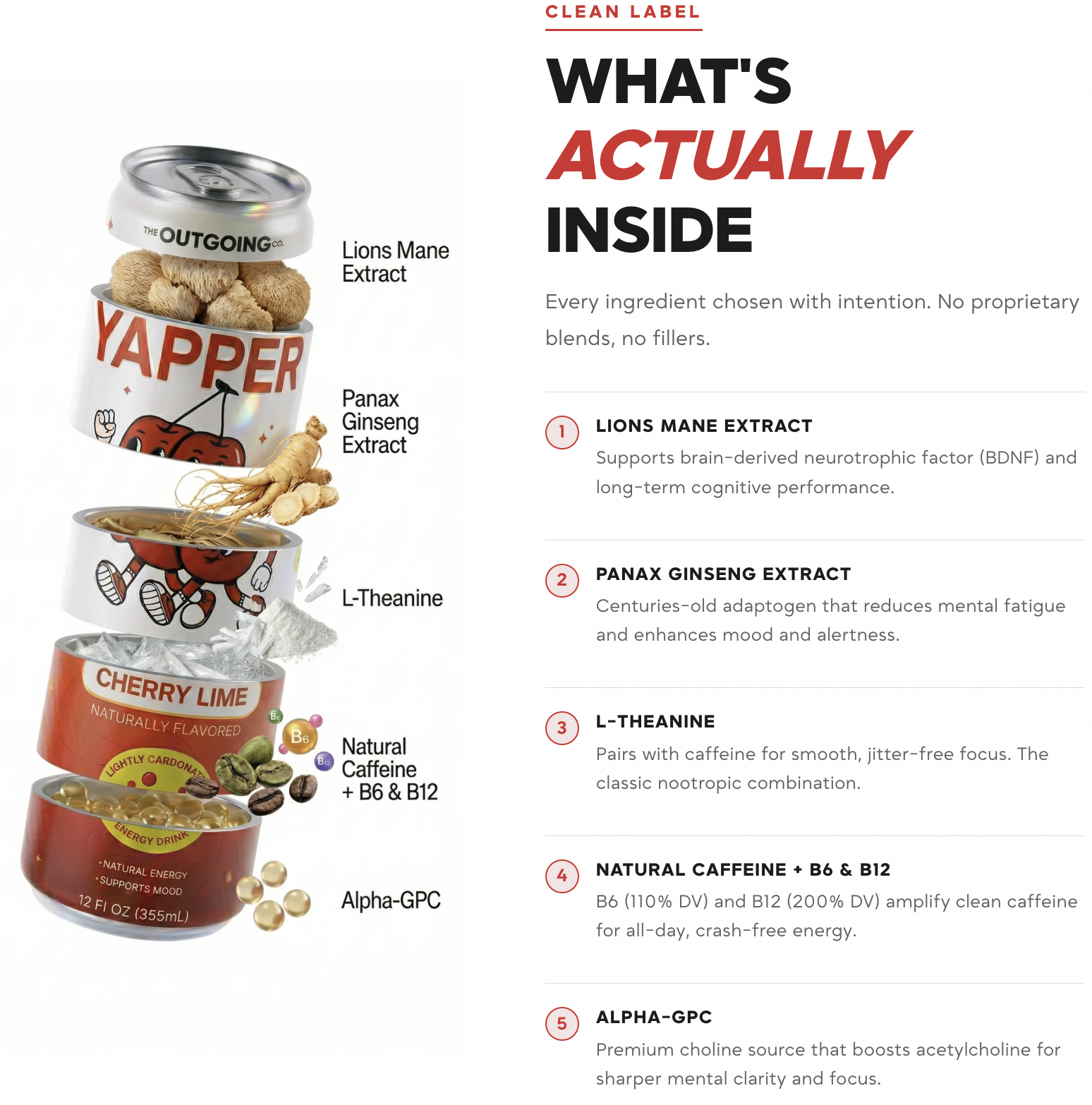 Yapper uses some ingredients that are common to standard energy drinks like Red Bull and Celsius, but they’ve made some additions (and removals) to make the formula more designed for socialization, communication, and focus rather than just pure energy.
I’ll be evaluating the ingredients from the context of Yapper’s best use cases—socializing and doing deep work.
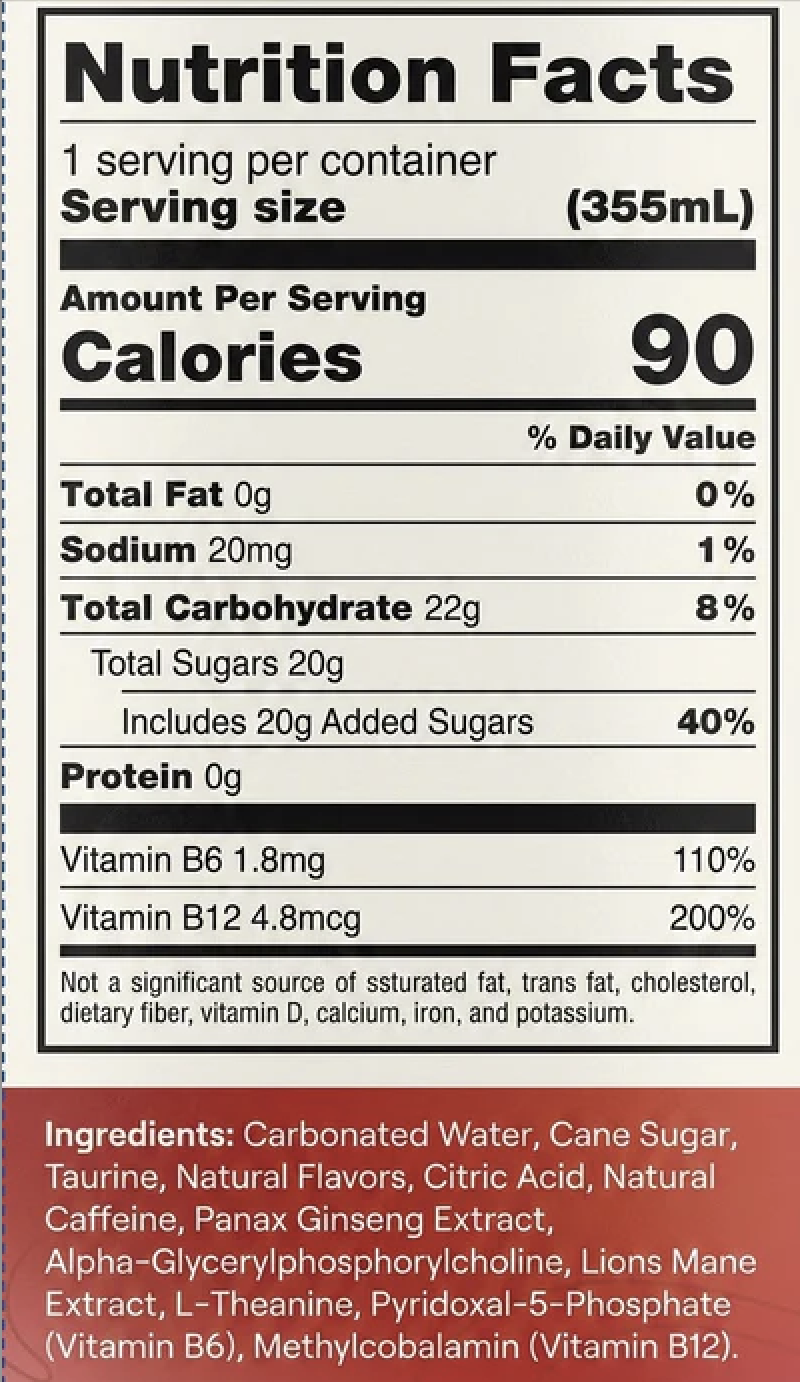
Cane Sugar (Granulated) (20.4 grams)
Yapper uses cane sugar, the type most energy drinks use. However, soda typically contains high-fructose corn syrup, which is one of the reasons it is so bad for you.
At 20.4 grams of cane sugar in a 12 oz can, Yapper uses noticeably less sugar than a Red Bull (27 grams of sugar in an 8.4 oz can). That is, of course, assuming you aren’t opting for a sugar-free Red Bull, which I often mixed with The Outgoing Co.’s other product, Outty.
20.4 grams of sugar is enough to make it enjoyable, but you’d never describe Yapper as sweet. Also, Yapper fits into a low-carb diet but not a ketogenic one, so that’s worth noting for anyone doing keto.
The sugar is also what gives Yapper its fast initial “kick.” You won’t experience a sugar rush or anything like that, but it is 20.4 grams of liquid carbs (roughly 81 calories) of energy.
Taurine (1 gram)
Taurine is an amino acid involved in hydration, electrolyte balance, and nervous system regulation. It’s commonly included in energy drinks not as a stimulant, but to help the body maintain a more stable physiological state under stress or stimulation.
At 1 gram, this is a standard, effective dose—it’s the same amount used in Red Bull, and for good reason. Taurine is included to help smooth out stimulation and may reduce the edge or jittery feel some people get from caffeine.
In the context of a social, alcohol-alternative drink, taurine promotes a smoother, more relaxed alertness.
Java G 40% Caffeine (250 mg)
Java G is a plant-derived caffeine source standardized to 40% caffeine. At 250 mg of the ingredient, this yields about 100 mg of actual caffeine in a 12-oz can.
For context, an 8.4 oz can of Red Bull contains 80 mg, while a typical 16 oz coffee contains 180–200 mg. Yapper sits right in the middle—noticeably stronger than Red Bull, but much lighter than the large coffee most people drink.
On its own, caffeine increases alertness, reduces fatigue, and improves reaction time by blocking adenosine receptors in the brain.
At this dose in Yapper, most people will feel a clear but controlled boost. It’s enough to wake you up, sharpen your focus, and make you more engaged—without pushing into the overstimulated territory that higher doses can bring.
Of course, you can completely override this by drinking multiple Yappers in a short amount of time, but the same thing is true for any caffeinated drink.
Panax Ginseng Root (4% Ginsenosides) (200 mg)
Panax ginseng is an adaptogenic herb traditionally used to support energy, stress resilience, and mental performance. Its active compounds, ginsenosides, are thought to help regulate how the body responds to physical and mental stress, rather than directly stimulating it like caffeine.
At 200 mg standardized to 4% ginsenosides, this is a decent dose. On its own, ginseng isn’t going to hit you with a noticeable boost, but it has been shown to improve stamina, focus, and mental resilience.
Where this matters is in situations that require you to stay “on” for a while. In social settings, that can mean staying engaged in conversation without mentally checking out or feeling drained.
For work, it’s the difference between a short burst of focus and being able to maintain steady attention over time. It’s not something you feel directly—it’s something you notice by what doesn’t happen: less mental drop-off, less fatigue, and a more consistent level of engagement.
Alpha GPC 50% Powder (192 mg)
Alpha GPC is a choline compound that supports the production of acetylcholine, a neurotransmitter involved in memory, learning, and focus. It’s commonly used in nootropic formulas to improve mental clarity and cognitive performance.
At 192 mg of a 50% powder (about 96 mg active), this is below the typical dose used for strong, standalone cognitive effects. On its own, it may provide a mild boost to mental clarity, but it’s not enough to carry the experience. It’s more of a supporting ingredient than a primary driver.
Where it can matter is in how sharp you feel moment to moment. In social settings, that can mean better recall, quicker responses, and less of that “losing your train of thought” feeling. For work, it shows up as slightly cleaner thinking and better mental organization.
Lion’s Mane Extract (liquid) (96 mcg)
Lion’s Mane isn’t the kind of ingredient you feel right away—and that’s the point. Most of its potential benefits come from consistent, repeated use, not a single dose.
Research and user reports both suggest that improvements in mood, mental clarity, and energy tend to emerge gradually over a few weeks rather than immediately.
That matters when you look at how it’s used in a drink like Yapper. At 96 mg, Lion’s Mane aficionados will note this isn’t a performance-level dose meant to hit you in the moment. It’s a maintenance-level inclusion—something that contributes over time if you’re drinking it regularly.
But Lion’s Mane wasn’t something meant to hit you immediately, anyway, regardless of the dose.
It is included as a liquid extract, which may be more bioavailable than a raw powder, but dose still matters, and this is on the lower end compared to typical standalone supplements. Think of it less like caffeine and more like something you layer into your routine.
Drinking this dose over time will make it easier to stay mentally present. You’ll also be less prone to brain fog and more consistently engaged in conversations. It’s not going to give you a big brain and social motivation boost overnight, but it does support a more clear-headed feeling that makes cognitively taxing work—like an evening conversation with friends—easier.
For creative or deep work, it plays a similar role. It’s not about a spike in focus—it’s about reducing the friction that builds up over time: mental fatigue, scattered thinking, and that slow drop-off in clarity. Daily use is what gives it a chance to actually do something.
Lion’s Mane in Yapper isn’t there for the immediate effect—it’s there for the accumulated effect. If you’re only drinking it occasionally, it doesn’t matter much. If you’re drinking it daily, that’s where it starts to make sense.
Get your Yapper here!
L-Theanine (96 mg)
L-theanine is an amino acid known for promoting relaxation without sedation. It’s naturally found in green tea and is one of the key compounds responsible for its calm, steady feel compared to coffee. It’s commonly used to reduce mental tension and create a more focused, composed state.
At 96 mg, this is a solid, effective dose. On its own, L-theanine can take the edge off stress and improve subjective focus, but it doesn’t increase energy. Its primary function is calming and stabilizing, not stimulating.
If you’ve ever tried to use coffee in place of alcohol for socializing, you know how antsy and wired it can make you feel. I run into the same problem when I use coffee for deep work—I’m focused and ready to go, but 20 minutes in, I feel restless and want to move. That’s not great when you’re trying to sit and write.
L-theanine helps with that. It takes the edge off so you can stay relaxed and present—whether that’s holding a conversation or settling in and getting work done—without losing alertness.
B Vitamins (B6 as P5P & B12 as Methylcobalamin)
Vitamin B6 and B12 are included here for a simple reason: they support the systems that control your energy, mood, and mental clarity.
B6 (in its active form, P5P) is directly involved in producing neurotransmitters like dopamine, serotonin, and GABA—chemicals that influence how focused, motivated, and socially at ease you feel. B12 supports nerve function and helps with red blood cell production, which plays a role in oxygen delivery and overall energy levels.
Most energy drinks include them for this reason, and Yapper is no different. When you’re stimulating the nervous system, it helps to have the underlying chemistry in place so you actually feel good and engaged—whether that’s writing, working, or just being social. B6 and B12 support that baseline.
The doses here are small but effective, which is typical for B vitamins.
You won’t feel them kick in like caffeine, but that’s not their role. In a drink designed for socializing or light cognitive performance, they act more like baseline support—helping ensure you don’t feel mentally flat, fatigued, or off.
They don’t create the experience, but they help everything else work the way it’s supposed to.
My first impression of Yapper
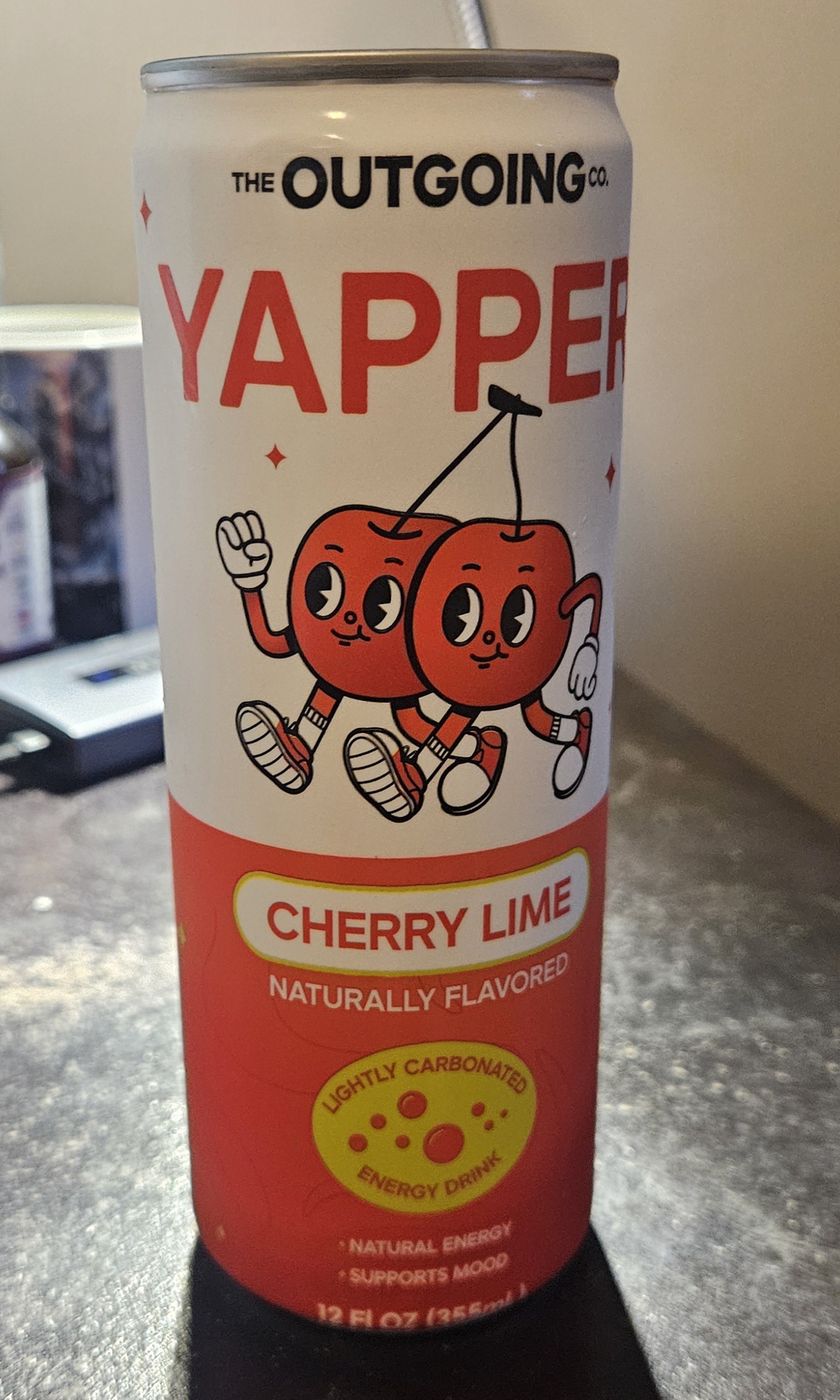 While I knew that The Outgoing Co. would release a new product after the success of Outty, I didn’t know the details. I expected it to be another mixable drink. But Yapper is an upgrade on multiple fronts.
As much as I love Outty, I did not like having to mix it up every time I wanted to make a drink. When you have to mix something up, there’s just more friction involved in using it. It’s technically just as portable as any other drink, but you have to mix it at home and take it with you. It also means that unless you use ice-cold water or ice cubes, it won’t be as cold.
Yapper fixes all of this.
Yapper comes in a can, so it’s obviously premade. It also means I can put a few in the fridge and just crack them open when I’m in the mood or about to take a drive.
I’m a big fan of this upgrade, as it removes mental friction and puts The Outgoing Co. on a level of professionalism that lets it compete with other drinks in the space.
What does Yapper taste like?
 In my review of The Outgoing Co.’s other product, Outty, I remarked that it had a good taste, with just enough bitterness to remind you of an alcoholic drink, and I frequently mixed it with sugar-free Red Bull to get a mixed-drink effect.
Yapper is a different beast here. It is delicious, but not overly sweet. However, the decision to add sugar is huge, and it makes a difference.
You’re not going to feel like you drank juice or soda, but you also won’t feel like you’re drinking a sugar-free Red Bull, which is definitely closer to an acquired taste than something you just naturally find delicious.
In terms of flavor profile, I’d say Yapper is like natural lemonade with just enough sugar to make it thirst-quenching, but not so much that you think it came out of a vending machine. That’s the best way I can describe it.
I don’t mean that it tastes like lemons. Rather, it tastes remarkably close to the flavor it’s marketed as—cherry lime. And, like those flavors, you probably wouldn’t gorge yourself on something that is naturally a mix of naturally picked cherries and limes, but it tastes pretty good.
The Outgoing Co.’s website lists the orange flavor as out of stock, and I’m curious to try it because orange is another one of those flavors where, if there isn’t enough sugar, it’s good but not something you want to crush for days. However, most people’s experience with orange juice is of something loaded with sugar.
Overall, Yapper is better tasting than other energy drinks. This is one of the reasons you should buy multiple cases or subscribe. The only warning about it concerns the caffeine it contains.
You can’t taste the caffeine, but you will definitely know you drank something with caffeine in it if you drink it too late. As I write this section of the review, it’s currently 11:30 pm. I really wanted to drink a Yapper while writing this to make it feel more immersive, but that’s just a bad idea.
What does Yapper do? My personal experience
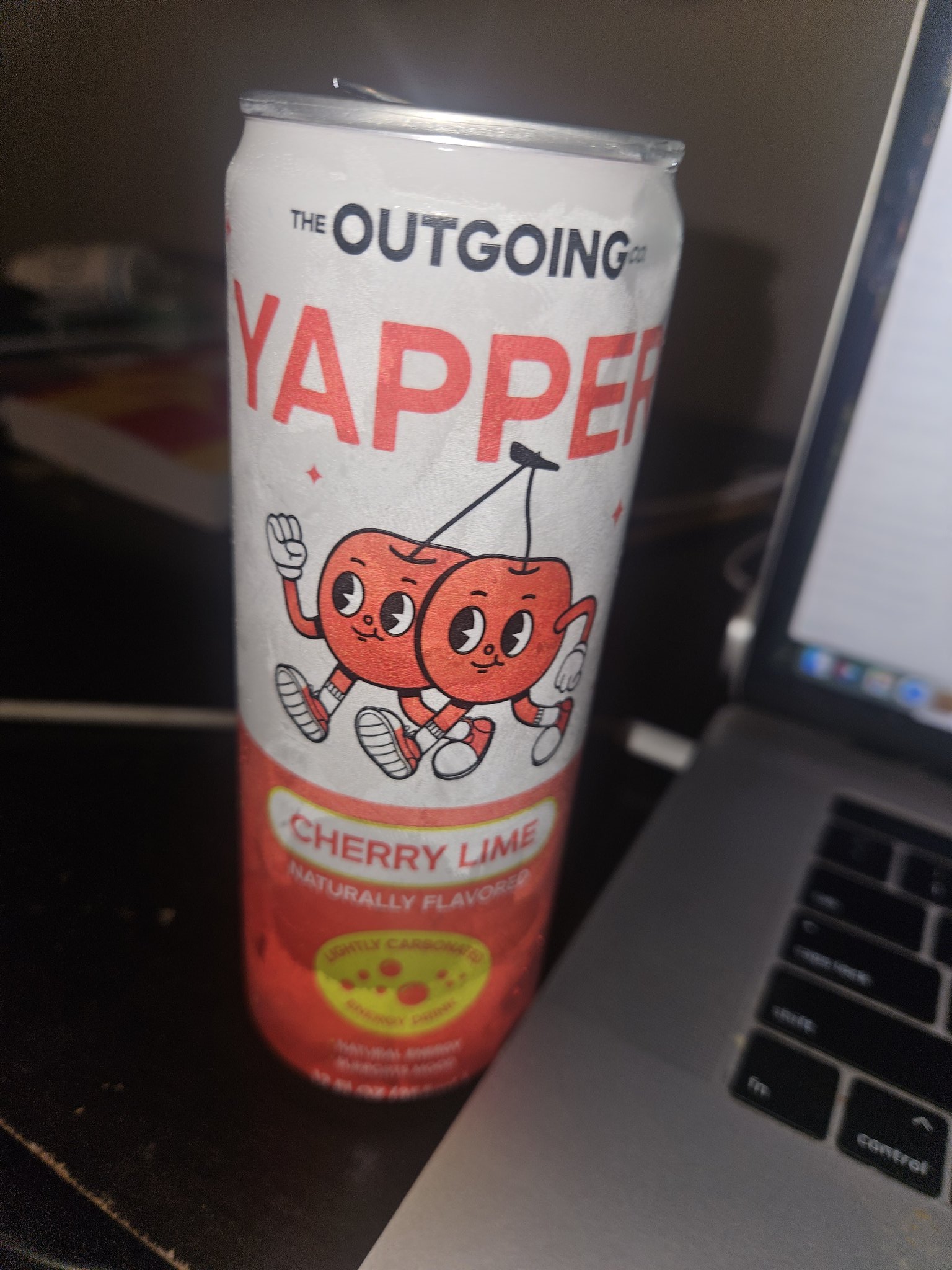 I said earlier that Yapper is like a lightweight energy drink crossed with a unique nootropical blend.
I’ve got quite a bit of experience with nootropics, ranging from more conventional products like
To more unconventional methods like chewing nicotine gum and kratom.
Most nootropics have the same ingredients mixed in various proportions depending on what effects they want to emphasize. Yapper’s primary aim is to make you feel more relaxed and be verbally and cognitively sharp. Basically, you think faster but not too much. As the name suggests, you will want to “yap.”
I can say that Yapper definitely accomplishes this, but it’s not something that’s going to last all night long. After about an hour of finishing a can, you may feel a bit of a “come down.” It’s not like crashing after doing cocaine or anything crazy like that, but the initial rush definitely dials back.
In my case, it most clearly manifested in how I personally use Yapper: writing the essays I’ll use for my YouTube channel. That might not seem like the same thing as socializing, but I do have to be on top of my verbal game.
I also noticed a similar effect when I drank a Yapper before going to a social event. Now I don’t normally have any reservations about seeing my friends, but I often struggle with not thinking about work while I’m out. Yapper doesn’t make me forget that I’d rather be working on the next essay or piece of content, but it does allow me to get into the moment a bit more.
Keep in mind that I’ve been sober since 2013. It only took me a few months to realize that if I didn’t figure out how to have a social life that didn’t revolve around getting drunk, I’d turn into a boring hermit—but it still takes effort.
Yapper makes it take less effort.
Get your Yapper here!
How much does Yapper cost?
Yapper costs $35.99 if you set it up on a monthly subscription, and $47.99 if you buy without subscribing. Each order comes with twelve 12-oz cans of the drink.
Before we get to discounts and shipping fees, consider the Yapper cost per can. At the subscription price of $35.99, that’s $2.99 a can. At the one-off price, that’s $3.99 per can. If you bought a similar product at a retail store like Red Bull or Celsius, Yapper is only slightly more expensive, and those products don’t include nootropics, adaptogens, or l-theanine.
Obviously, the 25% discount on the subscription is meant to entice you to become a regular customer. To be honest, it’s a good play, but it comes with a caveat.
That 25% discount for being on subscription is only good for the first order. After that, the discount drops to 10%, making your monthly purchase price $43.90, which is still cheaper than a one-off purchase, but doesn’t seem like that much.
However, signing up to the subscription model saves you $9.99 in shipping costs, so ultimately you end up paying $44 rather than $57. That’s a pretty good deal, but let’s be real here:
Given the price difference, you aren’t signing for a subscription to save money. You’re doing it for convenience and because you’re going to drink a lot of this stuff, and you’d like to know that you always have a case on deck.
Saving $13 and getting your first case significantly cheaper is nice, but if you can afford to buy it at the one-off price, the subscription is cheaper, and you’ll definitely use it. You’ll likely put 2 or 3 cases on subscription, so you’ll be able to drink at least one every day.
Final verdict on Yapper
Yapper is a great-tasting drink that I think anyone would enjoy. It also just happens to be marketed as an alcohol substitute and a nootropic.
Technically speaking, anything you drink in place of alcohol is an alcohol substitute, but none of them will taste as good as Yapper, nor will they come with as many cognitive benefits.
You should pick up a case. If this review was helpful to you, I’d love for you to pick up a case or two using my affiliate link below or any of the affiliate links on this page.
Get your Yapper here!
Also, don’t forget to check out Outty, The Outgoing Co.’s flagship product.
Written by
Ed Latimore
Ed Latimore is a best-selling author, professional heavyweight boxer, and physicist. He writes about self-improvement, sobriety, fighting, and the lessons he learned growing up in the projects of Pittsburgh.
Follow @EdLatimore