Simpleology Review: A Productivity App With A Novel Approach

Simpleology Review: A Productivity App With A Novel Approach
The internet is full of productivity gurus whose primary achievement is convincing people they’re productivity gurus.
If I’m going to spend weeks learning someone’s system, I want to know whether they’ve actually built a life that demonstrates the principles they’re teaching.
Mark Joyner has.

His career started far away from Silicon Valley.
He enlisted in the U.S. Army as a Private, worked his way up to Sergeant, earned a bachelor’s degree in psychology through independent study while serving, attended Officer Candidate School, and ultimately left the military as a First Lieutenant after eight years of service.
During that time, he trained as a Korean linguist at the Defense Language Institute and worked on intelligence missions in Korea.
After leaving the Army, Joyner became one of the early pioneers of internet entrepreneurship.
Long before “software startup” became a household phrase, he was building companies around the emerging web. Over the course of his career, he’s founded more than thirty startups, including.
- SearchHound—one of the earliest pay-per-click search engines.
- ROIbot, which Amazon describes as the first online ad-tracking company and the first client-side SaaS platform.
- StartBlaze, a traffic-building system that reportedly became the 36th most visited website in the world within six weeks of launching.
He’s also an unusually prolific author. Joyner has written more than a dozen books that have been translated into over twenty languages, including The Irresistible Offer, Integration Marketing, The Worst Case Scenario Business Survival Guide, The Rise of the Author, and The Great Formula. Several have reached #1 bestseller status.
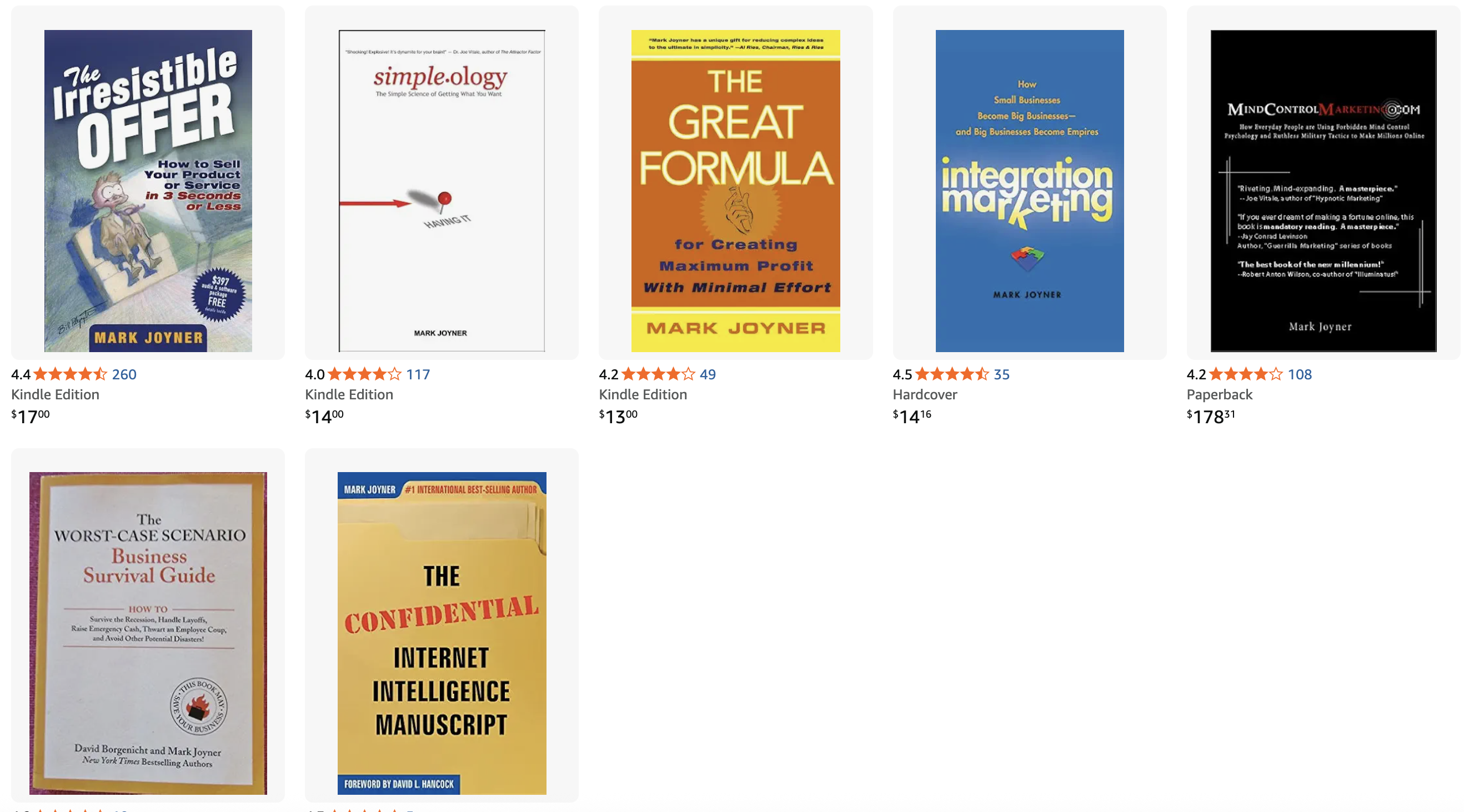
Today, he’s the founder and CEO of Simpleology, the platform this review is about.
None of that, by itself, proves that Simpleology works, but it does lay out credibility. It shows that the creator behind this productivity system isn’t someone who built a following by talking about productivity.
He’s someone whose career has revolved around building companies, writing books, creating products, and repeatedly turning ideas into reality.
Any of these activities, by themselves, demands focus and would earn someone credibility in productivity. But the fact that he’s done all of this shows that there is probably something worth learning here.
My First Impression of Simpleology
I have to admit, my first thought after opening Simpleology was:
“This doesn’t look very simple.”
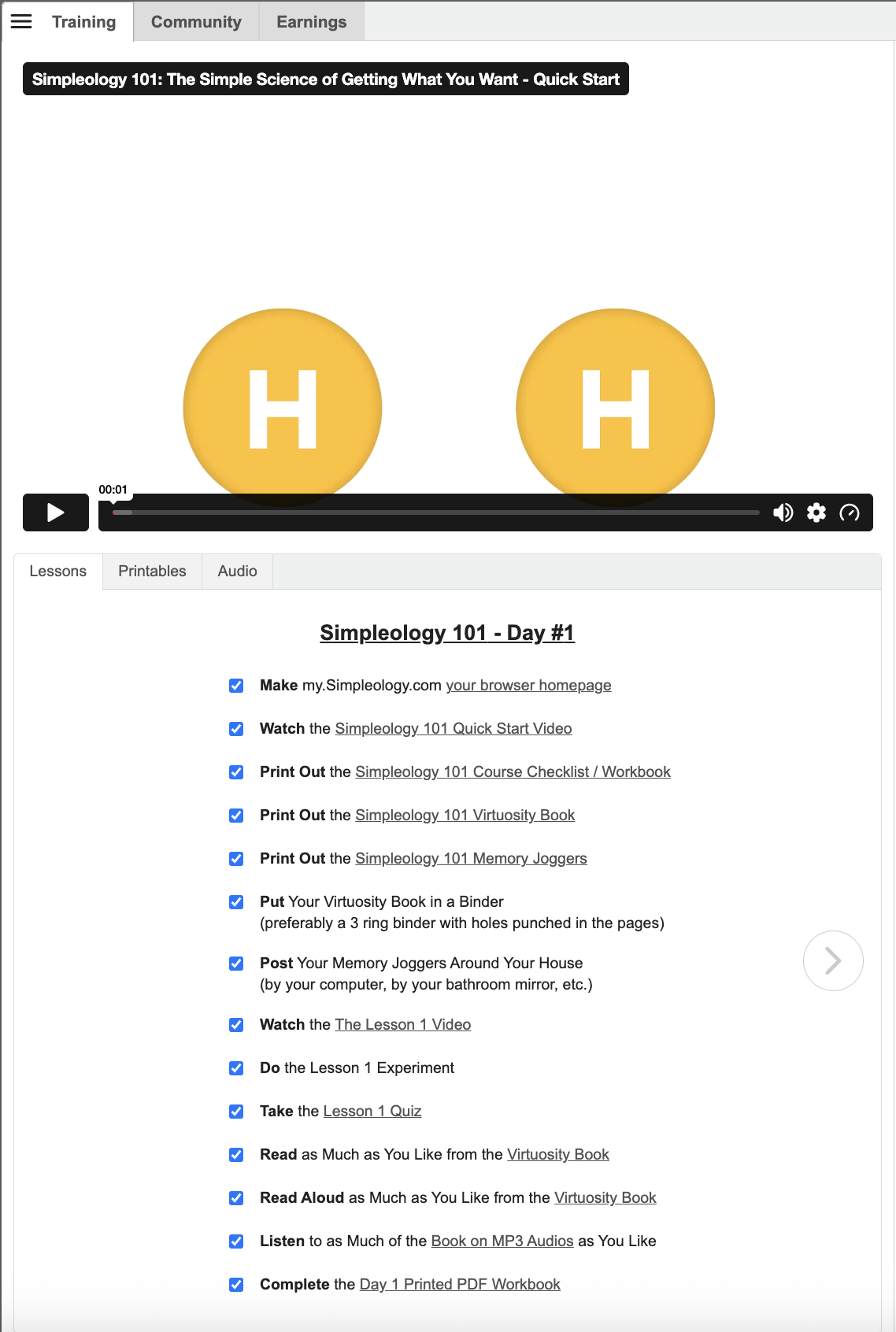
The very first lesson recommends printing the course workbook. I almost skipped it, figuring I could just follow along on my computer. But I wanted to give the program a fair shot, so I printed it anyway.
Forty-seven pages came rolling out of my printer.
Then I learned there was another book called Virtuosity.
Then a Memory Jogger.
Then audio recordings of the Virtuosity book that I could download and listen to while driving.
Then the videos, exercises, and tutorials.
Mind you, all of this was before I had even started exploring the producitivity software itself.
Once inside the platform, there were projects, journals, mind maps, observation logs, templates,
Dreamcatcher, places to define my major areas of focus, and a variety of organizational tools that I wasn’t entirely sure how—or even if—I was supposed to use.
Ironically, my first impression of a productivity system was that it looked like more work.
At that point, I started wondering whether Simpleology had fallen into the same trap as so many productivity apps. In an effort to help you organize your life, they create another thing you have to organize.
Thankfully, that wasn’t the end of the story.
One thing Simpleology gets right from the beginning is its onboarding. Rather than dumping you into the software and expecting you to figure everything out, the tutorials walk you through the platform step by step. I quickly realized that most of the features weren’t meant to be learned immediately. They were tools I’d be introduced to as I progressed through the course.
The pace of the course reinforces that philosophy.
You can’t simply binge your way through it.
Each lesson has to be completed before the next one unlocks, and even after you’ve checked every box and watched every video, you still have to wait until the following day before continuing.
At first, I wasn’t sure how I felt about that. Like most people, I wanted to jump ahead and see the “good stuff.”
Looking back, I think that restraint is intentional and it makes the course work better than any of the other productivity products out there.
Simpleology isn’t just trying to help you consume more information. It’s trying to change how you work.
Changing how someone thinks about something takes patience and time, and Simpleology is built to do that. I fully admit that I didn’t appreciate that during the first few days of the program.
All I saw was that the system seemed much larger and more complex than I expected. But as it turns out, that’s because I was judging the software before I’d learned the system.
The Five Laws of Simpleology Through the Lens of Physics
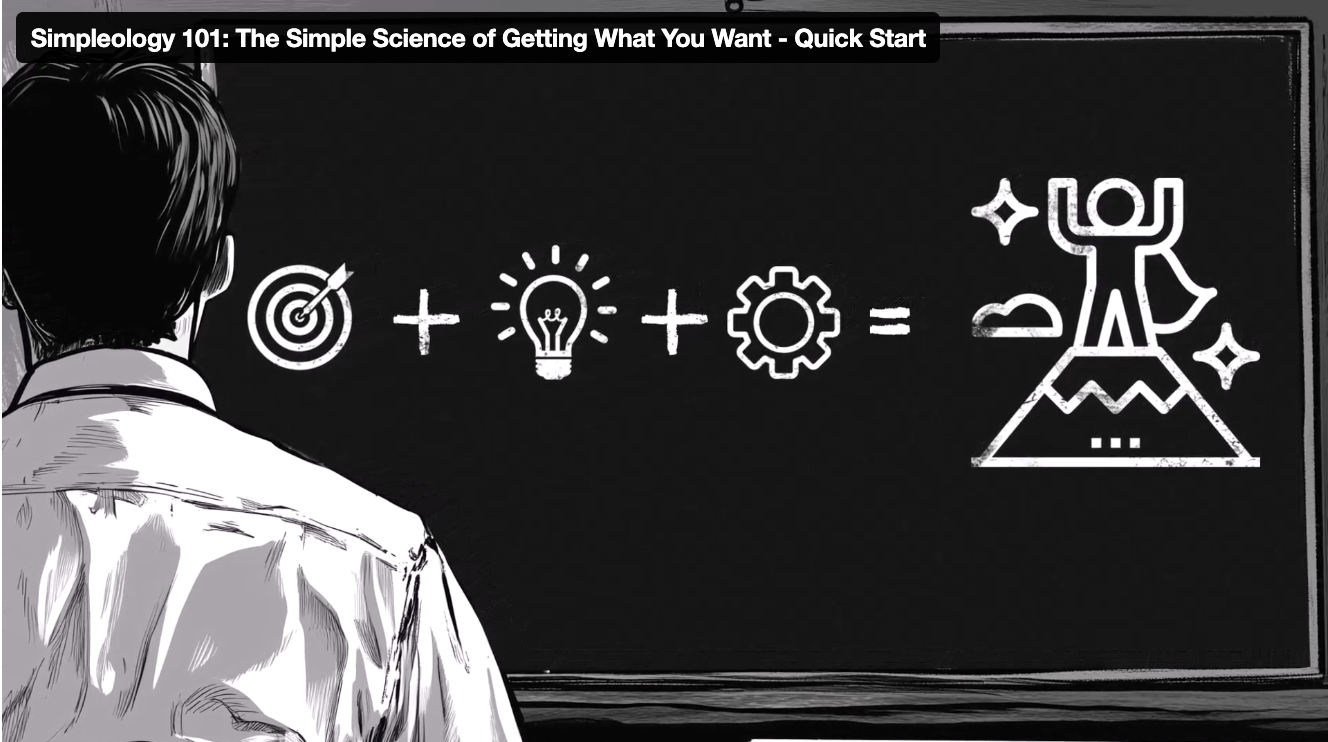
Mark Joyner doesn’t organize his philosophy around productivity “tips” or “best practices.”
Instead, Simpleology is built upon what he calls the Five Laws of Simpleology:
- The Law of Straight Lines
- The Law of Clear Vision
- The Law of Focused Attention
- The Law of Focused Energy
- The Inescapability of Action and Reaction.
As someone with a degree in physics, I appreciate this framing.
Physics is useful because an astonishing amount of reality can be explained by a relatively small number of fundamental laws.
Whether you’re describing the motion of planets, calculating the trajectory of a baseball, or predicting how electricity flows through a circuit, you’re usually applying the same handful of principles.
Once you understand the underlying laws, the complexity begins to simplify itself. And they seem to also apply to human behavior.
These aren’t scientific laws in the literal sense. Human behavior is far too messy for that.
They’re heuristics—mental models that explain why some people consistently make progress while others spend years spinning their wheels. Like Captain Barbarossa once said in Pirates of the Caribbean, “The code is more what you’d call guidelines than actual rules.”
Simpleology 101 is devoted to understanding and mastering these 5 principles.
The Law of Straight Lines
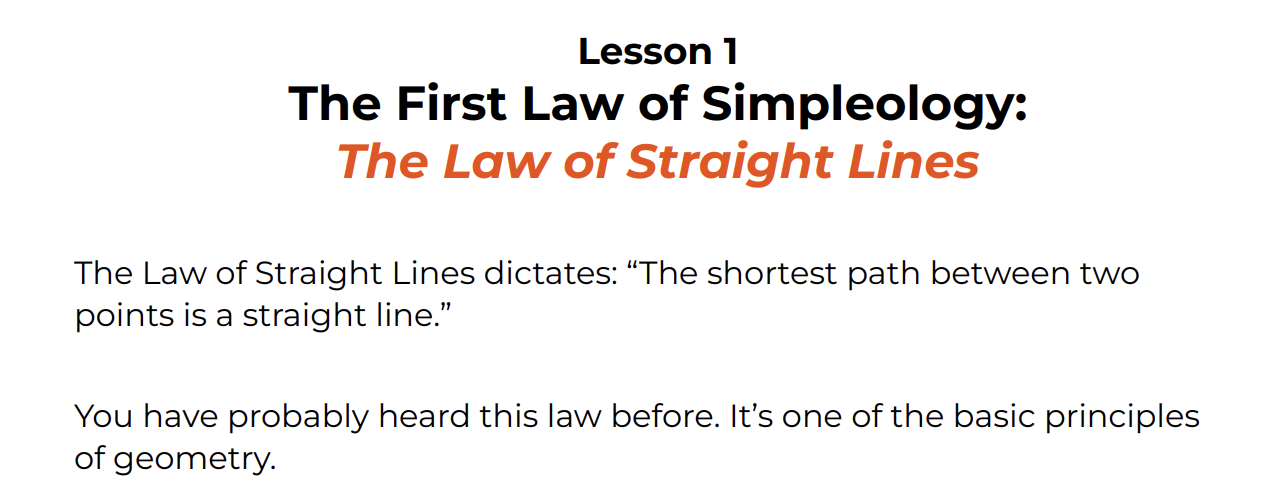
The Law of Straight Lines is built on an obvious but profound idea: the shortest distance between two points is a straight line.
Most people pursue goals indirectly.
- We start businesses while simultaneously planning our exit strategy.
- We decide to write a book, then abandon it halfway through because another idea seems more exciting.
- We convince ourselves that taking another course or reading another book is progress when, in reality, we’re simply delaying the difficult work of execution.
The result is that our lives become a collection of half-finished projects connected by frequent changes in direction.
We allow fear, distraction, and the illusion of optionality to pull us away from the direct path. The obstacle often isn’t that the goal is especially difficult. It’s that we interrupt our own progress by changing destinations and chasing after the next shiny object.
Every unnecessary commitment, backup plan, distraction, and abandoned project bends the line just a little further away from where we originally intended to go. The more often we make those small deviations, the farther we drift from the destination.
The Law of Straight Lines is more about discipline than productivity
It’s the practice of repeatedly asking a simple question before making any decision: Does this move me closer to where I’m trying to go, or is it just another detour or side quest?
The Law of Clear Vision

Most of us don’t actually lack motivation. Rather, we lack specific goals and targets.
People say they want to get in shape, make money, and have better relationships. All around, people just want to be happier.
Those sound like goals, but they really aren’t. They’re categories and ideas. They describe a direction without defining a destination.
The more precisely you define what you want, the easier it becomes to recognize opportunities that move you toward it and distractions that pull you away. Decisions that once felt complicated become simpler because they can be evaluated against a clearly defined objective.
The Law of Vision teaches you that productivity begins long before you write your first task on a to-do list.
It starts by defining the destination with enough precision that your daily decisions naturally start pointing in the same direction.
The Law of Focused Attention
The Law of Focused Attention asks an important question:
“What are you paying attention to?”
I’ve always said that attention directs energy, while energy reinforces attention. Or, to put a more physics-esqe spin on it, attention determines the vector, while energy determines the magnitude.
A big problem is that our attention is scattered across so many competing demands that we rarely devote enough uninterrupted attention to any goal.
We answer an email, glance at a text message, check social media, remember an errand we forgot to run, and suddenly thirty minutes have disappeared without accomplishing anything meaningful.
Your goals don’t simply disappear because you have distractions. Instead, they’re drowned out by everything competing for your mental bandwidth.
The important work is still sitting there, but it’s buried beneath notifications, unfinished tasks, browser tabs, meetings, emails, and the constant temptation to switch to something easier.
Most people try to become mentally stronger and focus harder while leaving the distractions intact, but according to Simpleology, that’s like putting the cart before the horse.
Simpleology approaches the problem from the opposite direction. Eliminate enough unnecessary inputs, and focus becomes much less of a battle.
The Law of Focused Energy
The Law of Focused Attention is about where your mind goes.
The Law of Focused Energy is about where your effort goes.
You can give something your attention without giving it meaningful effort. Most people have experienced this firsthand.
You think about writing the book, launching the business, or getting in shape almost every day, but your actual energy is spread across dozens of competing priorities. You’re mentally invested in the goal while physically making very little progress toward it.
According to Simpleology, every backup plan, unnecessary commitment, and distraction siphons away a portion of the energy that could have been directed toward your primary objective.
That idea immediately reminded me of one of the simplest equations in physics:
Pressure equals force divided by area.
You don’t need more force to cut through a piece of wood. You simply need to apply the same force over a much smaller surface area. That’s why a knife works.
The blade isn’t powerful because your hand suddenly becomes stronger. It’s powerful because it concentrates your effort onto an edge only fractions of a millimeter wide.
Human effort behaves in much the same way.
That’s what makes the Law of Focused Energy so powerful. It’s not really about working harder. It’s about resisting the temptation to dilute your effort simply because another interesting opportunity presents itself.
The Inescapability of Action and Reaction
Most people are familiar with Newton’s Third Law of Motion: for every action, there is an equal and opposite reaction.
Simpleology teaches that not only does every action change the system, but every failure to act does as well.
We tend to think of action as something active and inaction as something neutral. If I decide to write an article today, that’s an action. If I decide to wait until tomorrow, that’s simply postponing the decision.
Except it isn’t.
Tomorrow arrives with one less day available to write. The article still isn’t finished. Another obligation has probably appeared, and the opportunity cost has grown slightly larger.
What felt like “doing nothing” altered the circumstances under which the decision will eventually be made.
This is one of the reasons I think people underestimate the power of habits. We often evaluate our choices in isolation, asking whether today’s action matters.
The mistake is assuming that because today’s action produces only a tiny result, it doesn’t matter.
As the old saying goes, “We overestimate what we can accomplish in a day, and underestimate what we can accomplish in a year.”
Repeated actions, over time, matter more than individual actions, done only occasionally.
The Real Value of Simpleology Isn’t the Course
The real value of Simpeology isn’t the course. It’s the system created by the interaction of three different components.
- The course teaches you how to think.
- The software changes how you organize your life.
- The Praxis training makes sure you actually do both.
Individually, none of those pieces are anything new.
There are countless books, videos, and programs that explain the importance of having clear goals. There are dozens of productivity apps that let you organize projects and manage tasks. There are plenty of habit-building systems that encourage consistency through repetition.
Simpleology’s advantage isn’t that it invented any one of those ideas. It’s that it combines them into a single feedback loop.
The course gives the software context.
Without the lessons, many of the platform’s features would feel unnecessary or even overwhelming.
That was certainly my first impression. I saw Dreamcatcher, observation logs, journals, projects, mind maps, and a long list of organizational tools and wondered why any of them were necessary.
As I progressed through the lessons, however, each feature was introduced at the point where it solved a specific problem or allowed you to make greater use of Simpleology’s foundational principles. The software gradually transformed from a collection of tools into a coherent operating system.
The software, in turn, reinforces what the course teaches.
It’s one thing to hear that you should define your goals clearly. It’s another to sit down and actually define them inside “Start My Day.”
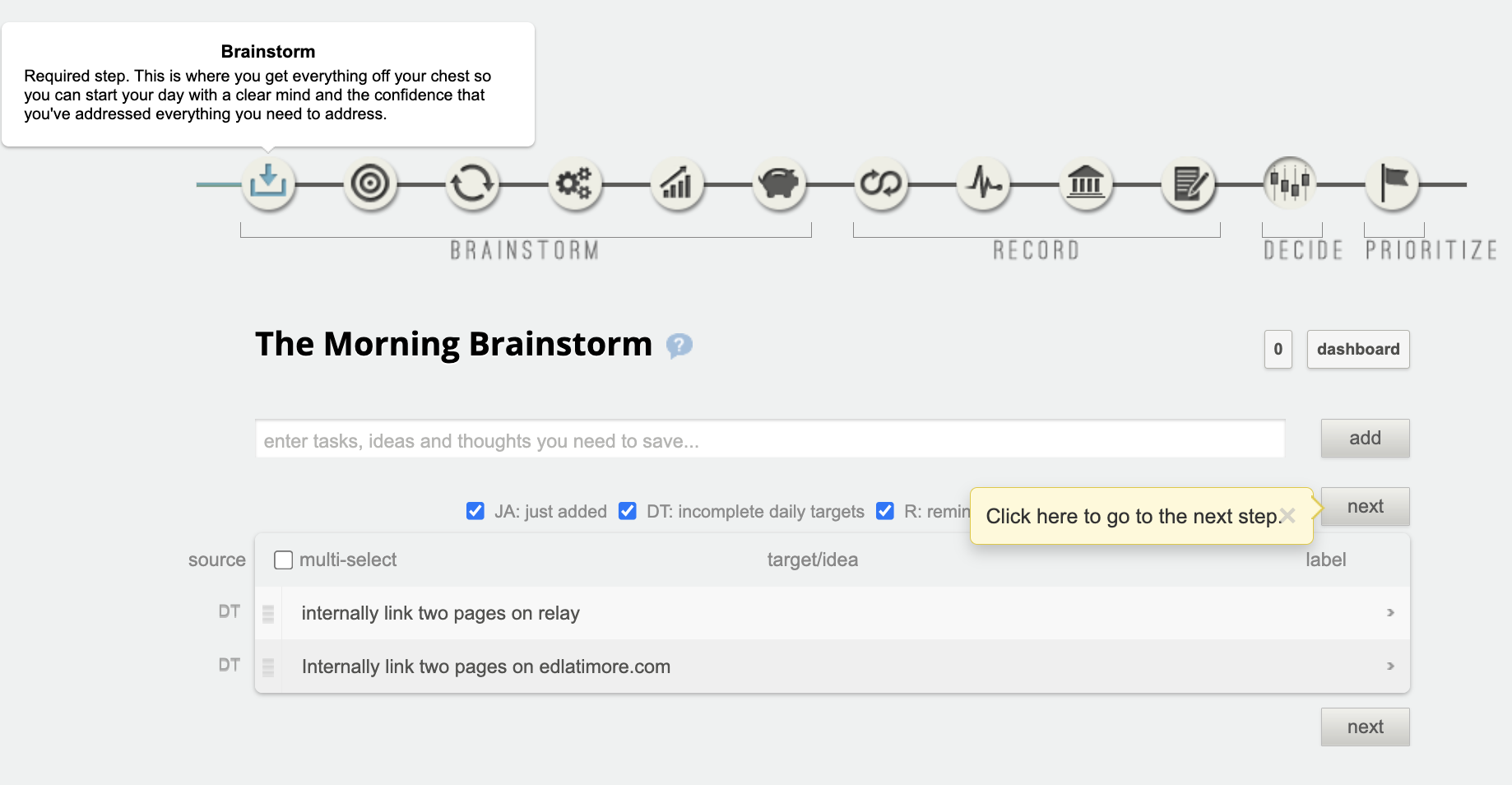
It’s one thing to learn about focused attention. It’s another to open your daily workflow and be forced to decide whether you’ll do a task today, deliberately schedule it for later, or dump it altogether. The platform constantly nudges you toward behaving in accordance with the philosophy you’ve just learned.
Then there’s Praxis.
Praxis, the practical application of Simpleology
I think this is the piece most people underestimate
Mark tells a story about a man who spent years practicing Hapkido but froze the first time he found himself in a real fight. His point is simple: knowledge and execution are not the same thing. You can understand every principle in the world and still fail to apply it when it matters. Praxis exists to close that gap by forcing you to practice the system until it becomes habitual.
That emphasis on application changes the character of the entire course.
Most online courses are designed to transfer information. You watch the videos, finish the modules, and move on to the next thing.
Simpleology isn’t trying to maximize the amount of information you consume. It’s trying to maximize the probability that you’ll actually change your behavior. That’s a much more difficult objective, and it explains many of the design decisions that initially frustrated me.
With that said, this brings up one of my biggest complaints about the course.
My Biggest Criticism of Simpleology
You don’t receive instructions on how to use the practical applications until you go through the 21 lessons of Simpleology 101. While I understand and agree with this choice, I think Joyner underestimates how powerful it is to give people an interactive glimpse into how the program will transform them.
I get having people learn the theory, but if I were designing the program, I’d make sure that each theoretical lesson progresses along with the application of the software in Praxis. It’s way too easy to feel like you aren’t making progress or getting your money’s worth if you spend nearly the first month of the course watching short videos and working in a workbook.
The Best Parts of Simpleology
My favorite feature of the platform is astonishingly simple.
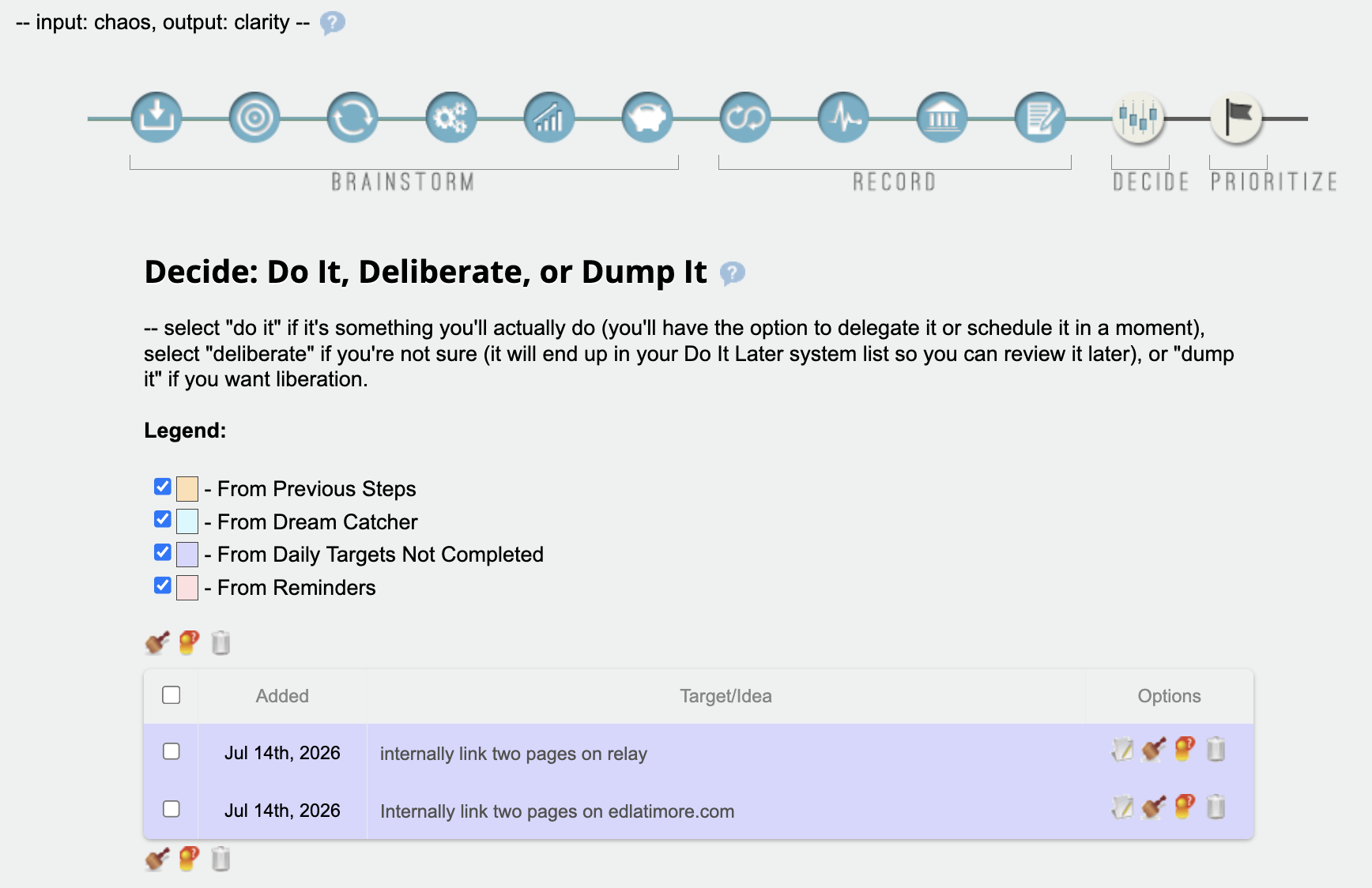
Every day, Simpleology asks you to make a decision about each task.
- Do it.
- Deliberate it.
- Dump it.
At first glance, it almost seems too simple to matter. Plenty of task managers let you create lists or assign due dates. This didn’t seem fundamentally different.
Then I realized it was solving a problem I hadn’t even recognized.
Like a lot of entrepreneurs, I have a terrible habit of leaving browser tabs open. At any given moment, I’ll have dozens of them scattered across multiple windows. An article I want to read. A product I need to research. An email I have to answer. A potential sponsorship. A scientific paper. Something I promised myself I’d come back to later.
Every open tab represented a tiny promise I had made to myself. Don’t forget this. Come back later. This is important. Individually, none of them seemed like a problem. Collectively, they created a constant sense of mental clutter. Every time I opened my browser, I was confronted with dozens of obligations competing for my attention before I had even begun working.
The irony is that the tabs weren’t helping me remember.
They were making it impossible to forget.
Simpleology gave me an alternative.
Instead of leaving a tab open because I was afraid I’d lose track of something, I could immediately capture the task inside the system. Then I had to make a decision.
If it needed to be done today, I did it. You also get the option to schedule it at a specific date and time, and you get a reminder.
If it was genuinely important but not urgent, I deliberately scheduled it for another day and even set a reminder if necessary.
If I realized I was never actually going to do it, I dumped it.
That last option was surprisingly liberating.
Most productivity systems assume every task deserves to remain on your list until it’s completed. Simpleology quietly acknowledges something most of us already know: many of the things we tell ourselves we’ll eventually do will never happen. Carrying them around indefinitely doesn’t make us more productive. It just consumes mental bandwidth.
That’s when I realized the real benefit of the workflow; it freed my attention.
Once I trusted the system to remember things for me, I no longer felt compelled to remember everything myself. When I finally sat down to work, I wasn’t greeted by a dozen competing priorities. I knew exactly what I had decided was important for that day.
As a business owner and a father, uninterrupted work time is a scarce resource. When I have an hour to work, I don’t want to spend the first fifteen minutes deciding what deserves my attention. I want to start immediately.
The Do It, Deliberate It, Dump It workflow makes that possible because the decisions have already been made.
Who Should Buy Simpleology?
After spending time with the course and using the software every day, I don’t think Simpleology is for everyone.
And that’s actually one of its strengths.
Too many productivity apps try to be everything to everybody. Simpleology has a very specific philosophy about how people should think, make decisions, and organize their lives.
If that philosophy resonates with you, I think you’ll get tremendous value from it. If it doesn’t, you’ll probably bounce off the platform before you ever see what makes it unique.
Buy Simpleology If…
- You’re constantly overwhelmed. If you wake up every morning wondering what you should work on first—or you end every day feeling busy but strangely unproductive—Simpleology excels at turning mental chaos into clear priorities. More than any feature, that’s what it did for me.
- You’re an entrepreneur or business owner. Entrepreneurs live in a constant state of competing priorities. Marketing, sales, product development, customer support, content creation, finances—there’s always another important project demanding attention. Simpleology isn’t just a place to keep track of those responsibilities. It gives you a framework for deciding which ones deserve your energy today.
- You’re juggling multiple projects at once. Whether you’re running a business, writing a book, managing clients, or balancing work with family life, the platform helps prevent important projects from getting buried beneath whatever feels most urgent at the moment.
- You constantly have fifty browser tabs open. This one was me. If your browser has become an external hard drive for your brain, you’re exactly the kind of person who will appreciate the “Do It, Deliberate It, Dump It” workflow. Once I trusted the system to remember things for me, I stopped using open tabs as reminders and started using them for what browsers are actually designed to do: browsing.
- You consume productivity content but rarely implement it. There are thousands of productivity books, podcasts, YouTube videos, and newsletters. Most of us don’t need more information about being productive—we need a system that helps us consistently apply what we already know. That’s where the Praxis training distinguishes Simpleology from almost every other productivity course I’ve encountered.
Skip Simpleology If…
- You only need a simple to-do list. If all you’re looking for is a place to track grocery items, household chores, or a handful of daily tasks, there are countless simpler and cheaper apps that will do the job perfectly well. Simpleology is trying to solve a much larger problem than managing a basic to-do list.
- You want instant results. Simpleology asks for a genuine investment of time and attention. You’ll read, write, complete exercises, and gradually build the system into your daily routine. If you’re looking for a productivity hack you can master in fifteen minutes, this probably isn’t it.
- You dislike structured learning. The course is intentionally methodical. Concepts build on one another, and the exercises are meant to be completed in sequence. If you prefer to skip around, learn by trial and error, or jump straight to the advanced features, you may find the pacing frustrating.
- You aren’t going to do the exercises. This is probably the biggest one. Simpleology isn’t something you passively consume. It’s something you practice. If you plan to watch the videos without completing the workbook, the Praxis exercises, or using the software consistently, you’re unlikely to experience what makes the system effective.
My Recommendation
Simpleology isn’t the productivity app I’d recommend to everyone.
It’s the one I’d recommend to people who have already tried the obvious solutions and still feel like they’re fighting their own minds.
If you’ve bounced from task manager to task manager, read every productivity bestseller, watched countless YouTube videos, and still find yourself overwhelmed by competing priorities, Simpleology approaches the problem from a fundamentally different angle. It assumes your biggest obstacle isn’t a lack of tools or information—it’s the habits and decision-making patterns that determine how you use them.
That’s a much harder problem to solve.
It’s also the reason I think Simpleology is worth taking seriously.
If you found this review helpful, you can sign-up for Simpleology using my link here. I’ll get a small commission at no extra cost to you.