My review of the Moment: Urge & Habit Control

Own The Moment Review highlights
- What it does: Moment helps you quit porn and break bad habits by identifying your triggers and guiding you through urges.
- What stood out to me: Personalized check-ins, an interactive journal, and breathing exercises give you specific actions to take when temptation hits.
- Porn blocking: It blocked every adult site I tested, but its DNS filter won’t catch all explicit content on social media or other mixed-content platforms.
- After a setback: Rather than just resetting a streak, Moment helps you examine what happened and adjust your plan.
- Price: Free to download; full features cost $8.99/month or $49.99/year.
- Availability: Currently available on iPhone in the United States.
- My verdict: I recommend Moment if you want practical help managing urges. I think of it as a “sponsor in my pocket.”
Introduction
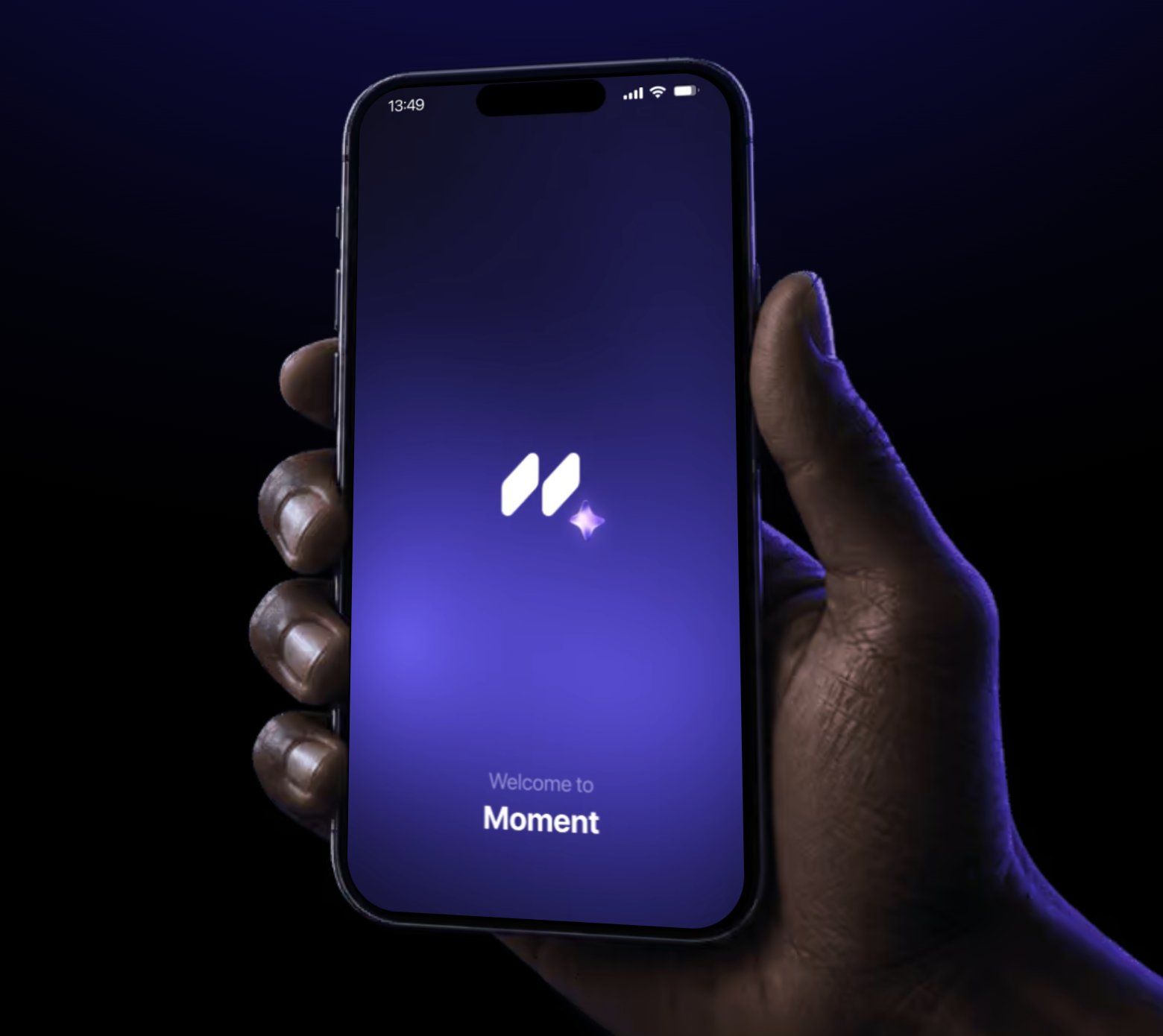
Moment is a fascinating new player among apps designed to help men quit porn. Rather than having you sign up for a course or join a cohort, or learn about the psychology of compulsive behavior, the Moment app takes a different approach.
I’ve worked with companies in this space and used their products, including Covenant Eyes, Quittr, and Relay.
Across the category, you’ll always find the usual suspects of features and tools such as content blockers, educational modules, accountability groups, and streak counters. Many programs also offer support rooted in religious faith.
There is a lot of value in those approaches.
Understanding your behavior and having people to lean on is incredibly useful when it comes to making change. But what many of these approaches have no been able to do is devise a system for anticipating and navigating your way through urges when they happen.
And that moment looks different for everyone.
For one person, it might come late at night when he’s alone. For another, it might follow a stressful workday, an argument, or an afternoon of aimless scrolling. Even knowing your triggers doesn’t necessarily mean you have a plan for responding to them.
Moment focuses on those individual patterns.
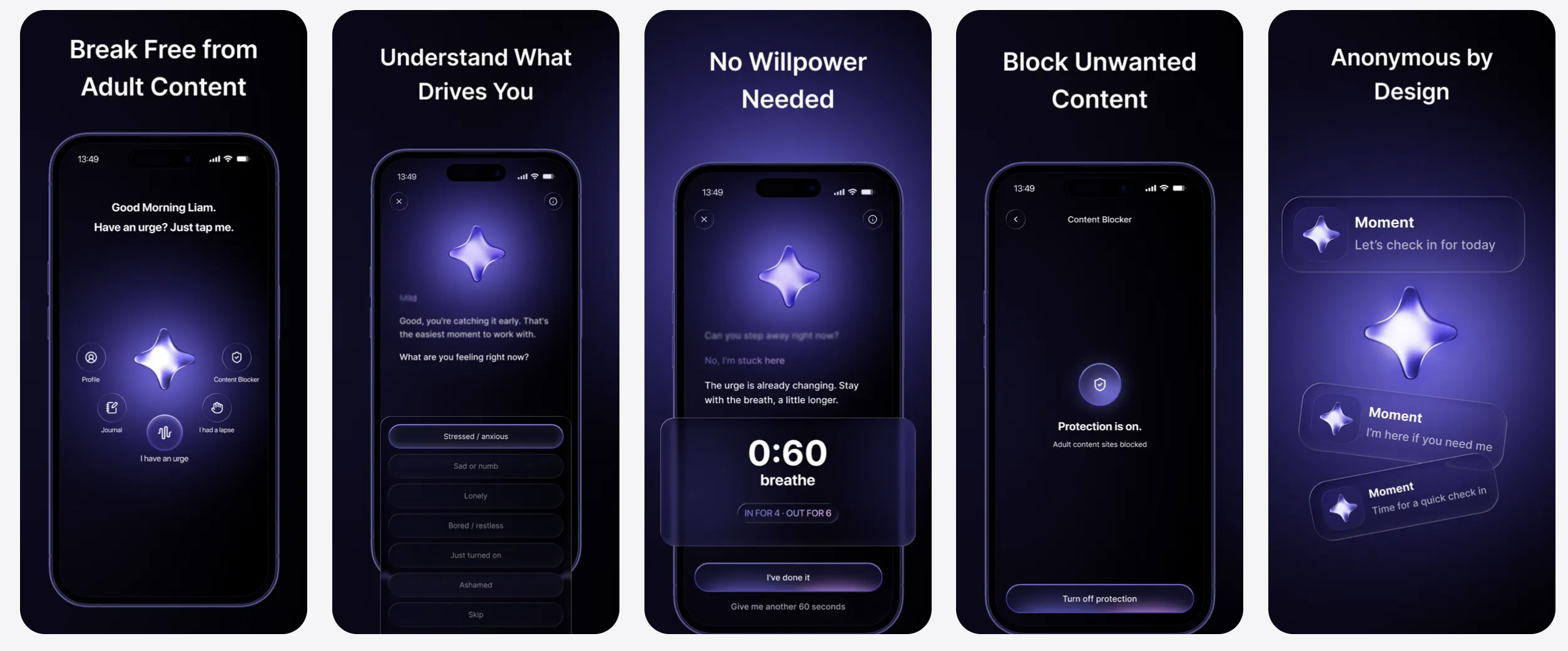
Through check-ins, an interactive journal, and practical principles rooted in behavioral psychology, the app is designed to learn from what you record about your habits, moods, and triggers.
It uses that information to help you recognize when you are most likely to experience an urge, check in with you, and guide you through those situations.
When an urge hits, you can open the app to access guided breathing and mindfulness exercises designed to interrupt the path between stimulus and action. Afterward, you use the interactive journal to reflect on what happened and use that information the next time.
The beauty of this approach is in its simplicity: recognize the pattern, interrupt the automatic response, and practice a different one.
In this Moment app review, I’ll walk through how its features work and explain the psychological principles behind the approach.
Downloading and signing up for Moment
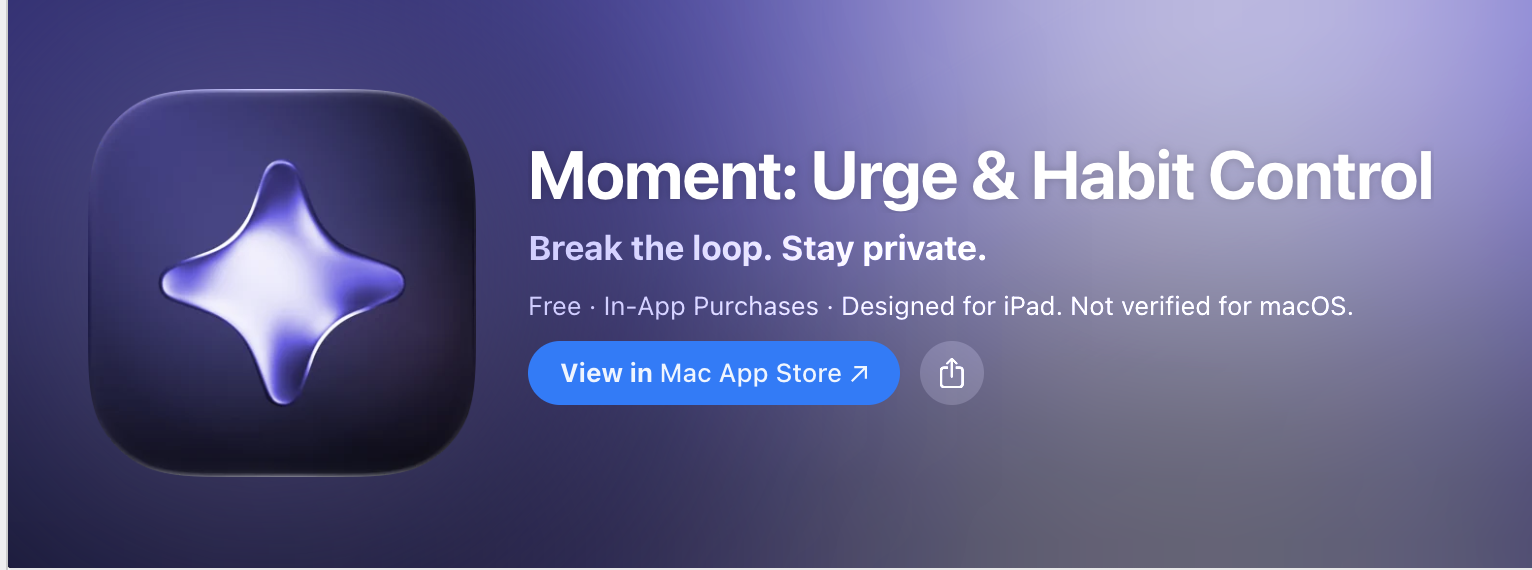
As of this writing, Moment is only available on iOS and in the United States. However, I’ve spoken to the team at Moment, and they do have plans for an Android version. However, the release date has yet to be confirmed.
Getting it set up is pretty simple. You could look for it in the Apple Store or go directly to their website to download it.
If you look it up in the Apple Store, you’ll need to search specifically for“Moment: Urge & Habit Control” by OTM App LLC. There are a few other apps named Moment, so make sure you get the right one.
The app requires iOS 16.0, which shouldn’t be a problem as that version of iOS is over 4 years old at this point. It’s also worth noting that while there are no graphics or description of anything graphic, the app does carry an 18+ age rating..
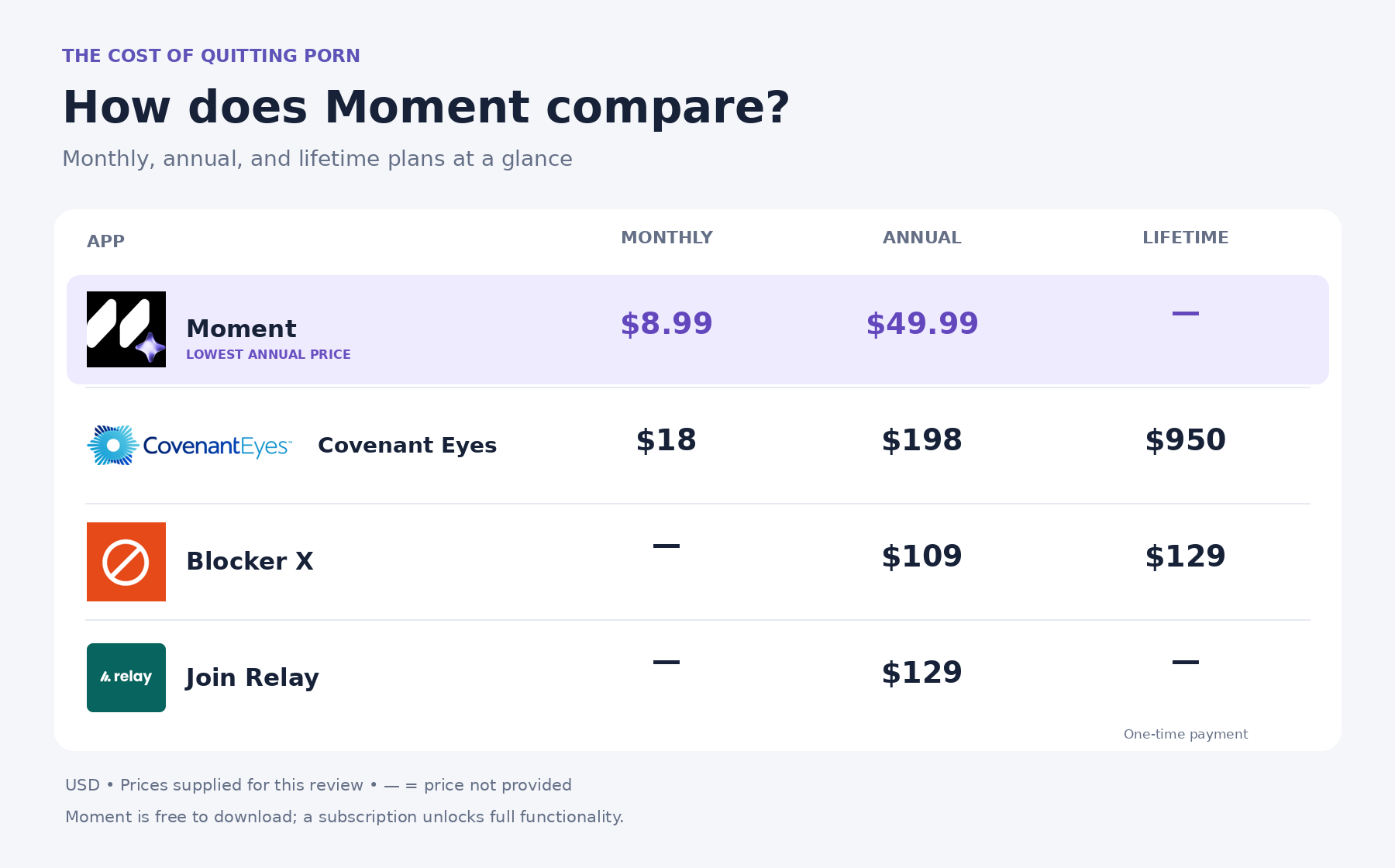
Moment is free to download, with a subscription listed at $8.99 per month or $49.99 per year.
Like every other app in the Apple Store, payments are processed through your Apple ID, and you can manage or cancel your subscription in your Apple account settings. Subscriptions renew automatically unless canceled at least 24 hours before the current billing period ends.
There isn’t much to the free version but an assessment of your triggers and progress. Full functionality isn’t unlocked until you sign up for one of the subscription plans. Compared to other apps in the space, Moment is quite a discount.
For comparison:
- Covenant Eyes: $18 per month, $198 per year, or a one-time lifetime payment of $950
- Blocker X: $109 per year, or a one-time lifetime payment of $129
- Join Relay: $129 per year
Navigating The Moment App
The app has an incredibly simple navigation screen.
There are only five icons, and one of them is just for checking out your profile. Below I’ll go over each feature.
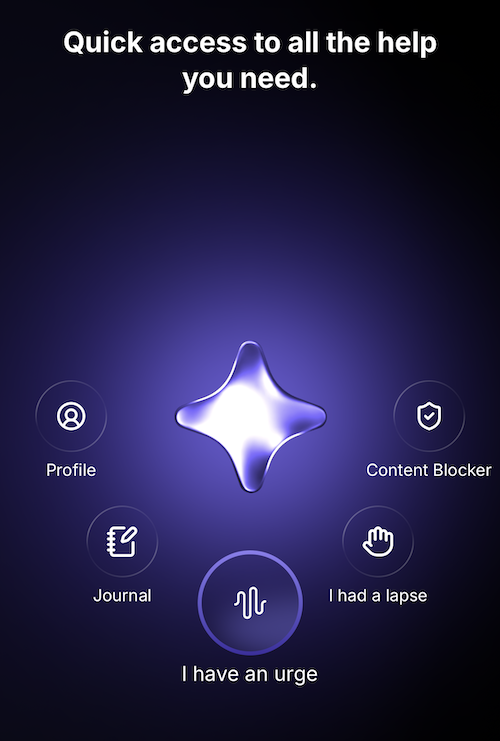
Profile
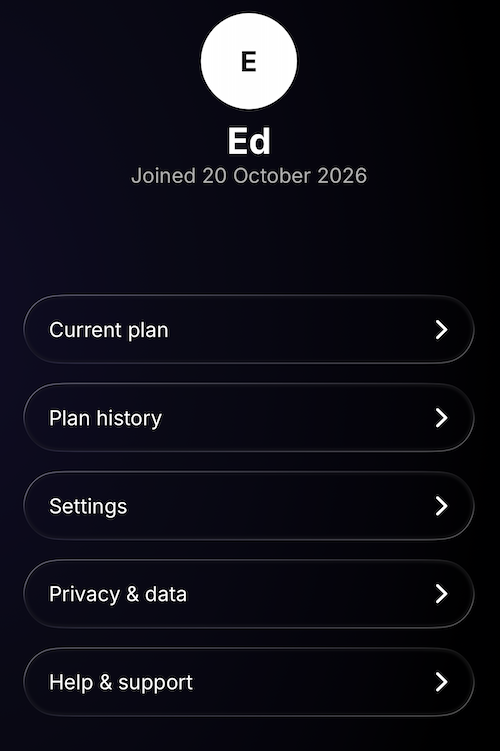
Current plan
The Current Plan section puts your risk window, triggers, and next steps in one place. In my example, it flags 6–10 p.m. as a moderate-risk period and identifies anger or frustration as a trigger.
It also gives you a simple response if an urge hits: leave the room, open Moment and tap “Help me now,” then breathe for 60 seconds.
You’ll also find a scheduled check-in, your chosen intervention—like a 12-minute walk—and a reminder of what you want back. In my case, that’s control over my attention.
I figure the idea here is to have a plan ready before the urge arrives, so you have specific actions to follow when it does, and the motivation to stay committed.
Plan history
Plan History shows when your plan started, how it was created, and when it was last modified.
Moment explains that it adjusts your existing plan as it learns about your patterns, with the “Last adapted” date reflecting those updates.
This is one of the more unique things about the app and what makes Moment stand out.
As you work with the app, the app learns about you. It’s nice to get feedback from the app and have it make changes as you grow.
After all, I’d imagine that the support you need after a 4-month streak is different than what you need after 4 weeks. And that will be different from what you need when you’re four days into this changing your habits.
Settings
Settings allows you to control when and how often Moment checks in with you.
You can adjust how far ahead of your risk window—the window when you’re most likely to be tempted—to receive a prompt, toggle daily journal reminders, and enable discreet lock-screen text. You can also turn on a weekly review and choose its day and time.
Moment says it respects your chosen prompt frequency across all risk levels. However, you can still open the app for support whenever you need it.
This is why I like to think of the app as a “sponsor in my pocket.”
It’s there whenever you need to check in, but it’s also checking in on you. I’ll reiterate this at the end, but part of getting the most out of this app is making sure your notifications are turned on.
You won’t need to remember to check the app. The app will just check on you.
Also included in this section are items you’d expect in an app’s settings section: your name, an optional gender setting, account details, and subscription controls.
Privacy and Data
The Privacy and Data section lets you see what Moment stores about you, gives you the option to export your records, review your consent choices, or delete your account.
The information shown includes your age range, risk window, triggers, chosen intervention, and account details.
You can also individually revoke consent for health data, product analytics, research, anonymized trends, and approximate location.
For an app dealing with something this personal, having these controls clearly accessible is a thoughtful touch.
Help and Support
The Moment app recognizes that it’s not a qualified health entity, so if you have any pressing mental or physical health needs, they offer the contact information for 911, the Suicidie and Crisis Lifeline, and The Crisis text line.
I didn’t even know that The Crisis support team had a text line.
I don’t think many people do, but it’s good to know that if your habits push you close to harming yourself or others, Moment provides a way for you to quickly get in contact with someone who can help.
This section also includes a way for you to reach out ot the technical support team for any issues with the app functionality.
Content blocker
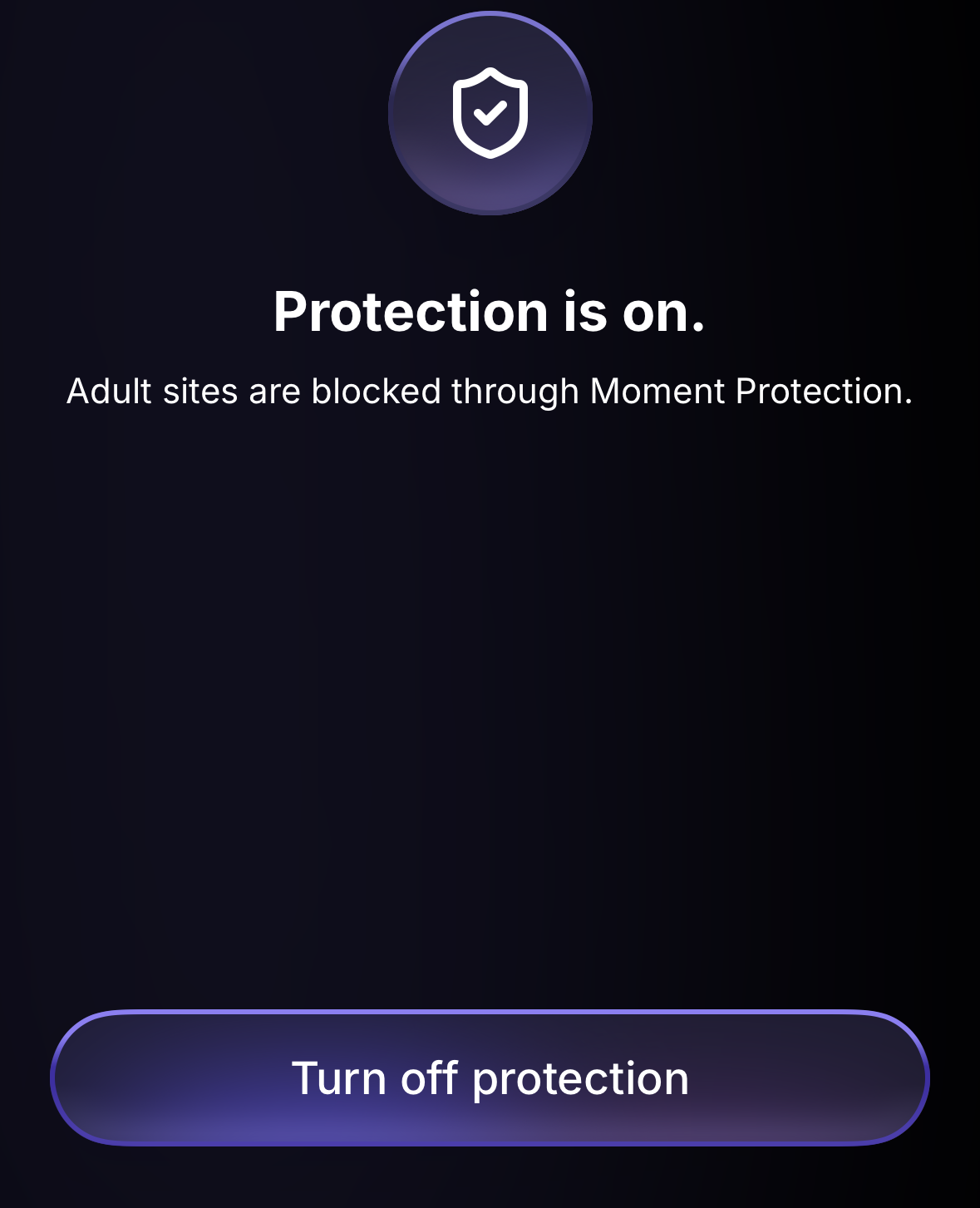
Moment includes a DNS content blocker that you enable through your iPhone’s settings.
DNS stands for “Domain Name System.” Think of it as the internet’s address book. When you enter a website’s name, your phone uses DNS to find the numerical IP address it needs to connect to that website.
Moment Protection puts a checkpoint in that process. Normally, a DNS service helps your phone find the website. With filtering enabled, it will refuse to provide a usable address for a blocked domain, keeping the site from loading.
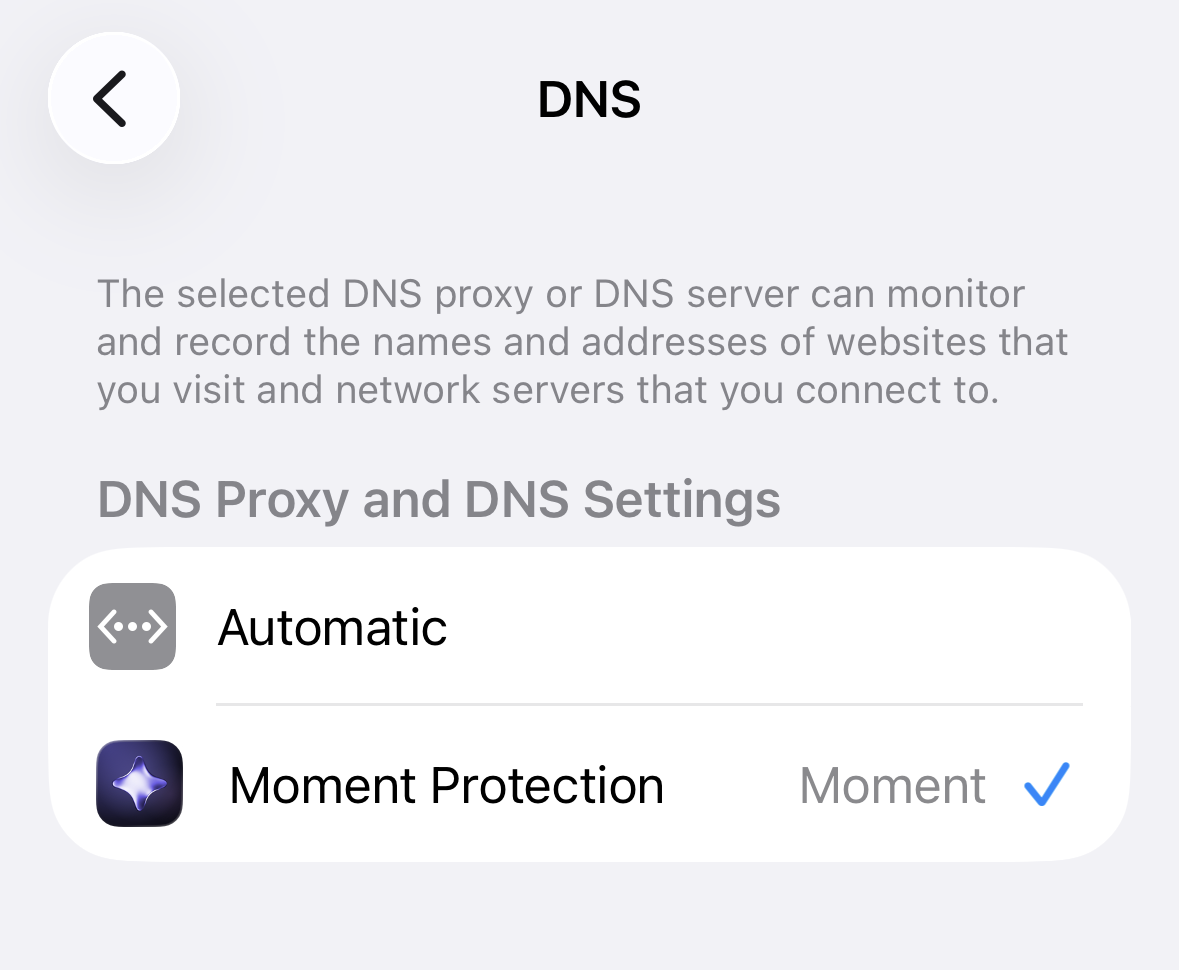
Moment likely identifies adult websites by checking their domains against a regularly updated list.
These types of lists can draw on automated website scanning, existing categorization databases, and human reports or reviews. I haven’t confirmed which sources Moment uses, so this is my best guess of how its DNS protection works.
I bring this up because DNS blocking isn’t guaranteed to filter every possible piece of adult content you could access. It also won’t stop you from seeing images that could trigger you. But DNS blocking will stop you from visiting explicitly pornographic sites.
DNS filtering checks the website’s domain—the address, such as “example.com”—rather than examining every image, video, or individual page you open. It can block an entire website categorized as adult content, but it may miss explicit material on platforms that also host ordinary content.
I tested Moment Protection myself by trying to visit several adult sites after enabling it. It blocked every one I tried. The sites simply wouldn’t load.
It’s important to remember that, as of this writing, you won’t receive a message reminding you that Moment is blocking a site. It just won’t load. If you forgot you had enabled content filtering, you might think your internet connection has crashed.
However, when you sign up for something like Moment, you’re trying to avoid these sites to begin with. Think of this as providing a working barrier between an urge and giving in to it.
This is especially useful for teens who access pornographic material on their phone.
Combined with Moment’s tools for identifying triggers and responding to urges, it gives you another way to interrupt the habit.
Journal
This is where I think Moment gets at something fundamental about behavior change: understanding what happens before the behavior you want to stop.
“I need to stop watching porn” identifies the goal. But it doesn’t tell you when you’re most likely to feel the urge to watch, what the circumstances or feelings you experience beforehand are, or which interventions actually help.
Moment’s interactive journal gives you a way to compile all of that information—and what you record influences how the app responds to you.
There’s research that supports this approach to behavior modification.
Psychologists call this self-monitoring: deliberately observing and recording your behavior or progress.
A 2016 meta-analysis examined 138 experimental studies involving 19,951 participants. Researchers found that interventions encouraging people to monitor their progress improved goal attainment, with larger effects when people recorded the information rather than simply keeping track mentally.
Moment’s journal gives you a place to apply that principle to your urges and the circumstances surrounding them.
Recording an urge close to when it occurs also leverages another psychological principle: ecological momentary assessment.
Ecological momentary assessment is a method for collecting information about people’s experiences as they go about everyday life. A major review explains that this approach helps reduce reliance on memory and allows researchers to examine how behavior changes across situations.
In other words, you’re recording the details while they’re still fresh.
- Where were you?
- What had just happened?
- Were you bored, frustrated, lonely, or tired?
- What did you do next?
Over time, those entries can give you something more useful than “I always end up doing this.” You might start noticing, “The urge often shows up when I’m alone after a stressful day,” or “Leaving the room seemed to help.”
The journal helps you see patterns and provides a specific goal and strategy for dealing with urges.
Naming your emotions has also been shown to be tremendously valuable in the battle against bad habits.
A 2007 laboratory study found that putting emotions into words reduced activity in the amygdala, a brain region that helps detect emotionally significant situations and generate emotional responses.
This matters because uncomfortable feelings can make you want relief immediately. If porn is how you usually get that relief, stress, loneliness, or boredom can trigger the habit before you’ve thought through what you need.
Naming the feeling—“I’m stressed” or “I’m lonely”—can turn down the emotional intensity. With less pressure to act immediately, you have a better chance to choose a response that addresses the feeling instead of automatically turning to porn.
Moment produces the same effect. It offers a possible explanation for why identifying what you feel could be useful.
The Journal and Your Pattern sections are the opportunity to turn repeated experiences into information you can act on.
If frustration keeps appearing before an urge, you can plan for frustrating days or, even better, take steps to not experience frustration at all.
Likewise, if taking a walk works better than calling a friend, then you know your specific game plan.
“I Have An Urge”
If the journal helps you understand your patterns over time, “I Have An Urge” arms you with the tools to do while the urge is happening.
In the sequence I went through, Moment asks how intense the urge is, what triggered it, how I’m feeling, and where I am. It then guided me through specific actions: stand up, notice and relax tension in different parts of my body, and spend 60 seconds breathing.
If I need more time, I can request another minute. There’s also an option to ask for a different exercise.
From a behavior-change standpoint, this makes sense: you get a concrete response to practice at the point when you might otherwise fall into your usual behavior.
Research into habits also supports this approach.
In their review Psychology of Habit, psychologists Wendy Wood and Dennis Rünger describe how repeating a behavior in a particular context can make that response increasingly automatic. The circumstances become cues for what you usually do next.
Moment’s sequence creates an opportunity to interrupt that familiar progression, and then create a different response. You notice the urge, identify the circumstances, and follow a different set of actions.
Standing up alone won’t erase a habit, but it gives you an immediate first step.
The questions also bring attention to what’s happening. “I want to watch porn” becomes a more specific observation: “I’m stressed, I’m alone, and something on my phone set this off.” As with the journal, that’s information you can use when planning how to handle similar situations.
The breathing portion introduces another relevant technique: urge surfing.
Moment describes the urge as something that rises and falls like a wave. The idea is to notice the experience and allow it to change without immediately acting on it. You practice experiencing an urge while choosing your response.
A 2009 randomized study tested brief mindfulness instructions based on urge surfing in 123 college students who smoked.
The mindfulness group smoked fewer cigarettes over the following seven days than the control group, even though the groups didn’t differ significantly in their reported urges.
This leads to an interesting insight about habit management: you can change how you respond before you notice a reduction in the urge itself.
If you finish an exercise and still feel tempted, that doesn’t mean the exercise was pointless. Choosing to delay or avoid the behavior is itself relevant progress. This should change how you look at urges entirely, and make you feel better.
Progress doesn’t always look like things getting easier. It often is you getting stronger and, in your increased capacity, taking on even more.
Even without the practice of urge surfing, there is supporting research for structured breathing more broadly.
A 2023 randomized study compared five minutes of daily breathing exercises with mindfulness meditation over one month. Breathwork, particularly a technique emphasizing prolonged exhalations, produced greater improvements in mood and reductions in breathing rate.
At the end of my walkthrough, I selected that the urge had passed, and Moment indicated it would log the event.
What I like about this feature is that it turns “resist the urge” into a manageable sequence of actions. You have a first step, an exercise to follow, and the option to continue if you need more time.
“I Had A Lapse”
As with everything challenging in life, it’s all about what happens after you experience a setback.
Moment’s “I Had A Lapse” feature is the tool you’ll use if you experience a relapse. It opens with reassurance and explains that the goal is to find the earliest point where the next chain of events can be interrupted.
During my walkthrough, it asked what triggered the urge, what made access easy, where I was, which device I used, and whether it happened once or continued. The sequence also included an answer about rationalizing the behavior because a streak had already been built.
Moment then asks you to choose an action.
The options shown included moving your phone out of the bedroom, walking before your risk window, or texting a support person. At the end, it displays the chain you’ve described and says your plan has been updated.
The main idea here is that a setback has a sequence you can investigate to increase the chances of it not happening again.
This is similar to an approach developed by psychologists G. Alan Marlatt and Judith Gordon called cognitive-behavioral relapse prevention. The idea is simple: understanding what led to a slip helps you prepare a better response next time.
That means looking at the circumstances, feelings, and thoughts that came before it. Were you stressed? Alone? Scrolling in bed? Were you expecting porn to help you relax? Each answer reveals a place where you could interrupt the pattern, such as keeping your phone outside the bedroom or finding another way to manage stress.
The model also explains why your reaction afterward matters.
Thinking “I’ve failed, so there’s no point trying” can turn one slip into a continued return to the habit. Marlatt called this the “abstinence violation effect.” Examining what happened and making a specific plan gives you a better way to move forward.
That’s how Moment’s reflection process fits this approach: it encourages you to use what happened to prepare for the next difficult moment.
Moment’s response appears intended to keep you engaged long enough to learn from what happened and take a corrective step.
That’s the value I see in this section: it helps turn a setback into a revised plan.
Whether Moment’s particular process prevents future relapses requires testing, but its combination of reflection, a constructive response, and a specific next action has a reasonable basis in behavior-change research.
What I like about the Moment App
I’m a big fan of the Moment App’s efficiency. Rather than it being a whole program you have to commit to, it’s about preventing undesirable behavior.
Although the website says that it’s to help guys quit porn, the app can be used for any problematic habit you’re trying to stop.
The Moment App is like a sponsor in your pocket. You check in with your journal entries; it checks in with you via daily questions and notifications about your mood, and if you get too close to relapsing, the app walks you back from the edge with a series of prompts and exercises.
And, should you relapse, the app helps you identify what caused it and then adjusts when it checks in on you and gives you guidance based on your environment and mood.
It’s also nice that despite taking a radically different approach than most of its competitors, the Moment App didn’t completely skip out on the content blocker. Keep in that DNS is good, but it has its limitations.
Because it filters by website rather than content, it’s entirely possible for you to end up viewing content that is triggering on a site that isn’t inherently adult, but that’s up to you to exercise discipline and use the app to help manage and control those urges.
What I don’t like about the Moment App
The app is currently only available on iOS, but this will likely change. Rarely do these types of useful apps remain in one operating system.
The content blocker is effective, but it only works on your phone. I spoke to the team at Moment, and there are plans to make sure the blocking covers your laptop as well, but at the moment, it would be easy to circumvent. But again, this is where using the app to modify your behavior—rather than just block it—is essential.
From a technical standpoint, the app doesn’t perfectly respond to your answers. For example, when I told that I was at my computer when I had an urge, all of the options for my next step involved something with my phone.
Many times during the check in, the app will assume I’m having a urge, and take me through the urge prompt. In theory, I get this. If it’s learning when I’m mostly likely to be triggered, it mkes sense that when it chimes in to check on me, that I’m dealing with an urge.
In practice, I suppose it’s a little presumptive but that is only a minor annoyance.
I recommend downloading the Moment App
The Moment App is excellent, not just for quitting porn but also for getting control of any other bad habits you want to tackle.
Also, the app naturally pairs with whatever method you’re currently using.
You can use it on its own or with courses, programs, and interventions.
If you have an iPhone, sign up and download the app today.