How Mind Lab Pro Improves Reaction Times And Athletic Performance

When it comes to athletic supplements, companies make many promises. But—to their credit—many of them actually deliver.
Creatine helps you get stronger and get more out of your training. Pre-workouts—stim or non-stim—can amp you up in the gym and boost your energy. Protein powder helps you reach your macros and build muscle. And if you throw in ingredients like L-citrulline, arginine, or taurine, you’ll even get a nice pump while you’re training.
Despite the supplement industry not being tightly regulated by the Food and Drug Administration (FDA), you can still find effective products if you do a bit of homework and stick with reputable brands.
Just because something isn’t FDA-regulated doesn’t mean it’s ineffective. Many supplements have a long body of research supporting their benefits—the FDA simply doesn’t regulate them the way it does pharmaceutical drugs.
For athletes competing under the rules of the World Anti-Doping Agency (WADA), there’s another layer to consider: anything you take has to be legal in competition. I sometimes joke with people in the training world that if you want to know whether something really works, check whether it’s banned by WADA.
All of this highlights an interesting gap in the supplement world, and one that I dealt with during my boxing career.

There are plenty of substances—both legal and banned—that improve physical performance. But when it comes to improving the mental side of athletic performance, the options are surprisingly limited.
And that’s strange, because your personal best is won in the mind before it ever shows up in your body.
Split-second decisions. Clean technique under fatigue. Staying composed when your heart rate spikes and your lungs are burning. These are mental skills just as much as physical ones.
I’ve always said that your mind will quit long before your body does—and research backs this up.
In one well-known endurance study, athletes who completed 90 minutes of mentally demanding work before cycling reached exhaustion much faster than those who didn’t. Their time to exhaustion dropped by about 15% simply because their brains were fatigued (Marcora et al., 2009).
Mental fatigue can directly limit physical performance.
This is where nootropics come in.
For athletes, the goal isn’t sketchy stimulants or banned performance enhancers. The goal is supporting the cognitive systems that drive performance in the first place—focus, reaction time, motivation, and the ability to stay calm under pressure.
Recently, I came across Mind Lab Pro, a nootropic supplement that combines several ingredients shown to support faster reaction time, clearer thinking, and mental endurance during training—all while remaining safe and compliant with WADA rules.
What Is Mind Lab Pro?
Mind Lab Pro® is what the nootropics industry calls a “universal nootropic.” Instead of targeting just one cognitive function—like memory or focus—it’s designed to support multiple brain systems simultaneously.
For example, caffeine-based formulas focus almost entirely on stimulation and alertness. Memory-focused supplements often rely heavily on compounds like bacopa monnieri or ginkgo biloba to support recall and learning. Others, such as L-theanine products, are primarily used for relaxation and stress reduction.
Each of these can be useful, but they only address one piece of the cognitive puzzle. Athletic performance, on the other hand, depends on several mental systems working together—focus, reaction time, mental energy, motivation, and composure under pressure.
Mind Lab Pro aims to support all of those at once.
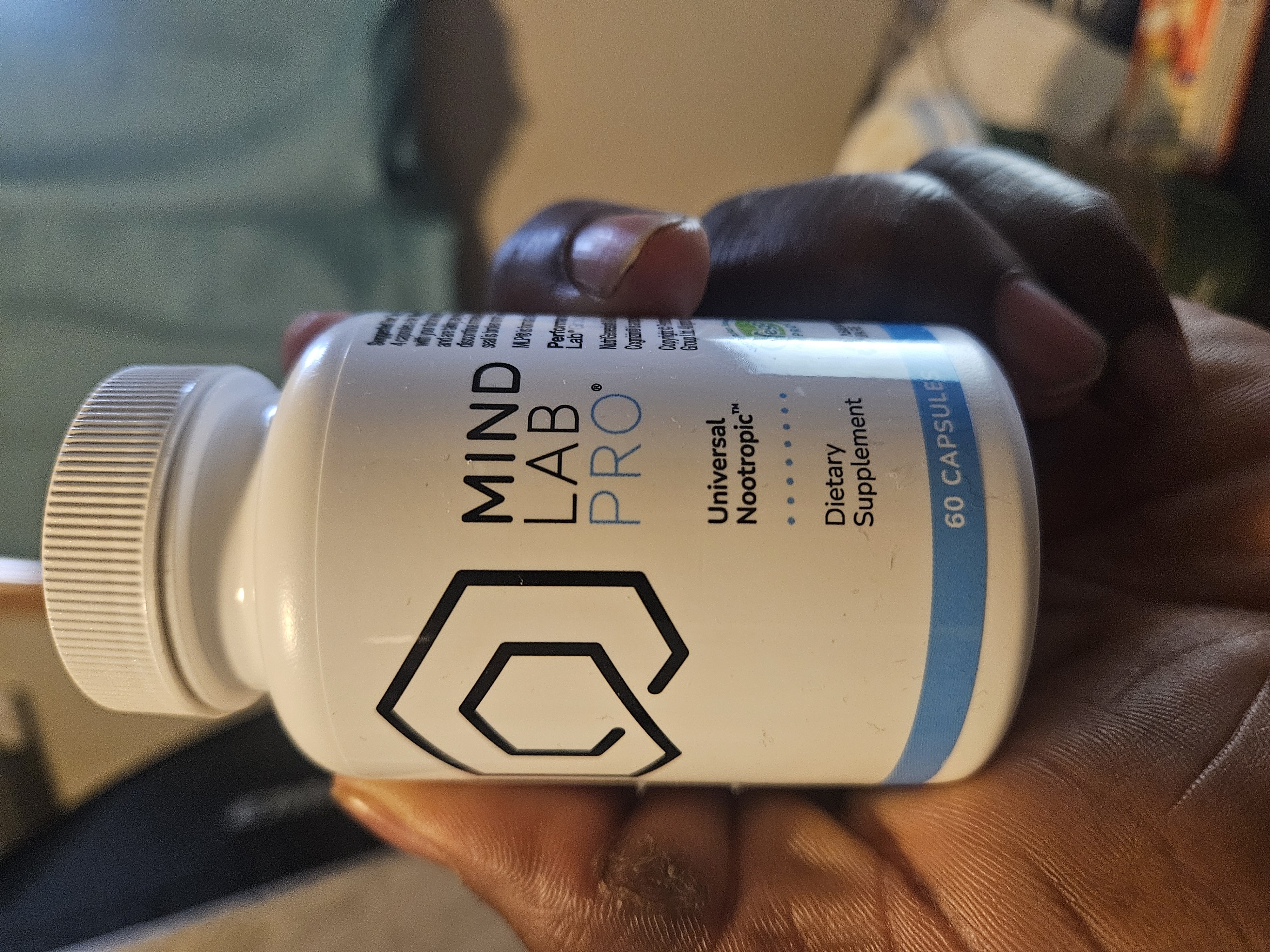
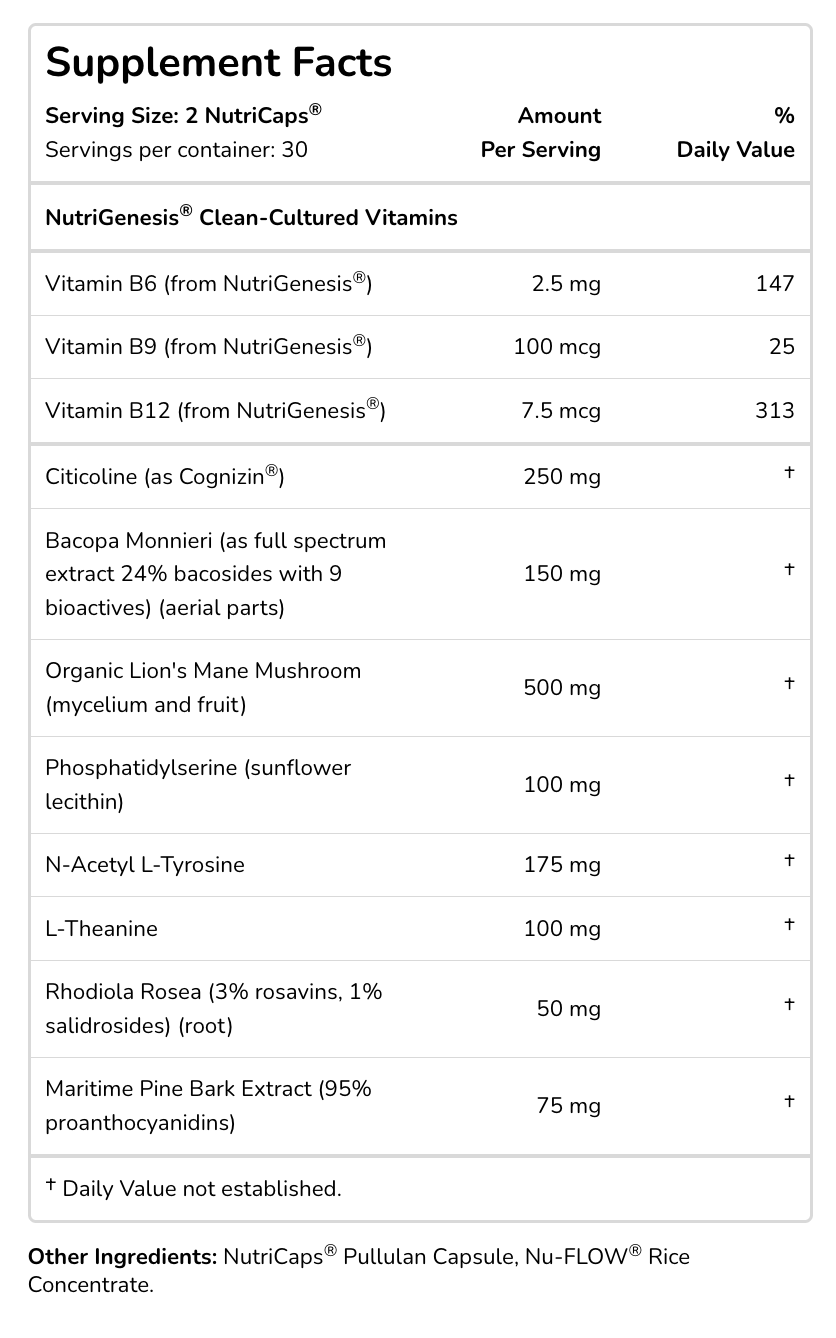
The supplement uses a stack of 11 research-backed nootropic ingredients, including compounds like citicoline, lion’s mane mushroom, bacopa monnieri, phosphatidylserine, L-theanine, N-acetyl L-tyrosine, rhodiola rosea, and maritime pine bark extract.
These ingredients work on different neurological pathways—supporting neurotransmitters, brain energy metabolism, neuroplasticity, and stress resilience.
In other words, instead of acting like a stimulant that simply forces the brain into overdrive, Mind Lab Pro is designed to optimize the biological systems that allow the brain to perform at its best in the first place.
Another important detail—especially for athletes—is that Mind Lab Pro is stimulant-free. There’s no caffeine or harsh stimulants in the formula. Instead, it relies on compounds that support sustained cognitive performance without the crash or jittery feeling associated with typical energy supplements.
This is particularly useful for sports that require calm focus and precision rather than pure stimulation.
From a research perspective, Mind Lab Pro is also unusual among nootropic supplements because the finished formula—not just the individual ingredients—has been tested in human clinical studies.
Multiple double-blind, placebo-controlled trials have examined its cognitive effects. In one study, participants taking Mind Lab Pro showed significant improvements in reaction time, information processing speed, and anticipation during cognitive testing.
Another randomized controlled study found that four weeks of supplementation significantly improved several types of memory, including auditory memory, visual memory, working memory, and delayed recall, compared to the placebo.
Across these studies, researchers have reported improvements such as:
- Faster information processing
- Better reaction time and anticipation
- Improved short- and long-term memory
- Stronger communication between brain regions measured by EEG
Taken together, these results suggest that Mind Lab Pro may support the types of cognitive abilities that directly influence athletic performance—fast thinking, mental endurance, and the ability to stay sharp under stress.
For athletes looking for a legal, research-backed cognitive performance supplement, that combination makes Mind Lab Pro stand out from most products in the nootropics category.
Before looking at how Mind Lab Pro has done in the laboratory settings and covering my own experiences, I want to dive into exactly how a nootropic improves other parameters of your performance.
Grab a bottle of Mind Lab Pro here
Nootropics and the Mind–Body Connection Necessary for Athletic Performance
Can nootropics improve athletic performance—even if their primary role is cognitive?
Yes.
Competitive sport is just as much mental as it is physical. In many cases, the psychological battle before competition matters just as much as the execution during it. Focus, composure, decision-making, and emotional control all shape what you’re able to do with your body.
Athletes often describe peak performance as being “in the zone.” It’s that state where everything feels automatic—your reactions are quicker, your movements are cleaner, and you’re not overthinking anything. You’re just responding.
There’s a neurological basis for that state.
When athletes are “in the zone,” brain activity tends to shift toward alpha and low-beta wave patterns—a balance between relaxed awareness and active focus. Too much high-beta activity (which is associated with stress and overthinking) can make you tense, reactive in the wrong ways, and mentally cluttered. Too little activation, and you’re sluggish or disengaged.
The sweet spot is controlled alertness: calm, but ready.
This is where different cognitive systems—attention, emotional regulation, motor coordination, and timing—start working together efficiently. When that happens, trained movements require less conscious effort. You’re not thinking through each step. You’re executing.
And because the brain controls all movement, any inefficiency at the cognitive level shows up physically. Mental fatigue slows reaction time. Stress disrupts coordination. Overthinking delays decisions.
That’s why the idea of cognitive support for athletes isn’t just theoretical—it’s practical.
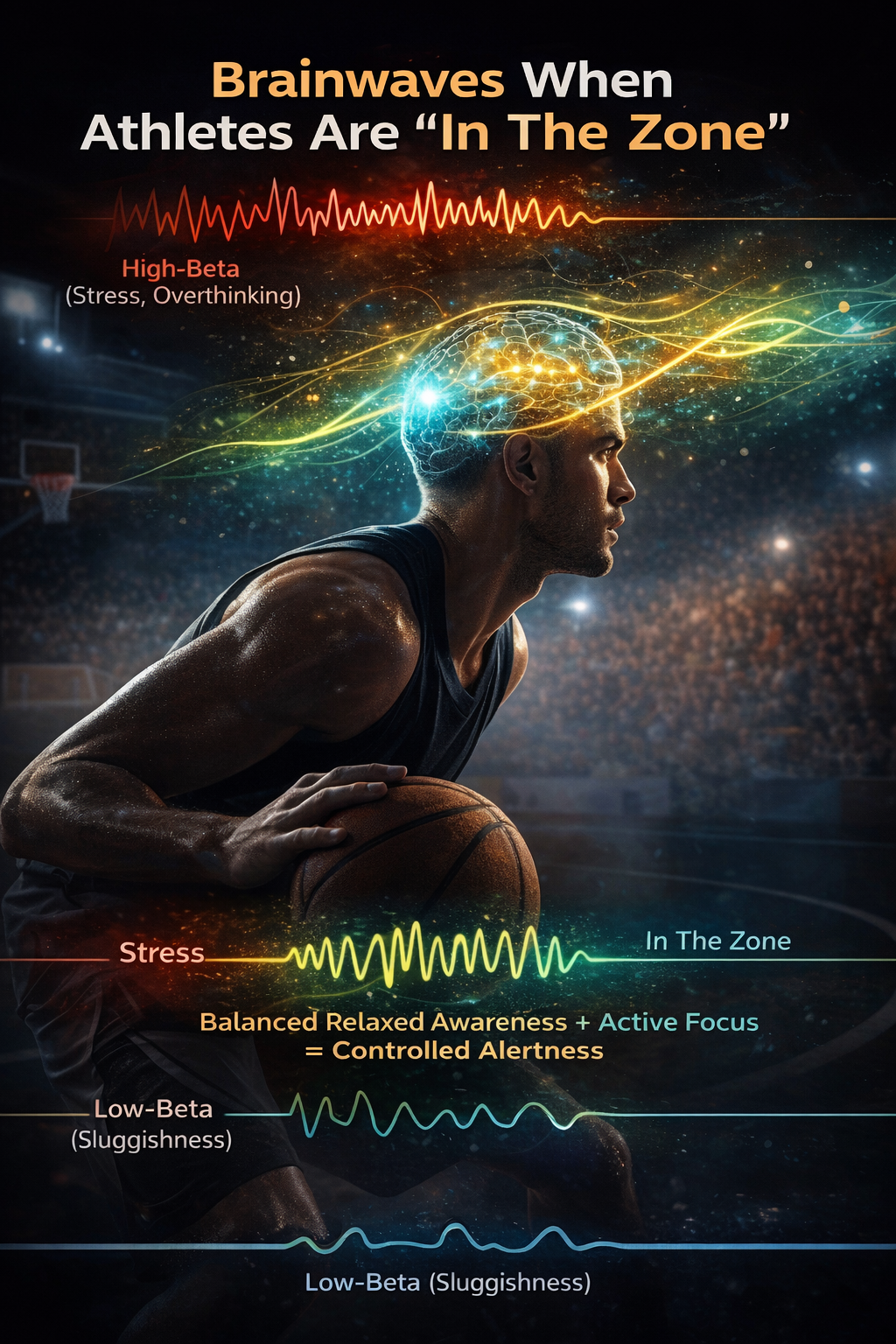
The right nootropics can help support this “zone” state by influencing the systems that regulate focus, stress response, neurotransmitter balance, and brainwave activity.
Mind Lab Pro uses a variety of ingredients to achieve this. For example:
- Ingredients like L-theanine are known for promoting relaxed focus—helping reduce excessive mental noise without causing sedation.
- Compounds such as citicoline and tyrosine support neurotransmitters involved in attention, motivation, and decision-making.
- Adaptogens like rhodiola rosea can help regulate stress response, which is critical for staying composed under pressure.
The goal isn’t stimulation for the sake of stimulation. In fact, too much stimulation can push you out of the zone.
The goal is efficient brain function—a state where you’re alert, focused, and calm enough for your training to express itself without interference.
Not all nootropics improve athletic performance. But the best ones support the mental systems that allow physical performance to happen in the first place: focus, reaction time, emotional control, and the ability to stay locked in when it matters most.Energy and Stamina
Without sufficient energy, athletes simply cannot perform.
All physical and cognitive activity ultimately depends on cellular energy production, primarily ATP. When energy levels are low—whether from poor sleep, overtraining, or mental fatigue—both physical output and decision-making decline.
Many athletes turn to stimulants for a quick energy boost. While stimulants can temporarily increase alertness, they often work by forcing the nervous system into a heightened state of activation. Over time, this can increase fatigue, disrupt recovery, and in many cases violate anti-doping rules.
Effective nootropics take a different approach. Instead of forcing stimulation, they support the biological systems that produce energy in the first place. By improving mitochondrial efficiency, supporting neurotransmitter production, and increasing cerebral blood flow, certain nootropics may help sustain both mental and physical stamina during training and competition.
Motivation and Intensity
Even highly disciplined athletes go through periods where motivation drops and training starts to feel like going through the motions.
At the neurological level, motivation is tied to dopamine and norepinephrine, but it also shows up in brainwave activity. When motivation is high, the brain tends to operate in a stable beta range—alert, engaged, and ready to act. When motivation drops, activity can shift toward lower-frequency patterns, which is where that sluggish, low-drive feeling comes from.
There’s also the opposite problem. Too much high-beta activity, which is associated with stress, can make you feel wired but unfocused. You have energy, but it’s scattered and hard to direct.
The ideal state for training is controlled activation. You want enough beta activity to drive effort and intensity, but without tipping into stress or mental overload. Some nootropics support this by improving catecholamine signaling and overall brain energy. When the brain can sustain that balanced activation, motivation becomes more consistent and less dependent on willpower alone.
Discipline matters, but it still depends on the systems that make sustained effort possible.
Attention and Multitasking
High-level sports demand more than focus. They require the ability to process multiple streams of information at once while still executing with precision.
Athletes are constantly tracking movement, spacing, timing, and positioning. At the same time, they’re performing trained actions without consciously thinking through each step. That only works when the brain is operating in the right state.
This is where brainwave balance becomes important. Performance tends to be strongest when alpha and low-beta activity work together. Alpha helps reduce mental noise and filter out irrelevant information, while low-beta supports active focus and decision-making.
If beta activity gets too high, especially under pressure, it can lead to overthinking and hesitation. If activation is too low, processing slows down and reactions lag. The zone sits between those extremes. You’re calm enough to stay composed, but active enough to respond quickly and correctly.
Nootropics that support working memory and information processing can help maintain that balance, making it easier to stay locked in on what matters while ignoring distractions.
Stress Management
Training and competition place real stress on both the body and the brain.
One of the clearest effects of stress is a shift toward high-beta brainwave activity. This is the state associated with anxiety, tension, and reactive behavior. It can be useful in short bursts, but when it sticks around, it interferes with timing, coordination, and decision-making.
At the same time, intense training activates the HPA axis and raises cortisol levels. Chronically elevated cortisol can impact recovery, mood, and cognitive performance. Physical exertion also increases oxidative stress, which contributes to long-term strain on the body.
To perform consistently, athletes need to be able to come down from that high-beta state and return to a more controlled level of activation. That’s where alpha and low-beta activity come back into play, allowing for composure and precision under pressure.
Some nootropics support this by helping regulate the stress response and promoting a more stable mental state. Others provide antioxidant support that helps counteract the physical demands of training.
The goal is not to feel relaxed in the sense of being slow or disengaged. It’s to stay composed, clear-headed, and responsive when the pressure is high.
All of these systems—motivation, attention, and stress regulation—come down to how efficiently the brain shifts between different states.
Performance isn’t just about effort. It’s about being in the right state at the right time, and having the control to stay there when it matters.
Mind Lab Pro Ingredients Overview
Mind Lab Pro is built around a simple idea: athletic performance is not just about physical output. It is also about how well your brain can generate energy, stay focused, manage stress, and make fast decisions under pressure.
That is why the formula does not rely on one flashy ingredient. Instead, it uses a stack of compounds that target multiple areas of cognitive performance simultaneously.
At a high level, citicoline, phosphatidylserine, and the B vitamins help support brain energy, neurotransmitter activity, and overall cognitive function. These are the ingredients that help keep the mental engine running.
Lion’s Mane and Bacopa monnieri are more geared toward long-term brain support, neuroplasticity, memory, and learning. For athletes, that matters because skill development is really just learning through repetition. The better your brain is at wiring and reinforcing patterns, the better you can ingrain technique and react without hesitation.
N-Acetyl L-Tyrosine and Rhodiola rosea are especially relevant for athletes because they are tied more directly to performance under stress. They may help support catecholamine activity, mental energy, resilience, and focus when you are tired, under pressure, or pushing hard in training.
L-theanine brings a different kind of value. It is not there to hype you up. It is there to help smooth out mental noise and support a calm but alert state. For sports that require precision, timing, and composure, that matters more than people think.
Then you have maritime pine bark extract, which is included for its antioxidant and circulation-support benefits. Better blood flow and better protection against oxidative stress can support both brain performance and recovery from demanding training.
Taken together, the formula is designed to support multiple aspects of the mind-body connection simultaneously: mental energy, reaction speed, stress management, working memory, focus, and long-term brain health.
That broad-spectrum design is what makes Mind Lab Pro different from many nootropics that rely on just one mechanism, like stimulation or memory support.
I’m keeping this ingredient overview at a high level here because this article is focused specifically on Mind Lab Pro for athletes. If you want the full ingredient-by-ingredient breakdown, including the research behind each compound, read my general Mind Lab Pro review.
What the Research Says About Mind Lab Pro for Athletes
If you’re an athlete, the most exciting thing about the Mind Lab Pro research is not memory. It’s not mood. It’s not some vague feeling of being “more dialed in.”
It’s reaction time.
That matters because reaction time is one of the hardest performance variables to improve. Strength can be built. Conditioning can be pushed. Technique can be sharpened through repetition. But the ability to process information faster, make the right decision under pressure, and time your movement precisely enough to act on that decision? That’s where performance starts getting separated for real.
And that’s exactly what the first Mind Lab Pro study measured.
This wasn’t one of those soft supplement studies where participants were asked whether they “felt sharper” or “felt more focused.”
Researchers used objective cognitive testing and measured performance in milliseconds. In a 30-day, double-blind, placebo-controlled study of 105 healthy adults, they tested three factors directly relevant to performance: simple reaction time, choice reaction time, and anticipation timing.
The results are the kind that athletes should pay attention to.
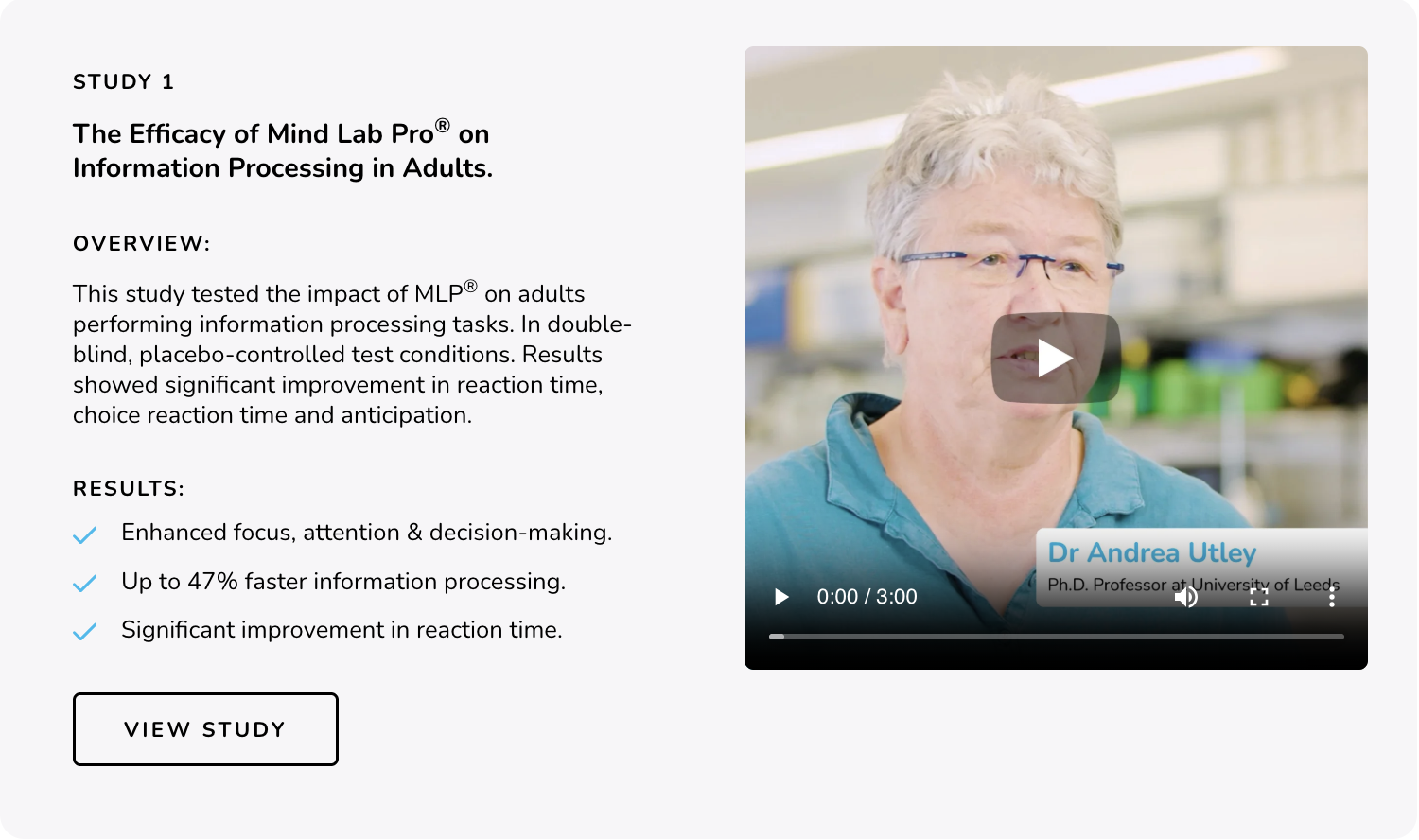
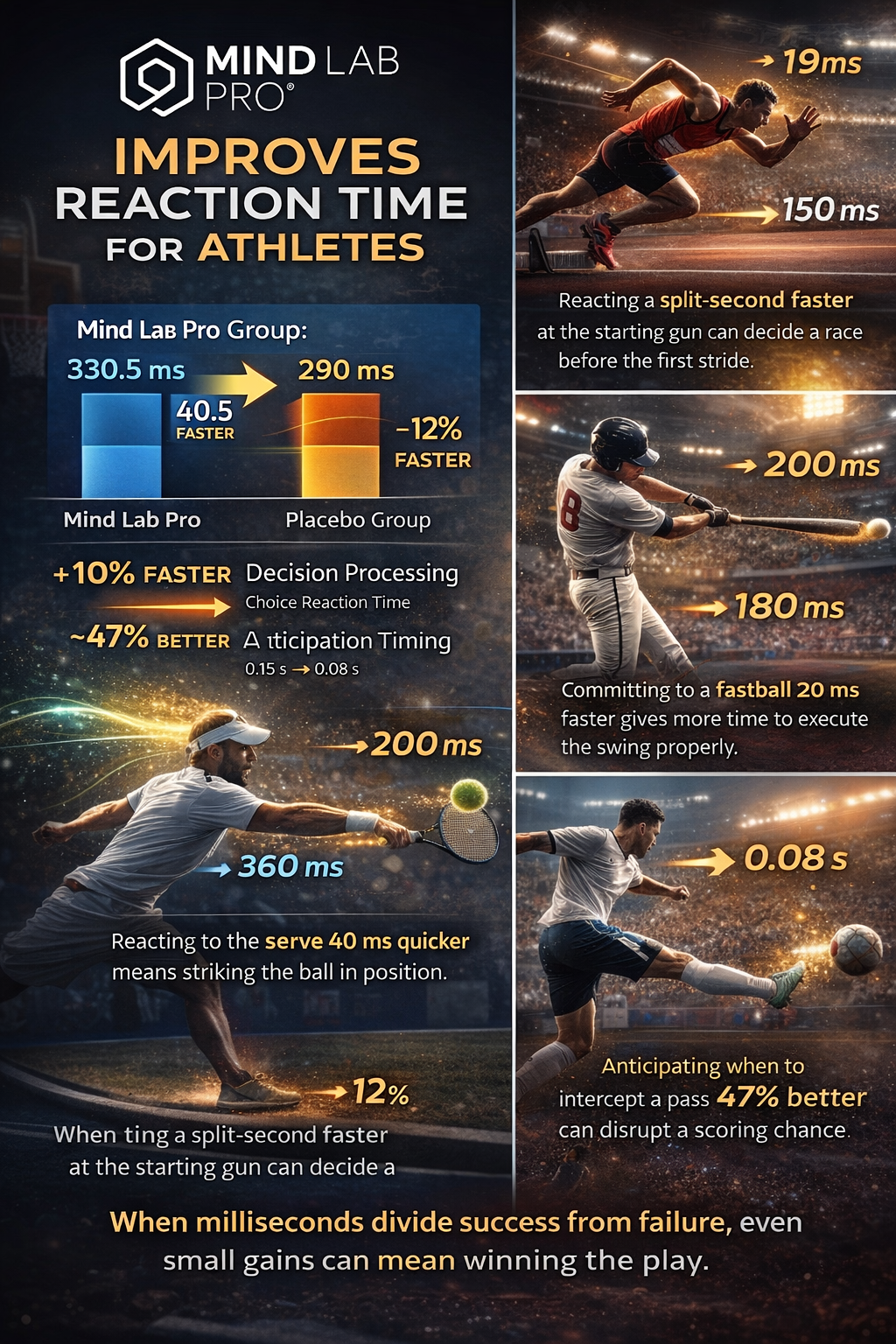
On simple reaction time, the Mind Lab Pro group improved from 330.5 milliseconds to 290 milliseconds. That’s a 40.5 millisecond improvement—about 12% faster. The placebo group actually got slightly worse over the same period, moving from 309.5 milliseconds to 318.5 milliseconds.
Twelve percent may not sound dramatic until you understand how thin the margins are in sports.
In sprinting, the difference between reacting to the starting gun in 150 milliseconds versus 190 milliseconds can mean losing the race before the first step is fully extended. In baseball, a 95-mph fastball reaches the plate in roughly 400 milliseconds.
The batter has about half that time to recognize the pitch, decide to swing, and begin the movement. If your brain processes the pitch even a fraction faster, you gain precious time to adjust your swing.
In soccer, it might mean reacting quickly enough to intercept a through pass before the striker breaks free. In tennis, it can mean recognizing the direction of a serve early enough to move into position rather than reaching for the ball late. In hockey, it might be the difference between deflecting a puck in front of the net and watching it slide past you.
Those improvements may only be measured in milliseconds, but in fast sports, those milliseconds are often the margin between success and failure.
And if an athlete already has a trained reaction time, improvements compound even more. A small percentage gain applied to an already fast nervous system can push an athlete from “very good” territory toward elite responsiveness.
But simple reaction time is still the simplified version of reality. Most sports are not “see one thing, do one thing.” Real competition involves recognizing multiple possibilities and selecting the correct action under pressure. That’s why the choice reaction time results are arguably even more important.
In the choice reaction test, participants had to identify the correct stimulus and select one of several possible responses. That’s much closer to what happens in real competition.
Here, the Mind Lab Pro group improved from 432.5 milliseconds to 388 milliseconds, a 44.5 millisecond gain—or about 10% faster decision processing. The placebo group again declined slightly, slowing from 551 milliseconds to 581 milliseconds.
This is where the athletic implications become even more interesting.
In basketball, reacting isn’t enough—you have to react correctly. A defender reading a pick-and-roll must decide instantly whether to switch, hedge, or fight over the screen. Being 40 milliseconds faster in processing that situation can be the difference between cutting off the drive and watching the ball handler glide past.
In baseball, the batter isn’t just reacting to the pitch; they’re deciding whether it’s a fastball, slider, or curve and whether it will land inside the strike zone. That recognition-and-decision window happens extremely quickly. Faster processing allows the batter to commit to the swing with better timing.
In American football, a linebacker reading the offensive line has a fraction of a second to determine whether the play is a run, pass, or misdirection. Being able to process that information even slightly faster helps them fill the correct gap before the running back breaks through.
In soccer or hockey, defenders constantly evaluate whether to close space, pass off coverage, or step into the passing lane. That’s choice reaction time in action—processing multiple possibilities and selecting the right motor response quickly enough for it to matter.
And in many of these sports, 40–45 milliseconds can absolutely matter. It may not look dramatic on paper, but in a live play, those tiny time advantages accumulate.
Then there is anticipation timing, which might be the most sport-specific measure of all.
In this test, participants had to predict when a moving light would reach a target and respond with precise timing. The Mind Lab Pro group reduced their timing error from 0.15 seconds to 0.08 seconds. That’s about a 70-millisecond improvement and nearly a 47% reduction in timing error. The placebo group again got worse.
This matters because athletic performance isn’t just about reacting quickly. It’s about being calibrated to the timing of events.
Think about a baseball batter again. Hitting a fastball isn’t just about recognizing the pitch; it’s about initiating the swing at exactly the right moment so the bat meets the ball in the hitting zone. Swing too early, and you pull off the ball. Swing too late, and the ball sails past the bat.
In tennis, returning a serve requires predicting the ball’s trajectory and arriving at the right position at the right moment. In soccer, timing a run behind the defense requires accelerating at precisely the moment a teammate releases the pass. Too early and you’re offside. Too late, and the opportunity disappears.
In basketball, rebounding often comes down to timing the jump correctly as the ball comes off the rim. In volleyball, blocking a spike requires jumping at the precise moment the hitter makes contact.
These are timing problems as much as they are strength or skill problems.
So when you see a supplement associated with roughly 12% faster simple reactions, 10% faster complex decisions, and nearly 47% improvement in anticipation timing after only 30 days, that should get your attention.
These improvements won’t turn anyone into a superhero overnight. But they represent the type of marginal gains that accumulate in competitive environments. Small increases in processing speed and timing precision can compound across hundreds of decisions in a game or match.
And this is why reaction time research is so interesting to me personally. Reaction speed and decision processing are notoriously difficult to improve. Training can help. Experience helps even more. Pattern recognition develops over time. But measurable improvements in cognitive processing speed are rare enough that when you see them in a placebo-controlled study, they deserve a closer look.
The second Mind Lab Pro study focused on memory rather than speed, but it still matters to athletes.
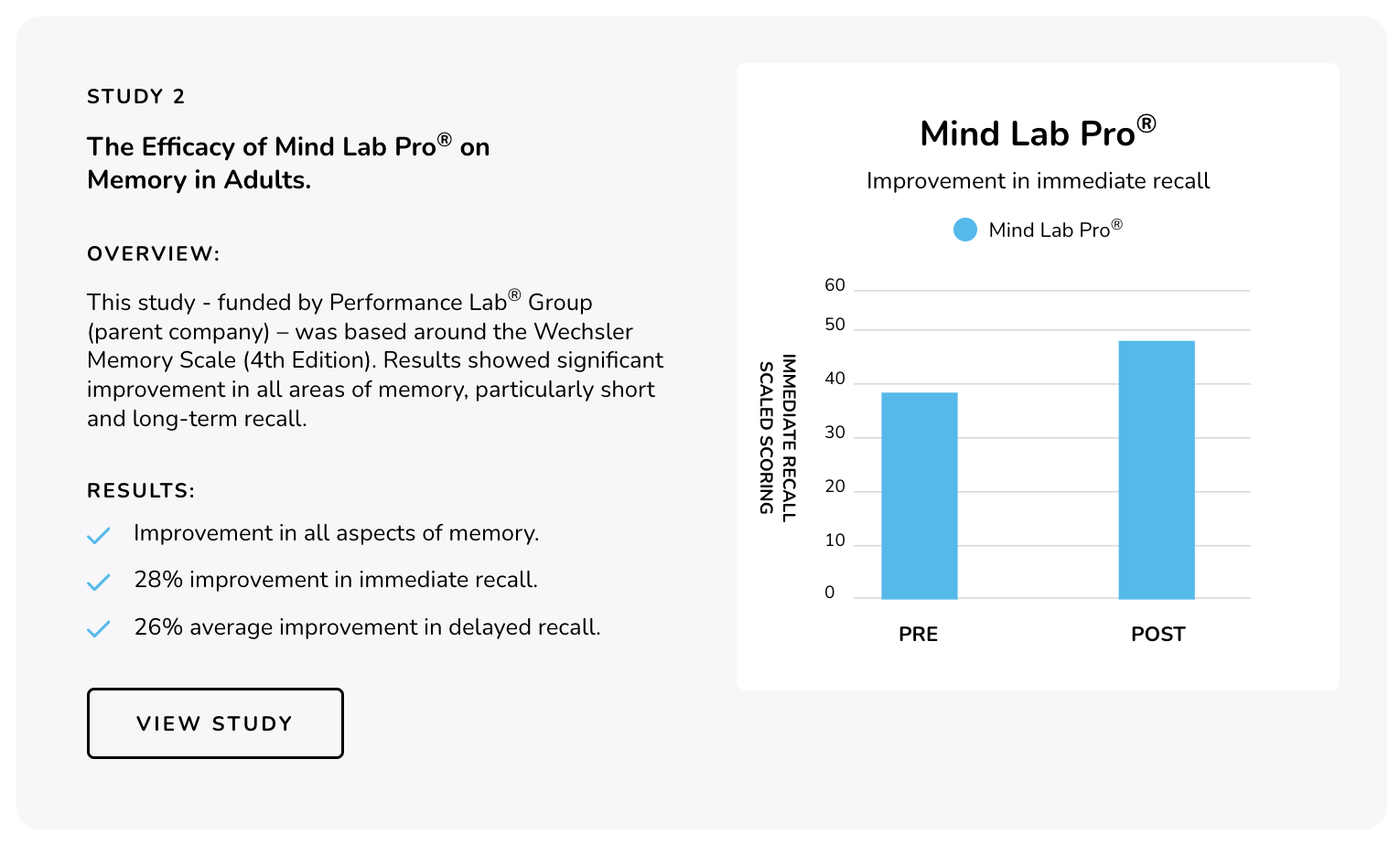
In a 30-day, double-blind, placebo-controlled trial involving 49 healthy adults, researchers used the Wechsler Memory Scale-IV to measure improvements in auditory memory, visual memory, immediate recall, and delayed recall.
The Mind Lab Pro group improved auditory memory by about 13%, visual memory by about 22%, immediate recall by about 11%, and delayed recall by about 16%. The placebo group improved slightly in some categories—which is normal in repeated testing, but the supplement group improved much more.
For athletes, this matters because performance isn’t just about reacting in the moment. It’s also about learning and retaining patterns.
Visual memory supports recognizing formations, positioning, and spatial patterns during play. Auditory memory helps athletes retain instructions from coaches or teammates during fast-paced situations. Immediate recall helps encode new strategies or adjustments during practice. Delayed recall ensures those lessons remain available later, when competition begins.
In other words, Study 1 showed faster processing speed, while Study 2 showed stronger memory and recall.
Speed without memory is chaotic. Memory without speed is slow. Athletes need both.
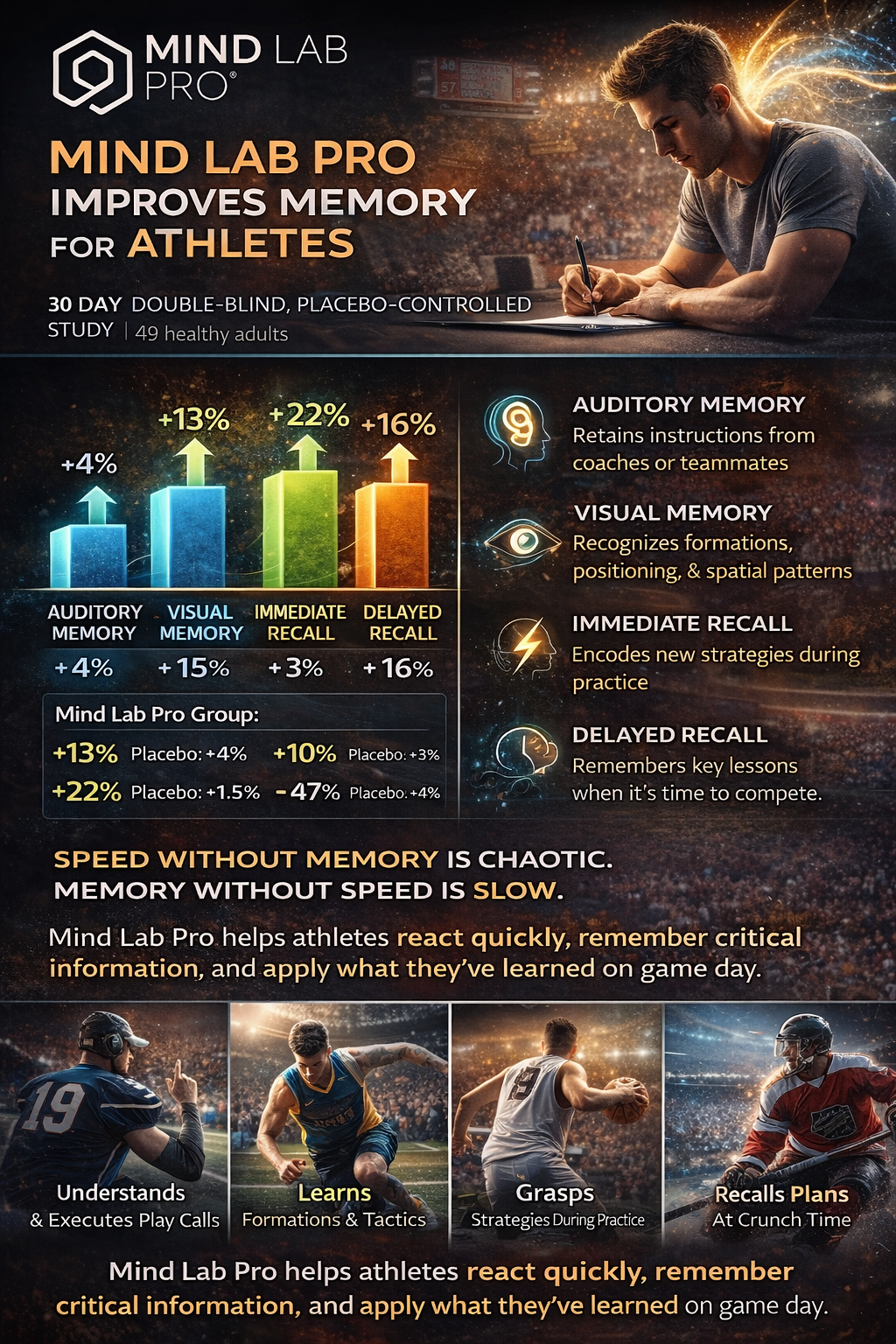
They need to see faster, decide faster, and move at the right time—but they also need to remember patterns, recognize situations, and apply what they’ve learned under pressure.
That combination is what makes the research on Mind Lab Pro particularly interesting. Instead of improving just one narrow cognitive function, the data suggest improvements across the system: reaction speed, decision processing, timing precision, and memory performance.
For athletes, that translates to the potential for sharper reactions, faster decisions, better timing, and stronger retention of the patterns that drive high-level performance.
And if you care most about reaction time—as I do—that first study is the headline. Because in sports where fractions of a second decide everything, even modest cognitive improvements can turn into real competitive advantages.
My Experience With Mind Lab Pro in Boxing
Boxing is the sport I compete in. That alone should qualify it as a sport where reaction time and decision-making matter—a lot. That’s exactly why this supplement caught my attention in the first place.
I didn’t walk into sparring with a stopwatch, so I can’t give you a precise measurement of how much my reaction time improved. But I can tell you something very real: punches that used to get through and hit me… stopped landing.
That’s notable because my sparring partners are not slouches.
I regularly spar with Kiante Irving, Atif Oberlton, and Ivan Dychko. Ivan is a two-time Olympic bronze medalist, Atif is rated by the WBC, and Kiante is a national amateur champion.
I’m not wiping the floor with these guys or anything like that. They’re more experienced than me, and two of them are much faster. But on Mind Lab Pro, I can keep up.
I’m seeing punches sooner. I’m parrying shots that used to land. I’m putting together counters that keep the rounds competitive. I still get hit sometimes—that’s boxing—but it’s happening far less often.
And I know this isn’t just familiarity.
I’d already been sparring these guys for months—and in Kiante’s case, for years. I’m also 41 years old now, which means the normal expectation is that I should be slowing down. And to be honest, I was.
But with Mind Lab Pro, something changed.
This has been the most exciting effect for me personally. What I’m experiencing lines up with the reaction-time research on the formula, and the improvement is not trivial. It feels like accessing another gear of cognitive performance.
If you’re an athlete—especially in a sport where reaction time and decision-making matter—this is worth trying.
If this breakdown helped you, grab Mind Lab Pro through any link on this page. It doesn’t cost you anything extra, and I get a small commission for the referral.
References
Marcora SM, Staiano W, Manning V. Mental fatigue impairs physical performance in humans. J Appl Physiol (1985). 2009 Mar;106(3):857-64. doi: 10.1152/japplphysiol.91324.2008. Epub 2009 Jan 8. PMID: 19131473.
Utley A, González Y, Imboden CA. The Efficacy of a Nootropic Supplement on Information Processing in Adults: A Double-Blind, Placebo-Controlled Study. Biomedical Journal of Scientific & Technical Research. 2023;49(1). DOI: 10.26717/BJSTR.2023.49.007746
Abbott-Imboden, C., Gonzalez, Y., & Utley, A. (2023). Efficacy of the nootropic supplement Mind Lab Pro on memory in adults: Double blind, placebo-controlled study. Human Psychopharmacology: Clinical and Experimental, 38(4), e2872. https://doi.org/10.1002/hup.2872

Written by
Ed Latimore
Ed Latimore is a best-selling author, professional heavyweight boxer, and physicist. He writes about self-improvement, sobriety, fighting, and the lessons he learned growing up in the projects of Pittsburgh.
Follow @EdLatimore