How to Punch Harder: The Physics and Biomechanical Drills To Make You A Knockout Artist

I was a Pennsylvania Golden Glove winner (2011 201+ lbs), national amateur champion (2011 National PAL 201+ lbs), and I’m still an active boxer at 41 with a 14-1-1 record. I also have a degree in physics from Duquesne University.
This combination of experience and education has given me unique insight into the physics and biomechanics of punching.
This article will teach you how to make your punches harder, faster, and more powerful, along with giving you exercises that aren’t commonly taught to fighters to increase their punching ability.
I have never believed in the old boxing adage that “punchers are born.”
I found a great YouTube Channel that motivated me to write this article, and the creator even has a course that goes further in depth laying out a full video plan for training power punching.
Once a fighter or coach understands the biomechanical principles that cause the body to generate force, he will no longer believe that either. If you’re a boxer or coach reading this essay and have further questions, feel free to email me at ed@edlatimore.com.
How to Punch Harder: The Physics and Biomechanical Drills To Make You A Knockout Artist
If you want to end a fight with a single blow, you might think the secret lies in the size of your biceps or the circumference of your chest. That idea has sparked one of the biggest debates in the boxing community.
On one end of the spectrum, there are coaches who think it has no place in boxing training.
These coaches and fighters believe punching power is either completely innate and can’t be trained, or they think that lifting weights is counterproductive to boxing ability.
At the other end of the spectrum, there are guys who spend more time training like a powerlifter than a fighter.
The pro-weightligting guys imagine that by curling heavy hand weights or a dumbbell, they’ll eventually develop the knockout power of a Moses Iatuma or David Benevidez.
The anti-weight lifting guys think that while you’ll get bigger and stronger, the time could be better spent developing your boxing skills.
The reality is that while the truth lies somewhere in the middle, it leans a little closer to no weights—especially for developing knockout power.
We’ve all witnessed the following.
The lean, whip-thin lightweights hitting the heavy bag with a crack that sounds like a gunshot, while muscular guys who look like they never miss a day pumping iron hit the bag with as much pop as a pillow.
It’s got nothing to do with muscle mass or muscular strength. Rather, it’s biomechanical mastery that comes from precision, technique, and coordination.
The ability to land a hard punch is the result of biomechanical physics rather than raw muscularity.
This guide is your roadmap to transforming from a fighter who pushes their punches into a knockout artist who pierces through targets, offering essential boxing tips and boxing training advice for every skill level.
The advice in the article also applies to MMA, kickboxing, traditional martial arts, bare-knuckle boxing, or any other combat sport where punching is allowed.
The biomechanics are—by far—the most important part of punching harder, but you also need to understand how to select the best gloves for punching. How to select the best boxing glovesThe Fundamentals: Perfecting Your Form for Maximum Impact
Before you touch a heavy bag, you must respect the mechanics of the punch and proper training techniques to achieve maximum power.
Without proper form, you are not only losing power but also risking injury to your wrists and shoulders.
The Power Stance: Stability Meets Agility
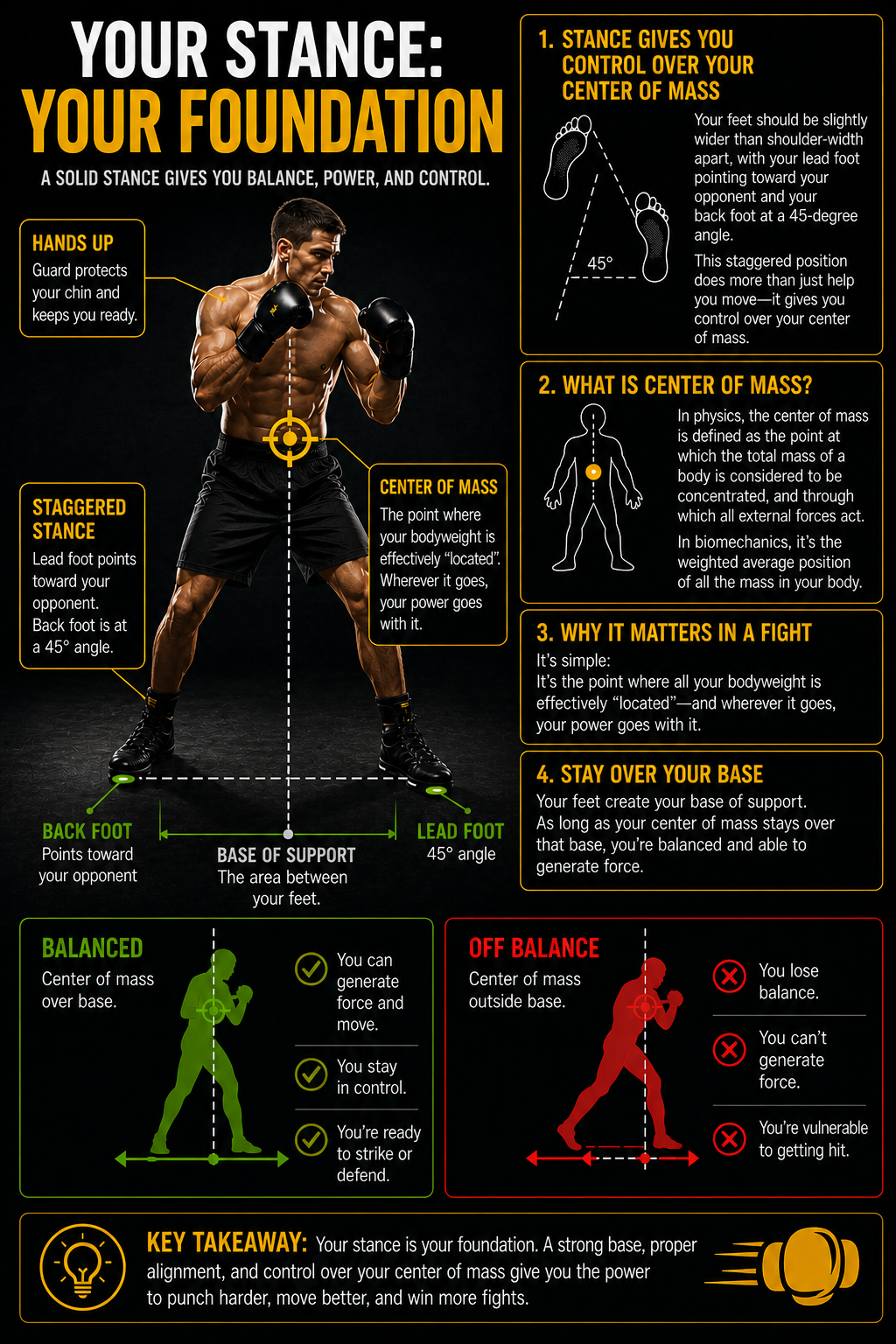
Your stance is your foundation.
Your feet should be slightly wider than shoulder-width apart, with your lead foot pointing toward your opponent and your back foot at a 45-degree angle.
This staggered position does more than just help you move—it gives you control over your center of mass.
In physics, the center of mass is defined as the point at which the total mass of a body is considered to be concentrated, and through which all external forces act. In biomechanics, it’s the weighted average position of all the mass in your body.
That sounds technical, but in a fight, it means something very simple:
It’s the point where all your bodyweight is effectively “located”—and wherever it goes, your power goes with it.
Your feet create your base of support. You can think of your base of support as the area between your feet. If you draw a circle around your feet with the smallest possible radius, you can think of your center of mass as being the point directly above the center of the circle.
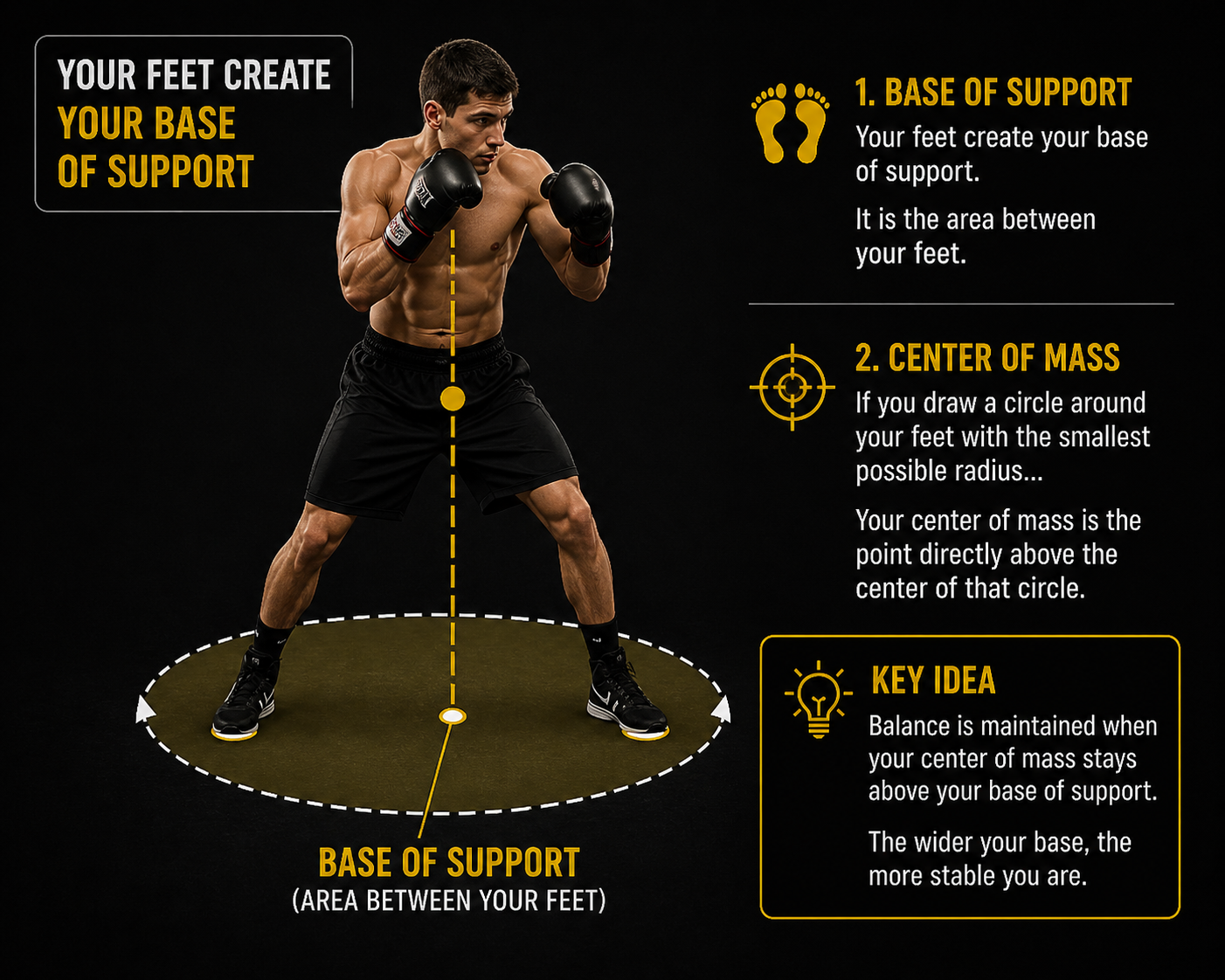
Ideally, your COM stays directly over that base of support. As long as your center of mass stays over that base, you’re balanced and able to generate force. The moment it drifts outside, you’re no longer striking—you’re falling.
This is where most people lose power.
If you lean too far forward trying to “put more into the punch,” your center of mass moves past your lead foot. You feel like you’re committing, but you’ve actually broken your structure. There’s no stable base to push from, so the force never transfers cleanly.
If you stay too far back, the opposite happens. Your center of mass never moves toward the target, so your punch has no bodyweight behind it.
This does not limit your defense capabilities. Dipping at the waist keeps you in position to brace against a punch and deliver your own.
The goal isn’t to stay still—it’s to stay in dynamic balance.
That means your center of mass is constantly shifting—loaded slightly over the back leg before the punch, then driving forward as you push off the ground and rotate—but always staying controlled and within your base.
Think of it like this:
You’re not trying to keep your weight frozen. You’re trying to move it aggressively without ever losing control of where it lands.
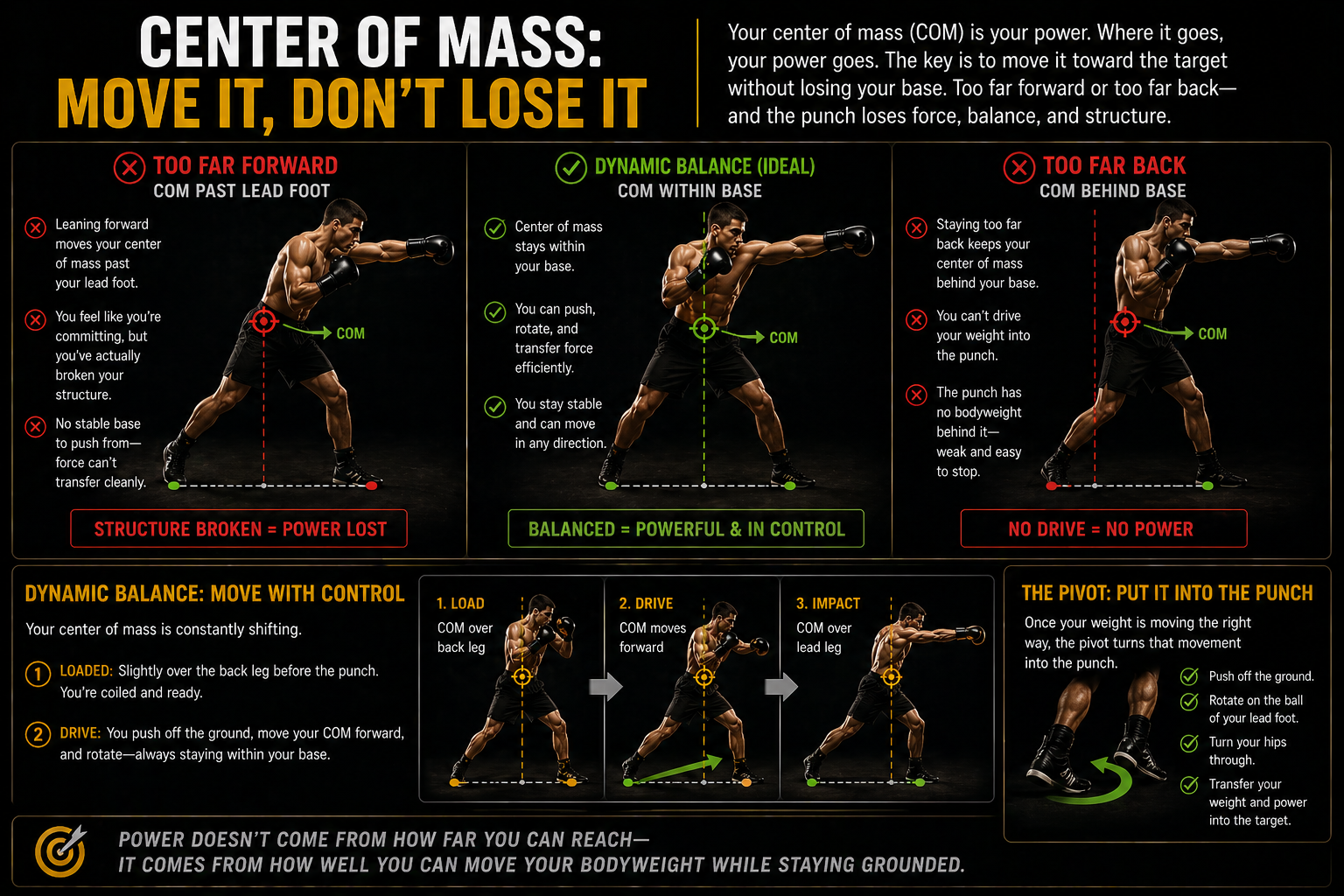
That’s the difference between someone who looks balanced and someone who can actually hit hard without falling apart.
Power doesn’t come from how far you can reach—it comes from how well you can move your bodyweight while staying grounded.
Once your weight is moving the right way, the pivot is what actually puts it into the punch.
The Punch Doctor Learn a more in-depth training system for power punchingThe myth of arm strength: How punching power is really made
First, let’s address a common misconception that exists from the amateur ranks all the way up to the pros: that a punch is an arm movement.
Your arms don’t generate the force—they transmit it into the target.

A useful analogy is a gun.
Your arm is the bullet. Your body is the gun.
It doesn’t matter how fast the bullet could move—without the explosive force of the gun behind it, it won’t do much damage.
This is where a key concept from physics and biomechanics comes in: effective mass.
When you punch, the force delivered isn’t just about how fast your fist is moving. It’s about how much of your body mass is actually behind that fist at the moment of impact.
In physics terms, impact depends on the product of mass and velocity (momentum). But in a punch, not all of your body mass is contributing—only the portion that is properly aligned and moving together at impact.
That’s your effective mass.
If you punch with just your arm, your effective mass is low. You’re essentially hitting someone with the weight of your arm and a bit of your shoulder.
Research in boxing biomechanics shows that increasing whole-body involvement increases effective mass and impact force, not just fist speed (Smith & Hamill, 1986; Walilko et al., 2005; Cheraghi et al., 2014).

But when you punch correctly—driving from the ground, rotating through the hips, transferring through the torso—you bring a much larger portion of your body into the strike.
Now your effective mass isn’t just your arm. It’s your arm, your torso, and the momentum of your entire body moving forward.
That’s the difference between a punch that feels like a slap and one that feels “heavy.” Whether you’re throwing a straight punch or a hook, putting your body behind the shot is the proper punching technique.
Two fighters can throw punches at the same speed, but the one who connects with more effective mass will hit significantly harder.
This is also why balance and structure matter so much. If your body isn’t aligned at impact—if energy leaks through a loose wrist, a disconnected shoulder, or poor foot positioning—you lose effective mass. The force never fully transfers.
So when people talk about “putting your body into the punch,” what they’re really talking about is maximizing effective mass.
Now, consider what happens if you rely only on your arms.
You’re limited to the relatively small muscle groups of the triceps and shoulders. These muscles are excellent for speed and quick strikes, but they don’t carry much mass, and they can’t generate the kind of force needed for true knockout power.
They’re also limited in their ability to create meaningful rotation, which is a major driver of force.
With this myth dismantled, let’s correct it with the truth of how punching power is generated. To do that, we start with understanding the concept of the kinetic chain.
Understanding the Kinetic Chain: A Lesson in Engineering and Biomechanics
To develop punching power, you must understand the “Kinetic Chain.”
The kinetic chain (sometimes called the kinematic chain) is an engineering concept used to describe how movement flows through the body. It was first introduced by Franz Reuleaux in 1875. His idea was simple: the body can be modeled as a series of rigid segments connected by joints, where movement at one joint influences movement at another.
Decades later, Arthur Steindler expanded on this idea and applied it directly to human movement and sport. He described the body as a system of connected segments working in sequence—a “complex motor unit” where each joint and limb contributes to the final action (Ellenbecker & Davies, 2001).
You’ll sometimes hear movements described as “open chain” or “closed chain.” That distinction matters in deeper biomechanics, but we don’t need to go that deep for purposes.
What matters is this:
Your body isn’t a collection of isolated muscles. It’s a connected system.
Your legs, hips, torso, shoulders, and arms are all linked. When one part moves, it transfers force and motion into the next. If that transfer is smooth and timed correctly, you get power. If it’s broken or mistimed, you get leaks.
That’s the kinetic chain—and understanding it is the foundation of punching harder.
To punch harder in boxing, our goal is the coordinated activation of muscle that transfers energy from the floor through your body and out through your knuckles.
Generally speaking, the kinetic chain is any sequence of movements in the body that influence one another to generate a force. There can be multiple kinetic chains involved in the same movement as well.
Specifically, for boxing—and for the scope of this article—we’ll simply and focus on the major kinetic chain for punching. That chain is divided into three sections: the lower body (legs and feet), core (hips and torso), and upper body (shoulders, arms, & fist).
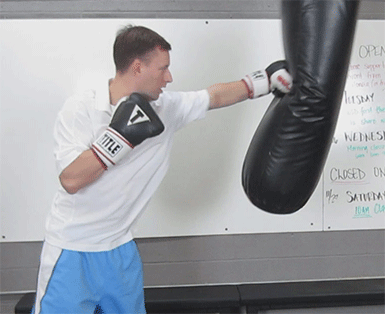
The Power Punching Blueprint
I give a great breakdown of the kinetic chain, but The Power Punching Blueprint by Alex Wiant DC has a much better course. I used many of the concepts in my latest knockout victory at 40. Highly recommended
Learn more hereEverything going forward will be discussed as if you are in an orthodox stance. Unless otherwise stated, assume the rear and lead foots apply to those stance position. If you’re a southpaw, make the switch.
Also, while the principles and training discussed will apply to all punches, this article is primarily written with straight punches (the jab and cross) in mind. The footwork for a hooks and upper cuts follow the same general principles, and you’re welcome to apply them, but the footwork for a hook is a subject that requires it’s own treatment that would distract from the main points of this article.
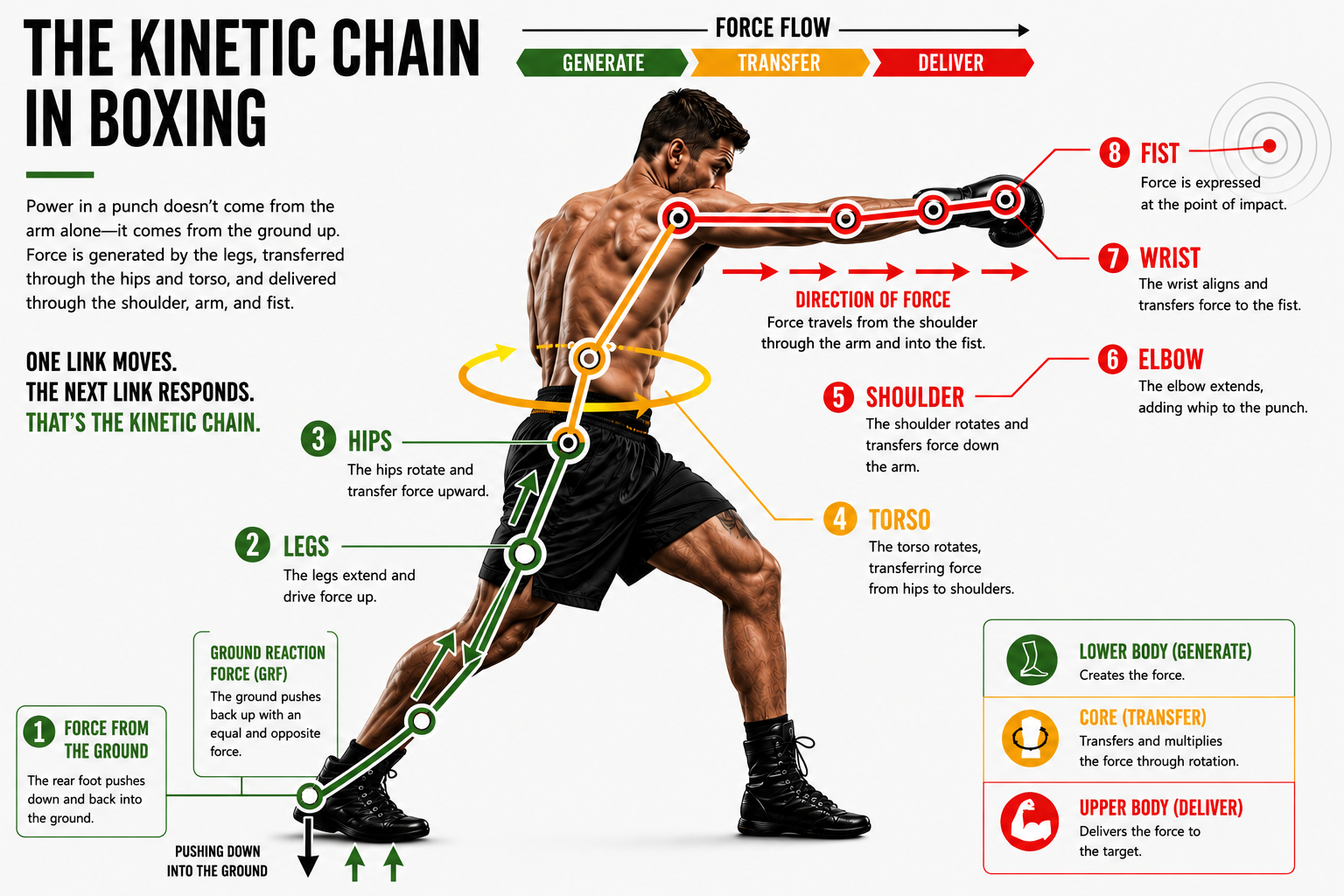
Feet and legs: The Ground-Up Connection
Punching power starts from the ground. Therefore, we start our discussion of the kinetic chain by focusing on the lower body.
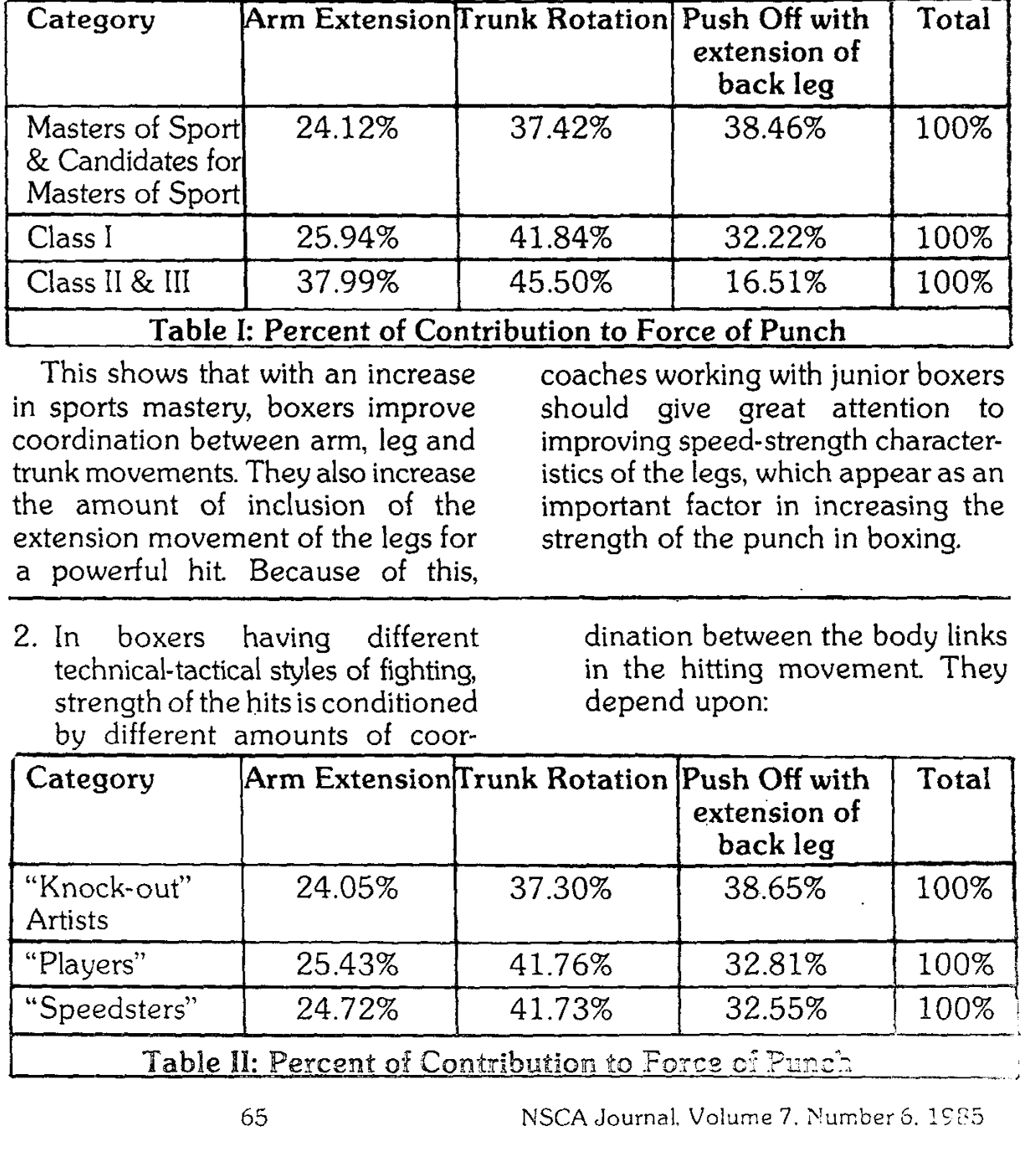
In biomechanical studies of elite boxers, arm extension accounts for only about 25% of total punch force. The majority comes from trunk rotation and leg push-off (Filimonov et al., 1985; Cheraghi et al., 2014).
This sequential transfer of force from the lower to the upper body is well documented in striking and throwing sports (Putnam, 1993; Lenetsky et al., 2013).
In other words, the punch doesn’t start at your shoulder—it starts at your feet.
When you see pro boxers like Terence Crawford or Gervonta Davis score a devastating knockout, they’re not just throwing punches; they’re launching their body’s effective mass into a focused point, using the arm merely as the conduit.
Elite fighters initiate movement from the ankle to drive into the ground, then the knee stabilizes while contributing to force production, sending that energy up into the hips to begin rotation. The torso follows, then the shoulder, and only then do the arms extend.
The image below gives a general treatment of what’s happening.

This sequencing allows energy to build and transfer through the body like a whip, rather than leaking out early.
Everything starts with the floor. Newton’s Third Law tells us that for every action, there is an equal and opposite reaction. When you push against the ground, the ground pushes back.
There are two reaction forwards that are taking place: the rear foot ground reaction forces to generate the force that will be transferred via core rotation and the lead foot that will catch the effective mass going forward.
Reaction force of the rear foot
Ground reaction forces generated through the legs are a primary driver of punching force and momentum transfer (Stewart et al., 2025; Cheraghi et al., 2014).
This is well documented in other sports that rely on rotation to launch projectiles—like baseball pitches, football throws, javelin, and discus—or to swing an object as fast as possible to transfer force into another object, like in baseball batting, tennis, and golf.
This ground reaction force is the raw fuel for your punch. If your feet are flat or your legs are locked out, the energy dies before it ever reaches your waist. You must maintain a slight bend in the knees, acting like coiled springs ready to unload.
When throwing the rear cross, fighters are often taught to step with the rear foot and then, as the punch makes contact, to drive that foot into the ground.
The step is to carry your body’s effective mass into the punch, and that drive into the ground generates the ground reactive force that will be transfer via torso rotation and transmitted by the fist.
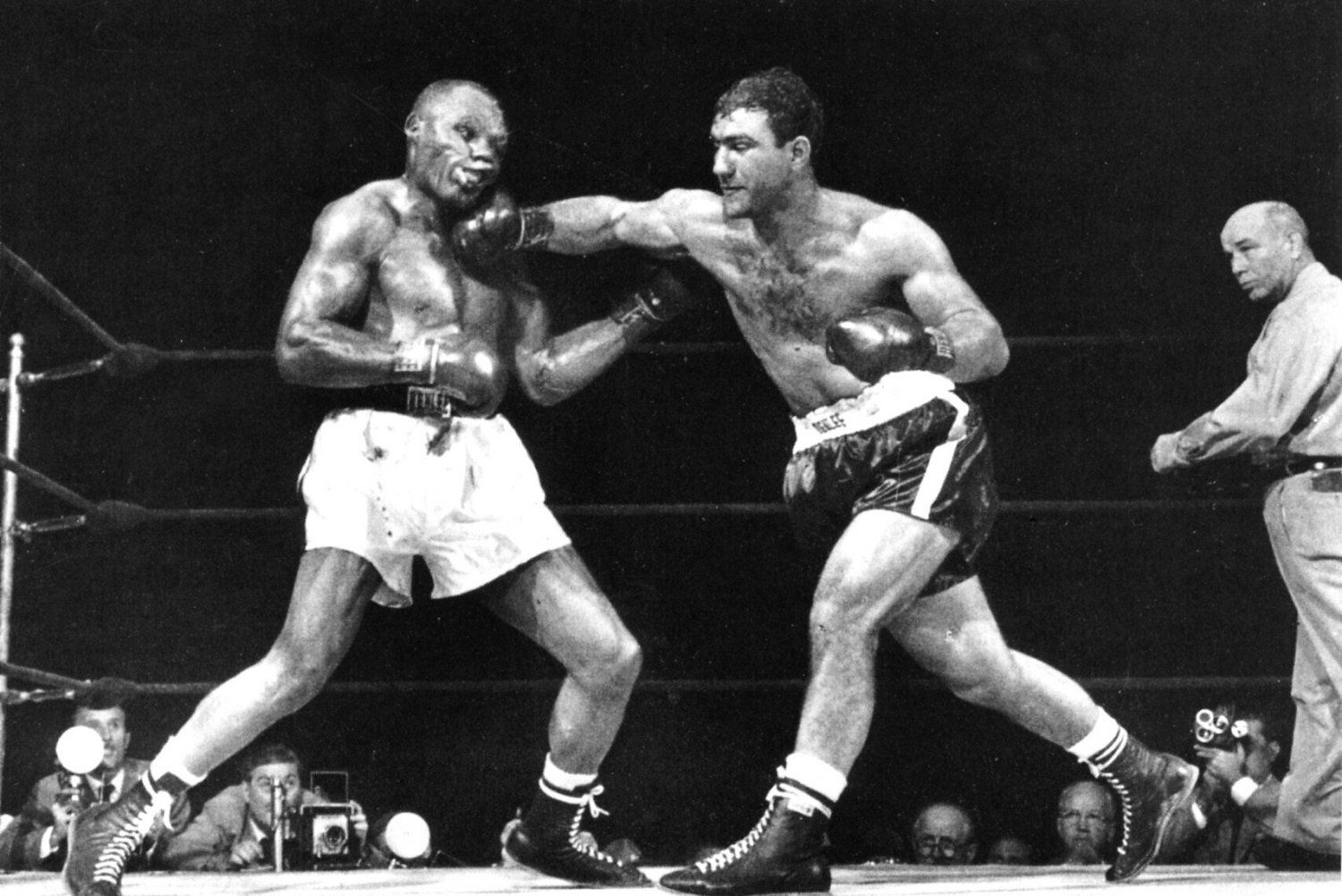
When you carry your effective mass with a step, you have to stop is so that you don’t go off balance or are out of position if you miss. Your front leg is now tasked generating a ground reactive force. This is the role of the lead leg.
There is a concept for baseball pitchers call the “first foot strike” (FFS). FFS is the critical moment in a pitcher’s delivery when the stride foot lands, initiating the transfer of energy from the lower body to the arm and controlling the direction of the pitch.
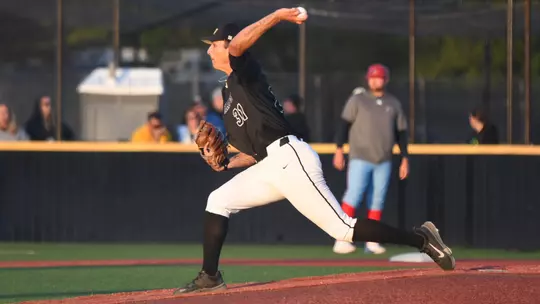
In boxing, we are taking advantage of that same principle. The only difference is that instead of a stride foot, it’s the foot on the same of the punch. A quick, strong FFS allows us to not only drive more reaction force, but to also do it quickly and on balance.
The role of the lead foot
The lead leg has to stop the mass of the body when it stops to land the punch. It also add to the force by pushing into ground to generate force for rotation.
When we move into the torso section of the kinetic chain, the lead leg will have a greater role, but for now all that needs to be understood is that it stops the body allows you to generate a ground reactive force that drives the rotation.
Hips and torso: The Role of Core Rotation
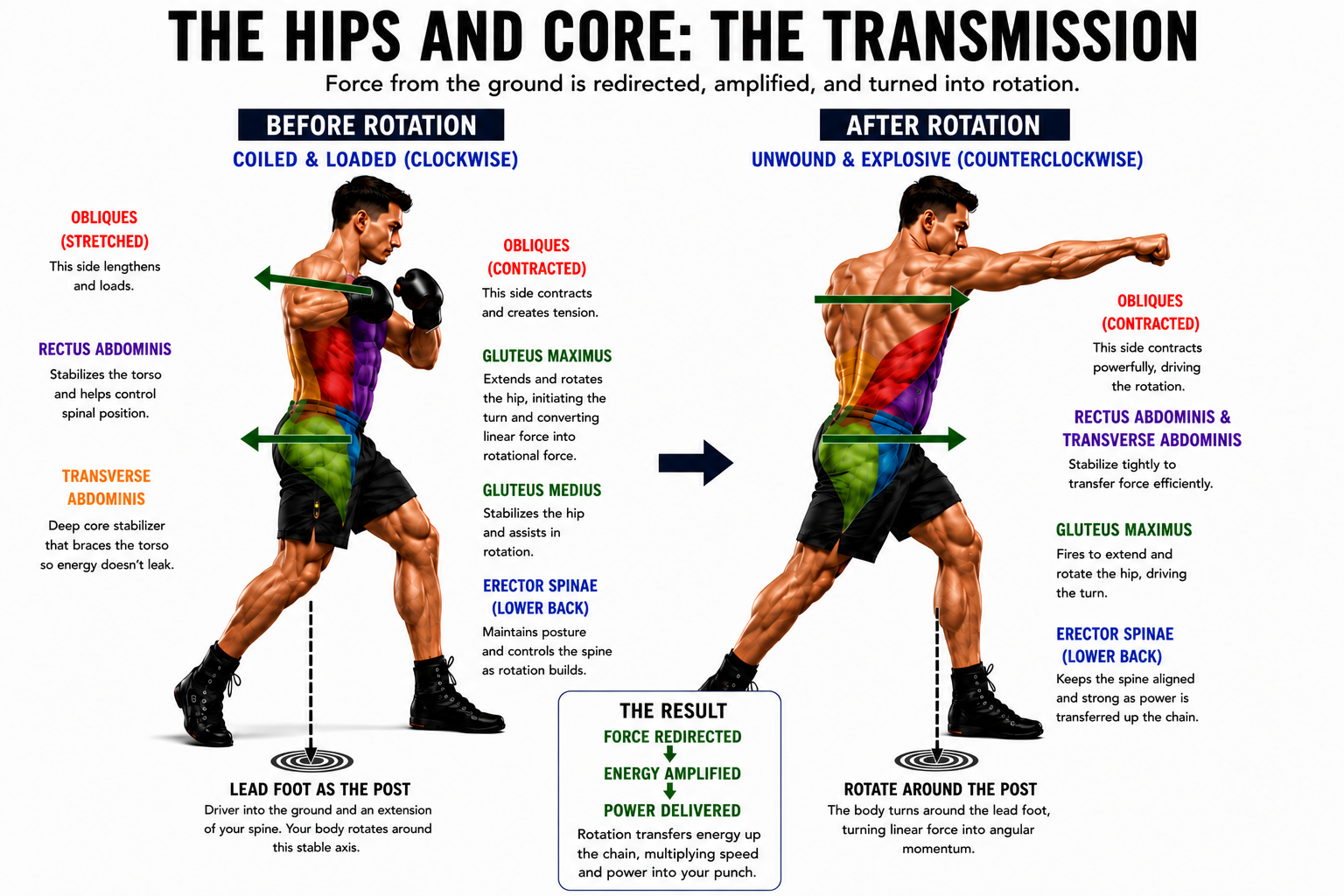
If the legs are the engine, the hips and core are the transmission.
This is where force gets redirected, amplified, and turned into rotation.
It starts with the glutes—primarily the gluteus maximus and gluteus medius. After force is driven into the ground through the legs, the glutes fire to extend and rotate the hips. This is the first major conversion point: linear force moving up from the ground is now being turned into rotational force.
From there, the core takes over.
Your obliques (internal and external) are the primary drivers of rotation. One side stretches while the other contracts, creating that coiled, spring-like tension. Your rectus abdominis and transverse abdominis stabilize the torso so energy doesn’t leak, while the erector spinae in the lower back maintain posture and control as rotation builds.
This system doesn’t just pass energy along—it reshapes it.
The force you generate by pushing into the ground doesn’t travel straight up. Through the hips and core, it’s redirected into rotation—what we can think of as angular momentum. Instead of just moving forward, your body begins to rotate around its axis, and that rotation dramatically increases the speed of your shoulders, and eventually your fist.
This is why rotation is so powerful. Rotational momentum allows you to take a large mass—your torso—and accelerate it in a way that creates a whipping effect. The hips initiate the turn, but the core carries and amplifies it, transferring that motion into the upper body. By the time it reaches your shoulder, the energy has compounded, allowing your arm to accelerate far faster than it could on its own.
This is where the lead foot earns its keep.
You can think of the lead foot as a post driven into the ground. That post becomes an extension of your spine into the floor, giving you a stable axis to rotate around.
As you rotate, one side of your body lengthens while the other contracts—glutes, hip rotators, and obliques working together to build tension like a coiled spring.
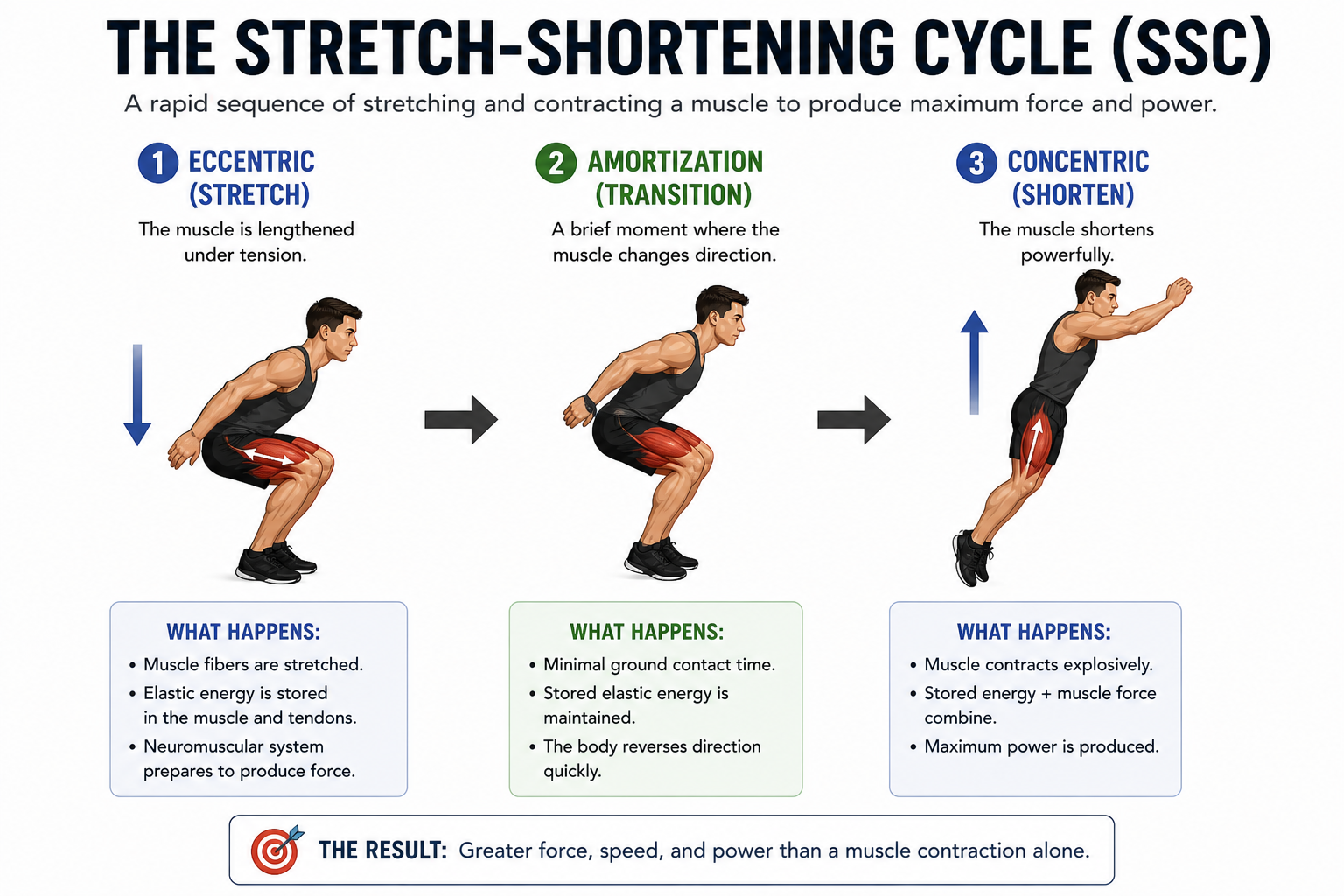
There’s a technical name for this: the stretch-shortening cycle.
As you initiate your punch, your torso undergoes a brief pre-stretch. This can come from a slight counter-rotation or the natural lag between your hips and shoulders. That stretch loads the muscles of the core—especially the obliques—like a spring being wound up.
When they contract immediately afterward, they don’t just produce force—they release stored elastic energy on top of it. That’s what makes the rotation faster, sharper, and more explosive.
And when that spring unwinds, that’s where the power comes from.
In other words, you’re not just turning—you’re snapping.
Without a strong, properly timed core, this entire system breaks down. The energy “leaks” out of your midsection like water through a cracked pipe. If your core is loose, it absorbs force instead of transmitting it.
If your hips rotate too late, the sequence is disrupted. If your arm fires too early, it disconnects from the rotation entirely. In each case, the energy never fully reaches your fist—it dissipates before impact.
That’s why some punches look fast but feel light, while others feel like they go through you. The difference isn’t just speed—it’s how well that speed is built, transferred, and amplified through rotation.
People often talk about rotating their hips, but the more accurate way to think about it is this: the hips initiate movement, but the core owns the rotation. The hips shift your mass into position, while the core turns that mass into rotational momentum and drives it forward.
When done correctly, your arm and fist land with the effective mass of your entire body behind them, while you remain grounded and balanced enough to continue generating force from the floor.
That’s the real role of the core—not just connecting the lower body to the upper body, but transforming raw force into explosive rotation and delivering it without loss.
Shoulders and arms: Delivering force generated by legs and transferred by the core
Once the energy has traveled from the ground, through the legs, and been amplified by the rotation of the core, it still has one final job:
It has to be delivered.
This is where most people misunderstand punching mechanics. They think the arm creates the punch. In reality, the arm—and more specifically the shoulder complex—is responsible for transferring and finishing the force your body has already generated.
This happens through a precise sequence of three movements:
First, shoulder extension loads the system.
As you initiate rotation, the punching arm often lags slightly behind the torso. This creates a stretch across the chest and front of the shoulder. That stretch stores elastic energy and primes the muscles to contract more explosively—like pulling back a slingshot before release.
Then, shoulder flexion carries the arm forward.
As the hips and torso unwind, the shoulder is driven forward. The key here is that the arm is not moving independently—it is being carried by the rotational force of the body. This is what separates a true punch from an arm strike. The shoulder flexes, but it does so as part of the larger kinetic chain.
Finally, scapular protraction finishes the punch.
At the moment of impact, the shoulder blade slides forward around the rib cage, driven by the serratus anterior. This adds the final extension to the punch, allowing force to travel through the target instead of stopping at the arm.
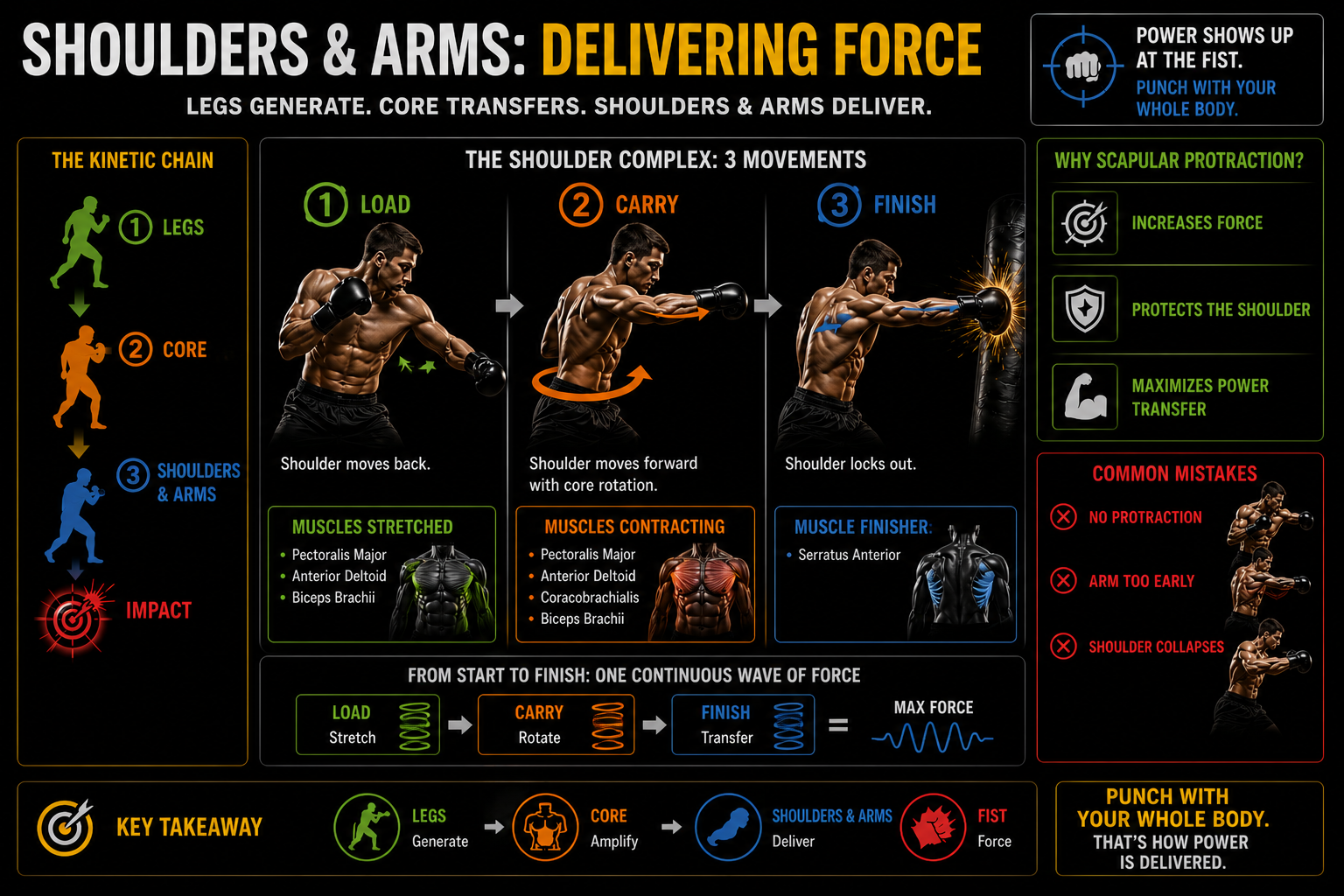
This last piece is subtle, but critical. Without scapular protraction:
- The punch loses penetration at impact
- Force dissipates at the shoulder
- You increase stress on the joint instead of transferring energy cleanly
When all three are timed correctly, the punch becomes a continuous wave of force:
- Loaded through extension
- Accelerated through flexion
- Delivered through protraction
This is what it means to punch with your whole body.
The fist isn’t generating power—it’s simply where the power shows up.
The Power Punching Blueprint
If this article is helpful, checkout The Power Punching Blueprint. The creator, Alex Wiant, helped me sharpen my explanations here with his extensive knowledge of boxing and anatomy.
Learn more hereMaking Space for Extension: Turning Movement Into Power
It’s often taught that when throwing a right cross, hooks, uppercuts, or even power jabs, your foot must pivot—like you’re crushing a cigarette into the floor. I maintain that not only is this incorrect, but it’s causing fighters to lose power and stability.
The “bug squishing” or “cigarette crushing” motion isn’t the source of power. Rather, it’s a misunderstood solution to a problem that boxers face: moving targets that do not want to be hit and are trying everything they can to avoid your fists.
In a perfect world, you wouldn’t need to move your feet at all. You’d stay planted, drive into the ground, and rotate freely—maximizing ground reaction force and minimizing energy leaks. When I was an amateur, I realized that I was great when guys didn’t move. Of course, guys move, so I didn’t progress until I learned how to move my feet and punch.
Read more of my story here Hard Lessons From The Hurt Business: Boxing And The Art of LifeBut fighting doesn’t happen in a perfect world.
Your target is moving, your range is constantly changing, and you have to stay in position to defend.
You need to be offensively and defensively capable create enough space for your body to move while allowing your hips can rotate so your joints can extend and force can can be transferred from the ground through to your fists.
So the question becomes:
How do you create space for movement without sacrificing balance, power, or position?
Sometimes that space comes from rotation.
Other times, it comes from movement.
(Fighting physics note) Impulse: Why Speed Changes Everything
To understand why some punches feel like a shove while others feel like they go through you, you have to understand impulse. This is the physics concept that governs what actually happens at the moment of impact.
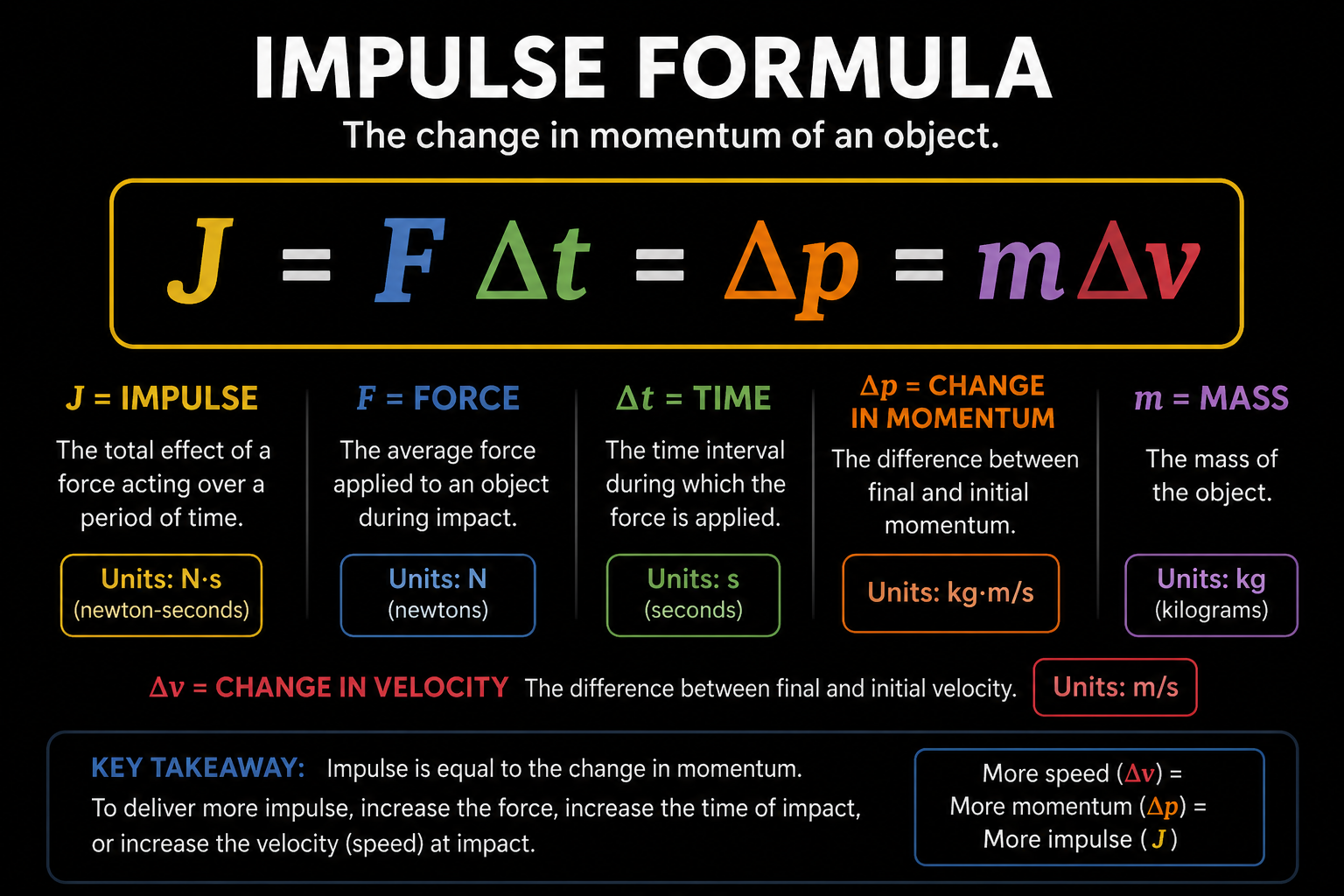
Impulse can be expressed in two equivalent ways: as force applied over time or as the change in momentum. Momentum itself is the product of mass and velocity. When you combine these ideas, you get a simple but powerful truth: a punch is not just about how much force you produce, but about how much you change the motion of whatever you hit.
When your fist lands, it is moving fast. Then, in a fraction of a second, it slows down dramatically—often close to zero. That rapid deceleration is what creates a large change in velocity, and therefore a large change in momentum. Since impulse equals that change in momentum, the faster your hand was moving before impact, the greater the impulse you deliver when it stops.
This is why speed matters so much. Your body mass does not change much from punch to punch, but your velocity can change significantly. Because momentum depends directly on velocity, even a modest increase in speed leads to a meaningful increase in momentum—and therefore a more powerful impact. If you double your hand speed, you double the momentum it carries into the target, and that dramatically increases the impulse delivered on contact.
At the same time, impulse can also be thought of as force multiplied by the time over which that force is applied. In punching, however, the time of contact is extremely short and largely outside your control. You are not pushing someone over a long duration—you are colliding with them.
This means the only way to generate a large impulse is to create a very high force in a very short amount of time. Faster punches accomplish exactly this. They produce more violent collisions, higher peak forces, and greater overall impulse, even though the contact time remains brief.
This is where proper technique becomes critical. If you stay tense throughout the punch, you limit your speed and reduce the momentum you can generate. If you stay too loose at impact, your structure collapses and the force never transfers cleanly into the target.
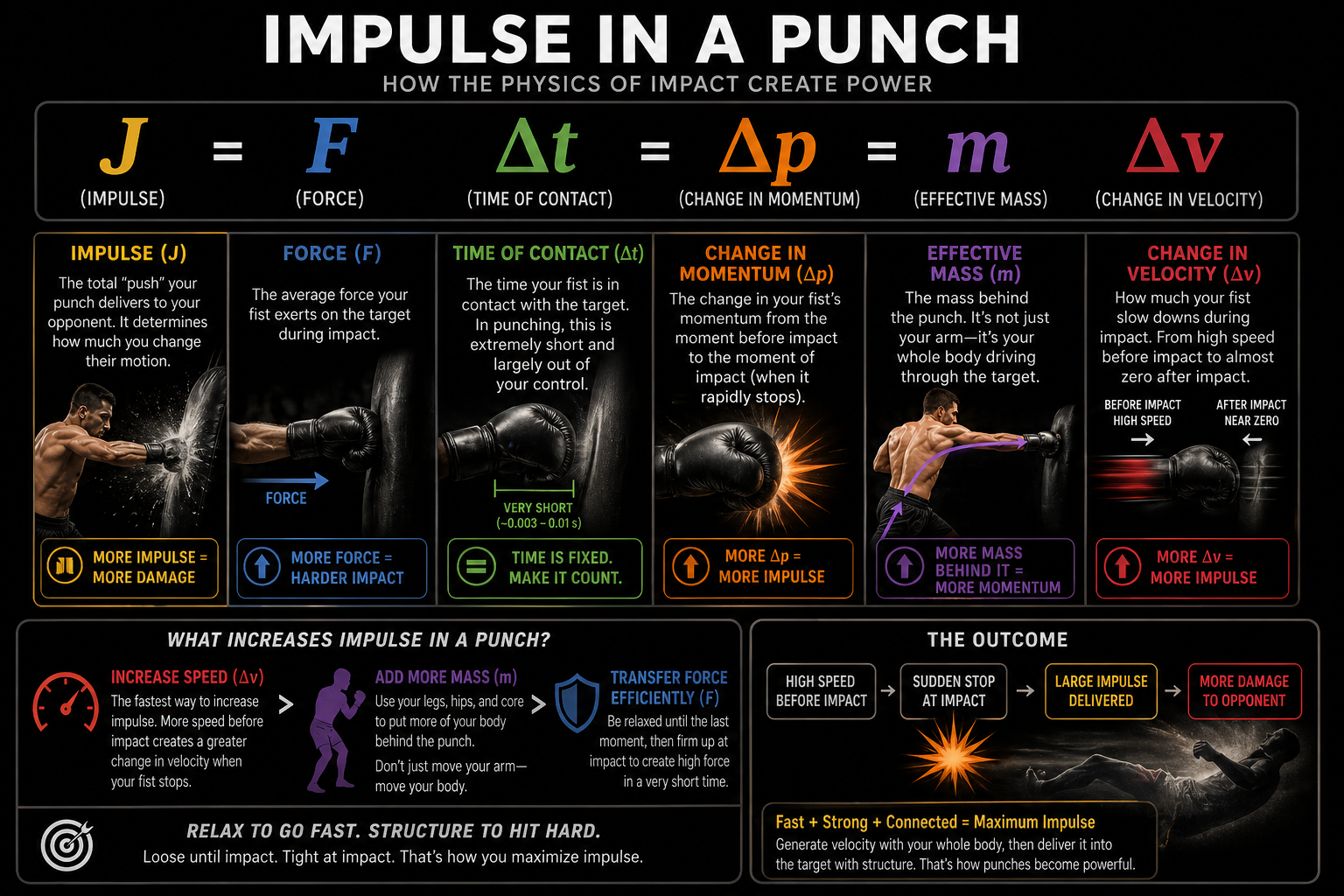
The solution is timing. You remain relaxed as the punch travels, allowing velocity to build, and then briefly stiffen at the moment of impact. This stiffness increases the effective mass behind the punch and ensures that the momentum you created is transferred rather than absorbed by your own body.
In practical terms, powerful punches are not slow and heavy—they are fast and abrupt. They carry momentum into the target and then stop suddenly, forcing that energy into whatever they hit. That sudden, violent transfer is impulse. It is the difference between making contact and doing damage, between touching your opponent and moving them.
A Tale of Two Paths: Straight and Curved
To better understand this, it helps to look at other sports.
Note: In the rest of this section, I’ll be using “straight” and “curved” to discuss the path of your arms. All punches and athletic motions have a curved component to them. Even straight forward walking and running. I’m simplifying for the sake of explanation, but I will not simplify it so much that the information is inaccurate.
In baseball, there are two primary actions: pitching and hitting.
A pitch moves the arm along a relatively straight path to launch the ball.
A swing, on the other hand, follows a curved path—rotating the body to bring the bat through the strike zone.
You see the same thing in tennis.
A serve drives forward.
A groundstroke rotates through an arc.
Boxing works the same way.
Most punches fall into one of two paths:
- a straight line (jab, cross)
- a curved arc (hooks, some uppercuts)
But you’re not locked into one or the other. Many punches are a hybid and can be thought of more as a diagonal line. Either way, it helps to think of punches as either straight or curve.
In both instances, you can adjust how much space you have to work with—and that changes how much power you can generate.
Fighting Physics Note: Straight Punches vs Hooks
Not all punches generate force the same way. A straight punch and a hook both hurt, but biomechanically they produce damage through slightly different mechanisms.
Straight punches — especially the rear cross — are generally the faster punch. They travel along the shortest path to the target and transfer body mass efficiently through the kinetic chain.
Hooks work differently.
Rather than emphasizing linear force transmission, hooks generate more rotational force and angular momentum. The hips, torso, and shoulders rotate violently around the body’s center of mass, creating a curved punch path that can produce tremendous rotational acceleration when it lands.
This matters because knockouts are not caused solely by raw force. Rotational acceleration of the head plays a major role in concussions and loss of consciousness. A clean hook to the jaw can rapidly rotate the skull, creating shear forces within the brain that are especially disruptive neurologically.
The research backs this up.
Studies analyzing fight-ending strikes suggest that hooks may be disproportionately associated with knockouts compared to straight punches. A 2024 analysis of 271 UFC KO/TKO finishes found that rear straight punches accounted for 29.2% of stoppages, while front and rear hooks combined accounted for over 50% of fight-ending strikes (Barley et al., 2025).
It can also break your jaw—which you can fight through (check out Opetia vs Braedis 1), but most men won’t.
Stepping Isn’t About Your Feet
You’ll often hear: step your lead foot with the jab, step your rear foot with the cross.
That advice isn’t wrong—but it’s incomplete.
Most fighters step because they were told to, but coaches never explained (or realized) what the step is actually doing.
It’s not about the foot.
It’s about your center of mass—and how you move it.
When you step, you’re shifting your bodyweight toward the target in a controlled way. Your back leg pushes into the ground, and the ground pushes back. That reaction force travels up your body and into the punch.
You’re not just reaching the target.
You’re bringing your weight with you.
Without that shift, a punch is just your arm.
With it, your body is moving behind the strike.
The Hidden Connection: Stride and Rotation
We now come back to baseball
In baseball, hitters don’t just rotate—they stride.
They load onto the back leg, then move their center of mass forward with a short or long step in a controlled way before rotation happens. That forward movement gives them more distance to accelerate and more bodyweight to drive into the swing.
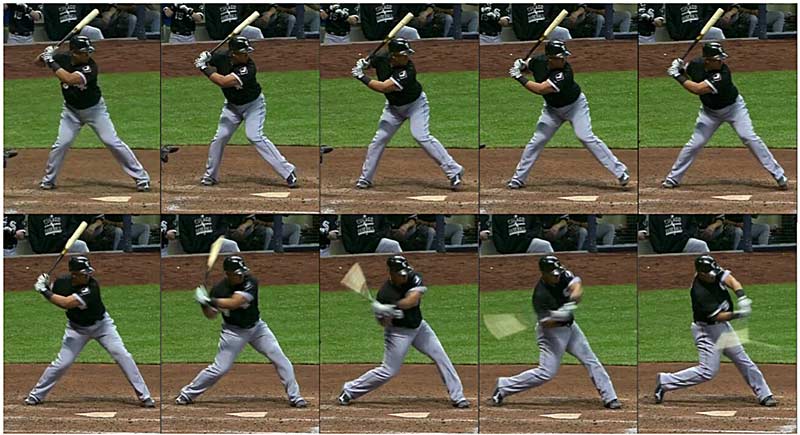
Boxing uses the same principle—it’s just compressed.
Sometimes it’s a full step.
Sometimes it’s a subtle shift.
Sometimes it feels like a controlled fall into the punch.
But the idea is the same:
You move your weight first…
then rotate it into the target.
That combination—linear movement and rotation working together—is what creates real power.
If you stay planted, you can generate force—but you may not have enough space to fully express it.
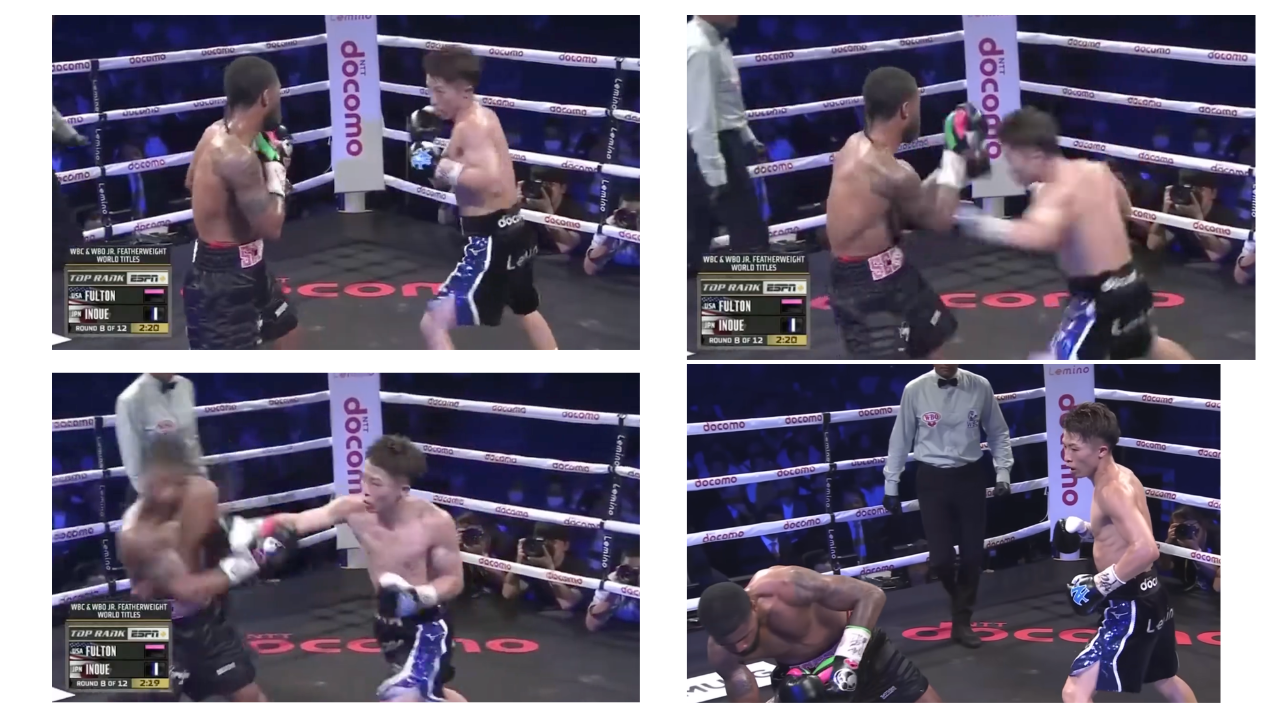
If you only step without control, you lose balance and leak energy.
The goal is to do both:
- Move your center of mass under control
- Stay inside your base of support
- Push into the ground
- Rotate without restriction
- Transfer that force cleanly into the punch
Sometimes that means pivoting.
Sometimes that means stepping.
Most of the time, it’s a blend of both.
You’re not just turning your body.
You’re not just stepping forward.
You’re creating space, moving your weight, and converting it into force.
You’re not stepping to step.
You’re stepping to move your weight—and make the punch heavier.
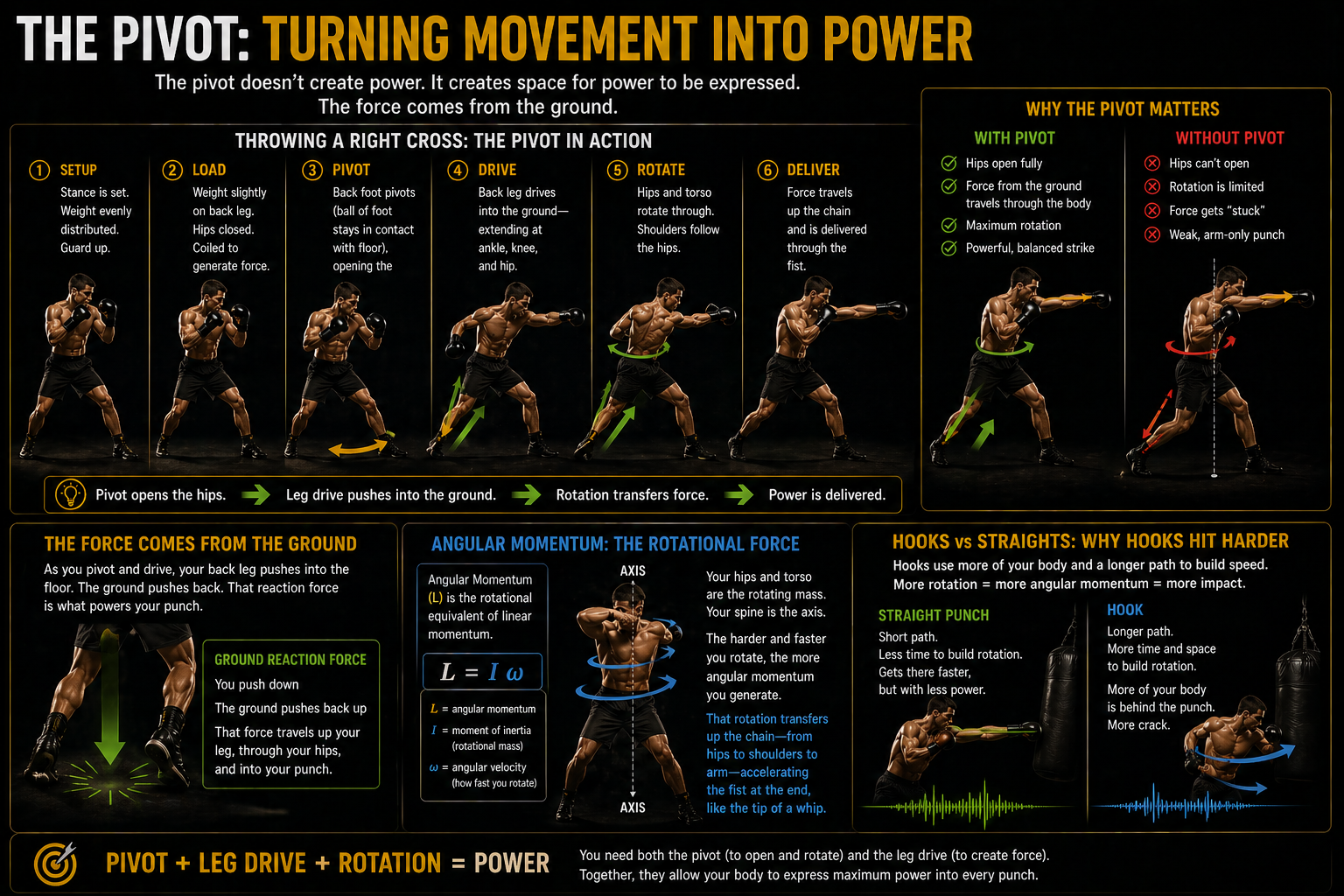 This is also where angular momentum comes into play.
In physics, angular momentum is the rotational equivalent of linear momentum—it’s what you get when mass is moving around an axis. In a punch, your hips and torso are that rotating mass, and your spine acts as the axis.
The harder and faster you rotate your body, the more angular momentum you generate. As that rotation transfers up the chain—from hips to shoulders to arm—it accelerates the fist at the end, much like the tip of a whip.
My hooks always hit the bag with more crack than my straight punches. That’s because the rotational motion lets me bring more of my body into the shot and accelerate the fist over a longer path.
A straight line gets there faster—but a hook has more room to build speed on the way. If the timing is right, that extra buildup shows up as a sharper impact and a louder crack.
(Fighting physics note) Cracking the Bag: The Sound of Excellence
That sharp cracking sound isn’t just satisfying—it’s a sign of efficient force transfer.
It happens when a large amount of force is delivered in a very short amount of time. In physics, this is a high rate of force application—what’s often referred to as impulse.
When your punch lands cleanly, the glove and the surface of the bag deform and snap back quickly. That rapid compression and release causes the materials to vibrate, and those vibrations produce the sharp “crack” you hear.
A dull thud, on the other hand, usually means the force was spread out over a longer time—less snap, less efficiency, less impact.
By the time your fist lands, your hips should have rotated aggressively into the punch—but only as far as you can control while staying balanced and in position to defend.
As a general guideline:
- Right cross: ~30–60° of hip rotation
- Lead hook: ~45–75° (sometimes more on committed shots)
- Uppercut: ~20–45°, with more emphasis on vertical drive than rotation
- Power jab: minimal rotation (~10–25°), mostly driven by a quick weight shift
These aren’t targets to chase—they’re the natural result of good mechanics. The moment you try to force more rotation than you can control, you lose your base, your timing breaks down, and your power disappears.
You see this same combination of drive and rotation in baseball, football, javelin, and discus. Any sport that involves throwing something with speed and power follows the same pattern: push into the ground, rotate the body, and transfer that force into the object.
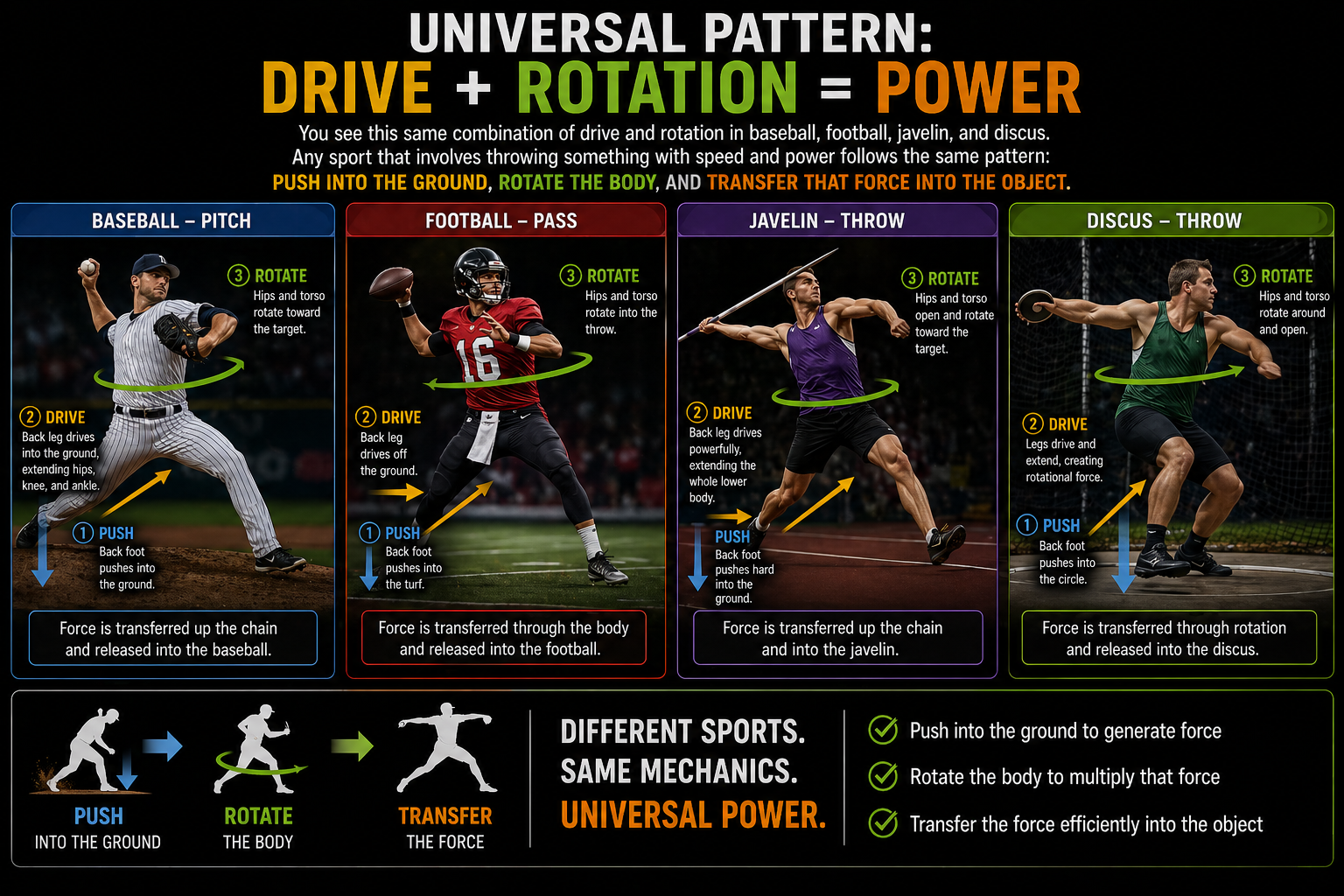
The only reason people miss it in boxing is because the movement is compressed. You’re not winding up—you’re generating that same force in a much smaller window, while staying balanced and ready to defend.
But the principle is identical.
You’re not just turning your body.
You’re driving force into the ground, converting it into rotational energy, and delivering it through your fist.
The Snap: Speed and Relaxation
A common mistake is staying tense throughout the punch.
Tension is the enemy of speed, which also makes it the enemy of power.
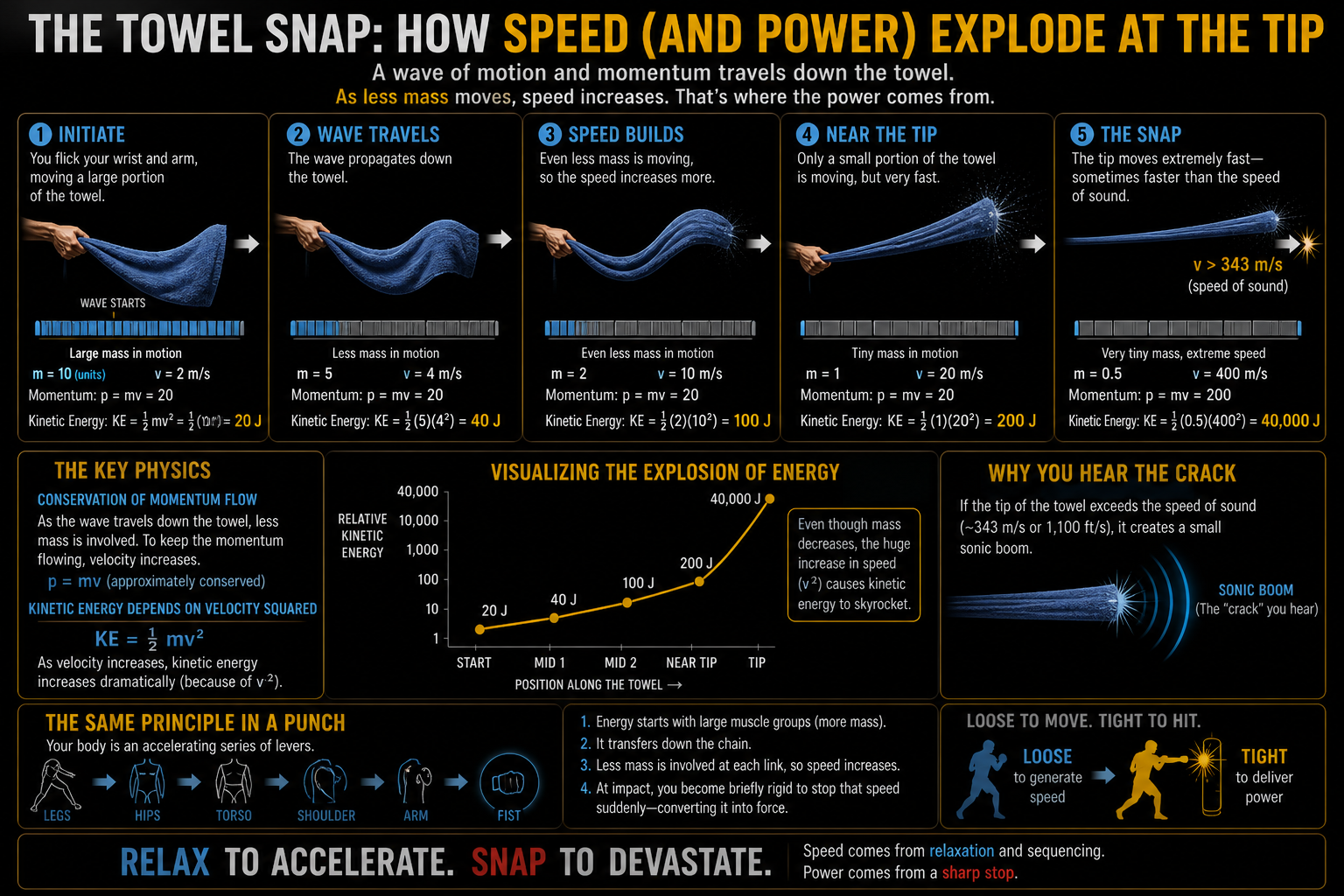
To understand why, it helps to look at something simple: a towel snap.
When you flick a towel, the motion doesn’t come from brute force. It comes from timing and sequencing.
You start the movement with your arm and wrist, sending (propagating) a wave of kinetic energy down the length of the towel. As that energy wave propagates, less and less mass is moving, so the speed of the wave increases (conservation of momentum).
By the wave of energy time it reaches the tip, it’s lighter because less of the towel is moving, but it’s faster now than your hand ever was.
That’s why you hear the crack. In some cases, the tip is moving fast enough to create a small sonic boom.
You’re not just sending a wave of energy—you’re sending a wave of motion and momentum down the chain. As less mass is involved, velocity increases dramatically. Because kinetic energy depends on velocity squared, that increase in speed causes a massive spike in energy at the tip.
Right before the towel fully extends, there’s a sudden deceleration—a sharp change in direction that accelerates the wave even more and concentrates all that energy at the very end. If the towel is wet, the added mass at the tip increases the momentum, which is why it hits harder.
 \Now, here’s where this connects to punching—and where most people get it wrong.
A punch works on the same principle of energy traveling through a chain, but with one key difference:
Your body isn’t just a flexible system like a towel—it’s an accelerating series of levers. Each segment fires in sequence, transferring energy forward while reducing the moving mass. This causes the final segment—the fist—to reach far greater speeds than any part before it.
- The legs drive the ground.
- The hips rotate.
- The torso turns.
- The shoulder, arm, and fist follow.
Each segment builds on the last, transferring and amplifying force down the chain—just like the wave in a towel. And ideally, it happens just as fast, not just so can maximize the kinetic energy you generate from the ground forces, but also so you can fight and react in real time.
If you stay tense the entire time, you break that chain.
Instead of a smooth transfer of energy, everything moves at once. You lose acceleration, you lose speed, and most importantly, you lose the ability to concentrate force at the end.
That final moment is what turns speed into damage and allows you throw punches that crack like a whip or drop like a hammer.
Essential Boxing Drills to Increase Punching Force
Now that the mechanics are set, you need to bake these movements into your muscle memory.
Use these drills as part of your boxing workout to turn theoretical knowledge into physical reality and increase your punching strength.
(Fighting physics note) Force vs. Momentum: What You Bring vs. What You Deliver
To understand why some punches feel heavy but harmless while others feel sharp and damaging, you have to distinguish between force and momentum. These two concepts are closely related, but they describe different parts of what happens in a punch.
Unfortunately, these two concepts are often used interchangeably as synonyms, but they are not the same and can not be used in place of each other.
Momentum is what you carry into the strike. It is defined as mass multiplied by velocity, which means it depends on how fast your hand is moving and how much of your body weight is effectively behind it. When a punch has good momentum, it feels like it has “weight” to it.
Momentum exists before impact. It is built through proper mechanics—using the legs, rotating the hips and torso, and allowing the arm to travel quickly and efficiently toward the target.
Force, on the other hand, is what happens at the moment of impact. It is the result of that momentum being rapidly changed—usually brought to a near stop (see the fighting physics note on impulse)—when your fist collides with something.
Force is what creates the sharp, immediate sensation of being hit. It is what causes visible effects like the snapping of the head or the compression of the body. While momentum is about motion, force is about what happens when that motion is interrupted.
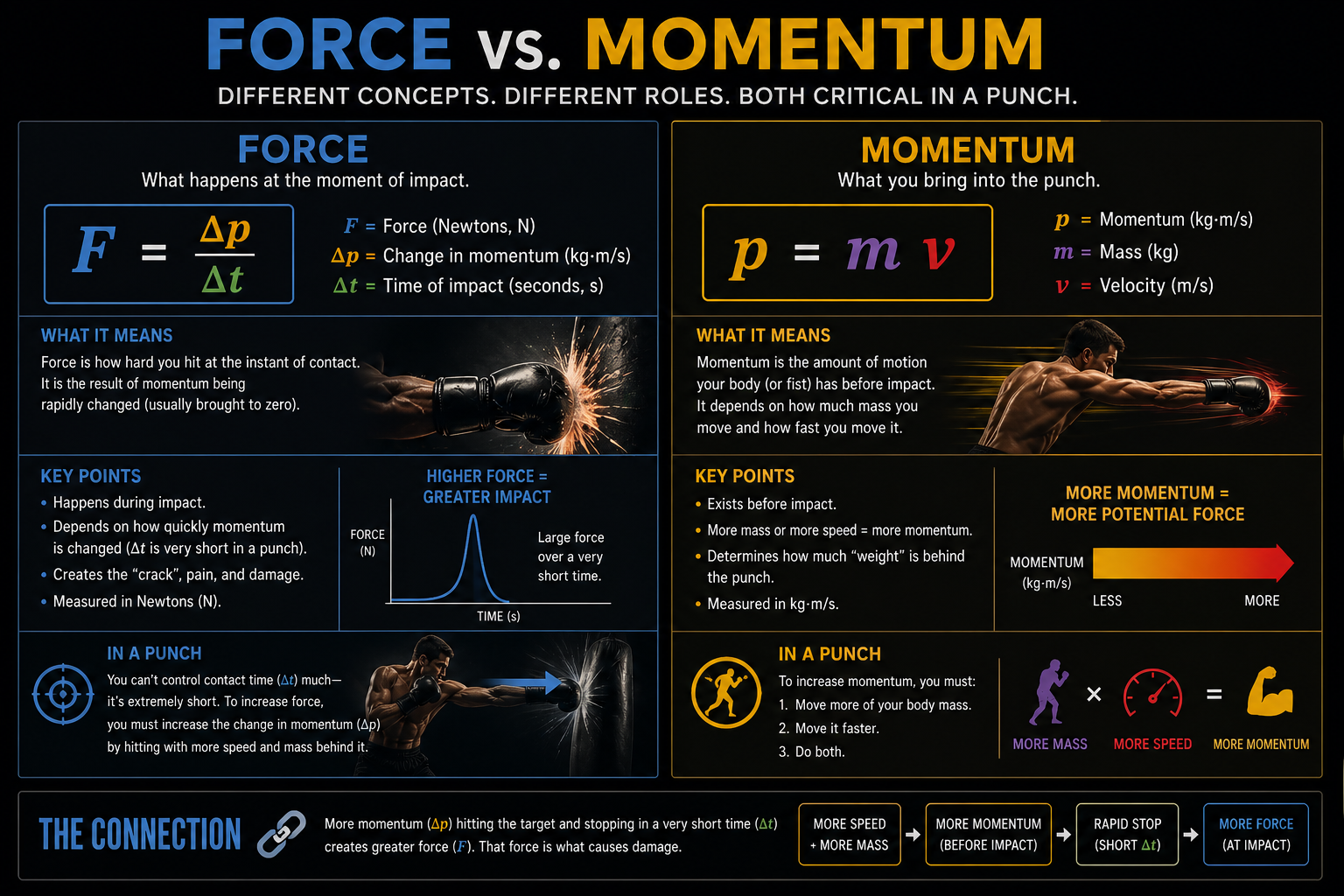
The relationship between the two is where real punching power is created. Force does not exist independently—it emerges from the change in momentum. When your fist, traveling at high speed, suddenly decelerates on contact, the large change in velocity creates a large change in momentum. That change, occurring over a very short period of time, produces a high force.
This is why speed is so critical. Increasing your velocity increases your momentum, and greater momentum creates the potential for greater force when the punch lands.
This also explains why simply trying to “push” harder does not result in a more powerful punch. A slow, forceful push may feel strong, but it lacks the momentum needed to create a sharp, damaging impact. In contrast, a fast punch that stops abruptly on contact converts its momentum into force very efficiently. The result is a strike that feels explosive rather than heavy, and damaging rather than merely forceful.
In practical terms, momentum is what you bring into the collision, and force is what you deliver when that motion is stopped. A powerful punch requires both. You must generate high momentum through speed and proper use of body mass, and then transfer that momentum cleanly at the moment of impact to produce high force.
This is why the best punches are not the ones that look the most muscular or strained, but the ones that are fast, fluid, and sharply timed.
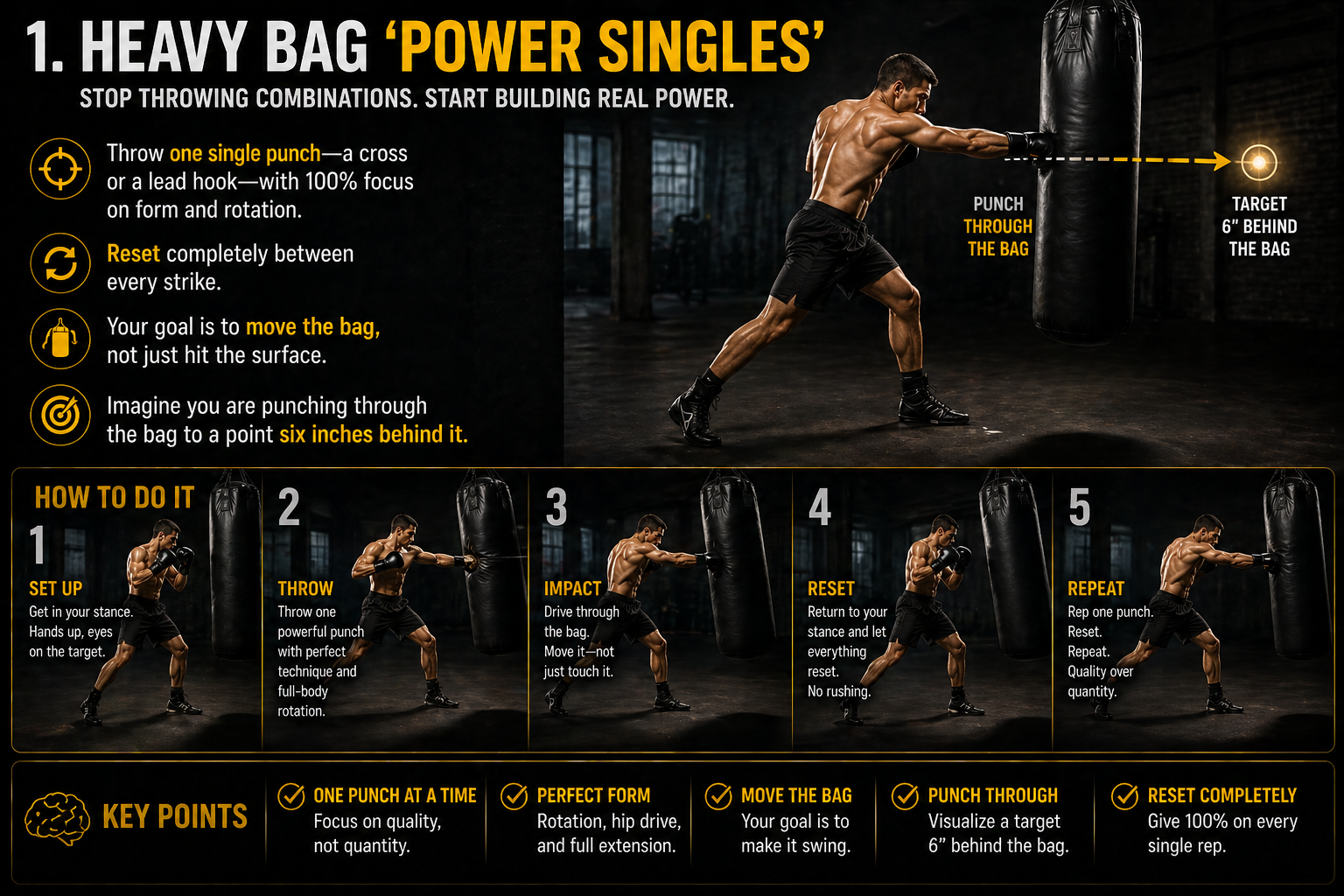
1. Heavy Bag ‘Power Singles’
Most beginners approach the heavy bag by throwing endless, pitty-pat combinations.
To build power, you must treat the bag differently.
Stand in your stance and throw one single punch—a cross or a lead hook—at the punching bag with 100% focus on form and rotation.
Reset completely between every strike. Your goal is to move the bag, not just hit the surface. Imagine you are punching through the bag to just the other side of it.
I always imagined that I was trying to hit something behind the bag. The bag just happened to be in the way and I need to punch through it.
2. Shadowboxing with Resistance Bands
The pro-weightlifting camp would have a much stronger argument if it focused more on variable resistance rather than just heavy loading.
Conventional weights use fixed resistance.
That means the load doesn’t change throughout the movement—50 pounds is 50 pounds at the bottom, the middle, and the top.
But your body doesn’t produce force evenly through a lift. Strength changes across the range of motion due to joint angles, leverage, and muscle length. There are positions where you’re mechanically weaker, and others where you’re stronger.
This creates two problems.
First, a general lifting issue:
In most exercises, the weight you can use is limited by your weakest position, not your strongest one. That’s why the hardest part of a bench press is usually near the bottom—your shoulders are in a disadvantaged position, even though your chest and triceps could handle more load later in the lift.
This mismatch is also where injuries tend to happen. It’s not that small muscles are always recruited first—that’s not how the nervous system works—but rather that certain joints and positions are more vulnerable under load. If the weight exceeds what you can safely control in that weakest range, something takes the stress.
Second, a problem specific to boxing:
Fixed weights encourage continuous tension throughout the movement. But punching isn’t a slow grind under tension—it’s a rapid acceleration followed by a brief, well-timed contraction at impact.
If you train with constant resistance—especially with hand weights—you risk teaching your body to stay tense throughout the workout. That works against the rhythm of a punch, which depends on staying loose to build speed, then tightening only at the last instant.
That’s where resistance bands come in.
Bands provide variable resistance.
At the start of the movement, there’s very little tension. As you extend, the resistance increases.
This better matches the mechanics of a punch.
You can accelerate freely early in the movement—staying relaxed and fast—then encounter increasing resistance as you approach full extension. That forces you to stabilize and contract at the end, reinforcing the “snap” of the punch without slowing it down at the start.
Bands let you train the exact pattern you want—loose during acceleration, tight at impact.
The best exercise for this is to wrap a long resistance band around your back and hold the ends in your hands. Or bands attached to a wall or around a post.
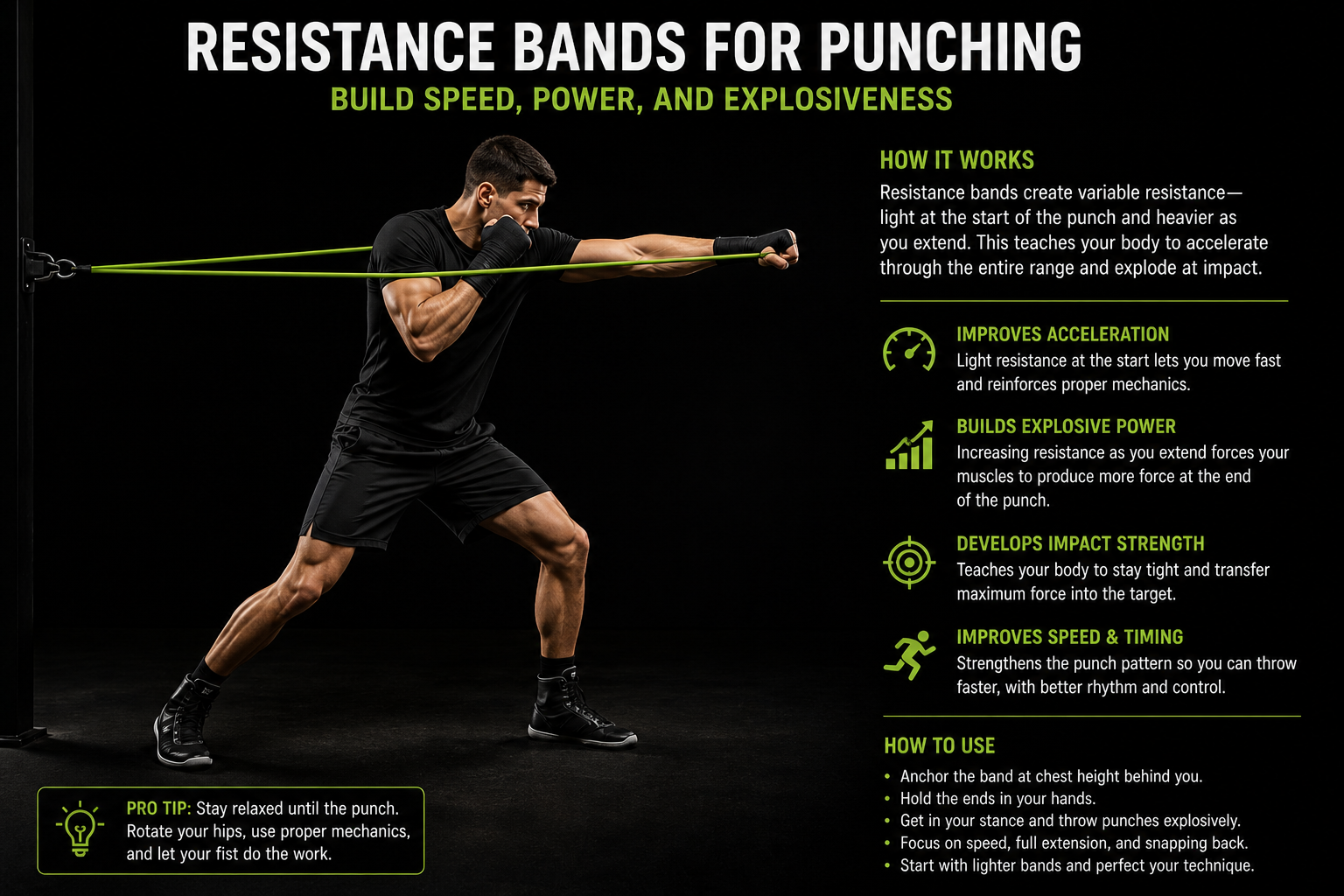
Perform your shadowboxing routine against the tension. The bands provide the most resistance at the end of the punch, acting as a form of resistance training that forces your muscles to accelerate through the entire range of motion.
This trains your body to avoid “slowing down” before impact, a common bad habit.
3. The Double-End Bag for Precision and Timing
Power is useless if it misses.
The speed bag builds rhythm, endurance, and basic cardio, but it doesn’t demand precision in the face of uncertainty. The double-end bag is different—it introduces unpredictable movement, which forces your nervous system to solve a much harder problem: when and how to apply force.
This is where “counter-power” comes in.
When you let the double-end bag move and then strike as it comes toward you, you’re not just practicing timing—you’re training your brain and body to coordinate force production under dynamic conditions.
From a scientific standpoint, this develops three key qualities:
1. Perception–action coupling
Your brain is constantly linking what you see to how you move. The double-end bag sharpens this link.
Instead of throwing pre-planned punches, you’re reacting to a moving target.
Your visual system tracks the bag’s speed and direction, and your motor system adjusts in real time.
Over repeated reps, this tightens the loop between perception and action, so you can time your punch to arrive exactly when the target is in range.
This is why fighters who hit moving targets well seem “effortless”—they’re not guessing. Their nervous system has learned the timing.
2. Rate of force development (RFD) under constraint
Effective power isn’t just how much force you can produce. It’s also about how quickly you can produce it. Improvements in rate of force development are strongly linked to explosive performance in sport (Aagaard et al., 2002; Cormie et al., 2011).
When the double-end bag is moving toward you, the window to land a clean shot is small, so you’re forced to generate force quickly and precisely. This trains your rate of force development in a way that static drills can’t.
Even more important: you’re learning to produce that force at the exact moment it matters, improving your timing. Not too early and not too late.
3. Effective impact through relative velocity
When you meet the bag as it’s coming toward you, you increase the relative velocity between your fist and the target.
Here’s another way to look at this:
If you punch a stationary object, all the speed comes from you. If the object is moving toward you, the speeds combine, increasing the effective impact due to higher relative velocity and momentum exchange (Walilko et al., 2005).
That increases the effective impact without requiring you to swing harder. But you only get that benefit if your timing is right—too early or too late, and the effect is lost.
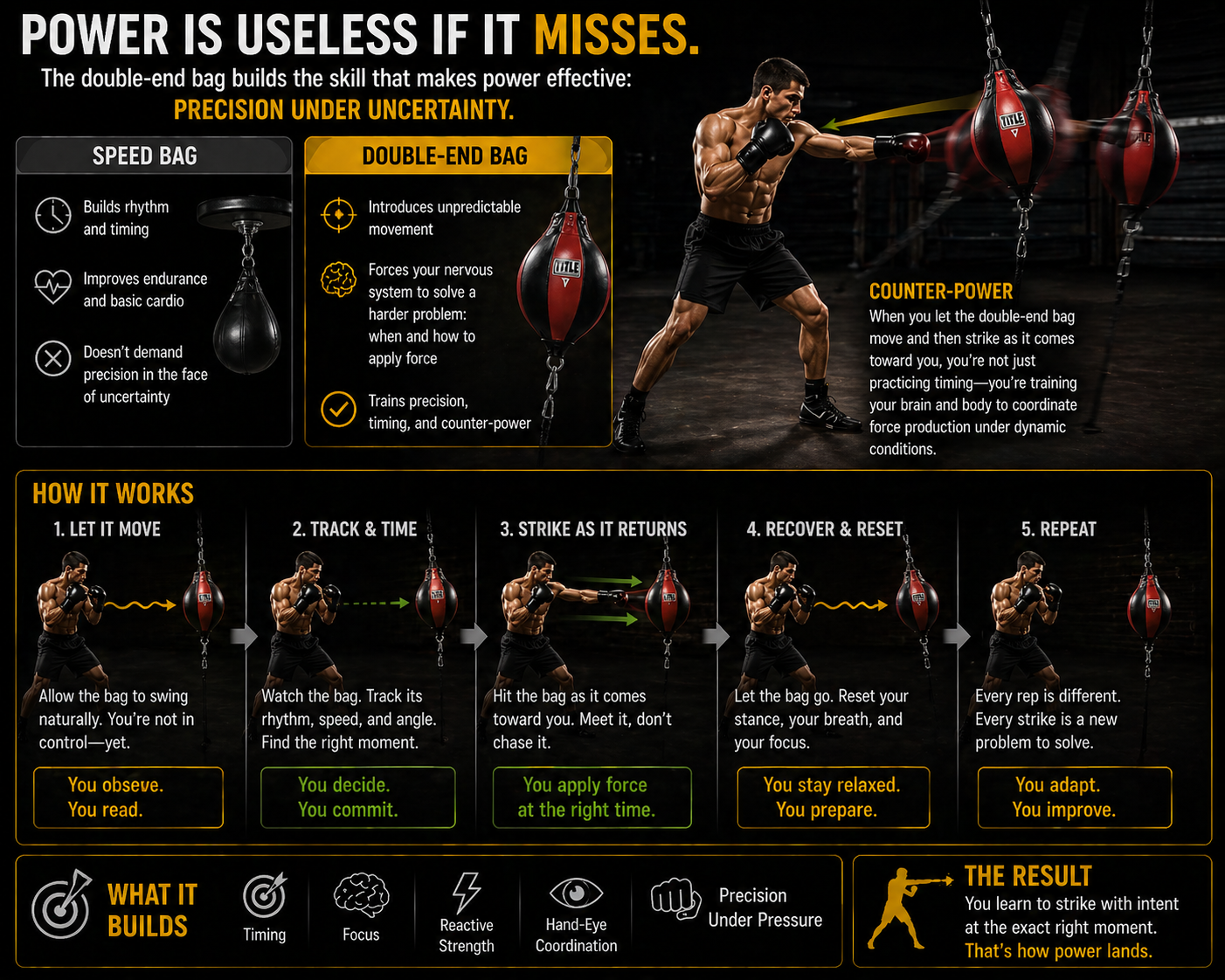
The double-end bag allows you to get your nervous system comfortable striking targets that are not just moving erratically, but also moving towards you, bridging the gap between bag work and live sparring. This mimics the conditions of a fight and gets your nervous system comfortable unleashing power in a variety of situations.
This is why counter-punchers often look like they hit harder than they “should.” They’re not necessarily stronger—they’re better at colliding with incoming force.
So what this drill really does is teach your nervous system to:
- Stay relaxed until the right moment
- Recognize when that moment is
- Deliver force rapidly and precisely into a moving target
That’s the difference between having power and being able to use it.
Effective punching power isn’t just force—it’s force applied at the right place, at the right time, under the right conditions.
The double-end bag is one of the few tools that trains all three at once.
4. Wall Sprints and Explosive Footwork
Power doesn’t start in your hands—it starts with how well you use the ground.
When you punch, you’re not just extending your arm. You’re pushing into the floor and using that force to drive your body forward. The faster you can generate and redirect that force, the more of your body weight you carry into the punch.
That’s exactly what the wall high-knee drill trains.
Find a wall and place your hands against it at shoulder height. Lean slightly forward so your body forms a straight line from head to heel. From there, drive your knees up rapidly while striking the ground with the balls of your feet as fast as possible for 15–20 seconds of high-intensity effort.
The key is intent: every contact with the ground should be sharp, fast, and forceful—like you’re trying to push the ground away, not just tap it.
If you’ve done sprint training, this should feel familiar. It’s essentially a sprint drill in place.
And that’s not a coincidence.
Sprinting and punching both depend on the same underlying mechanics, particularly the ability to generate high force in short ground contact times (Weyand et al., 2000; Morin et al., 2012).
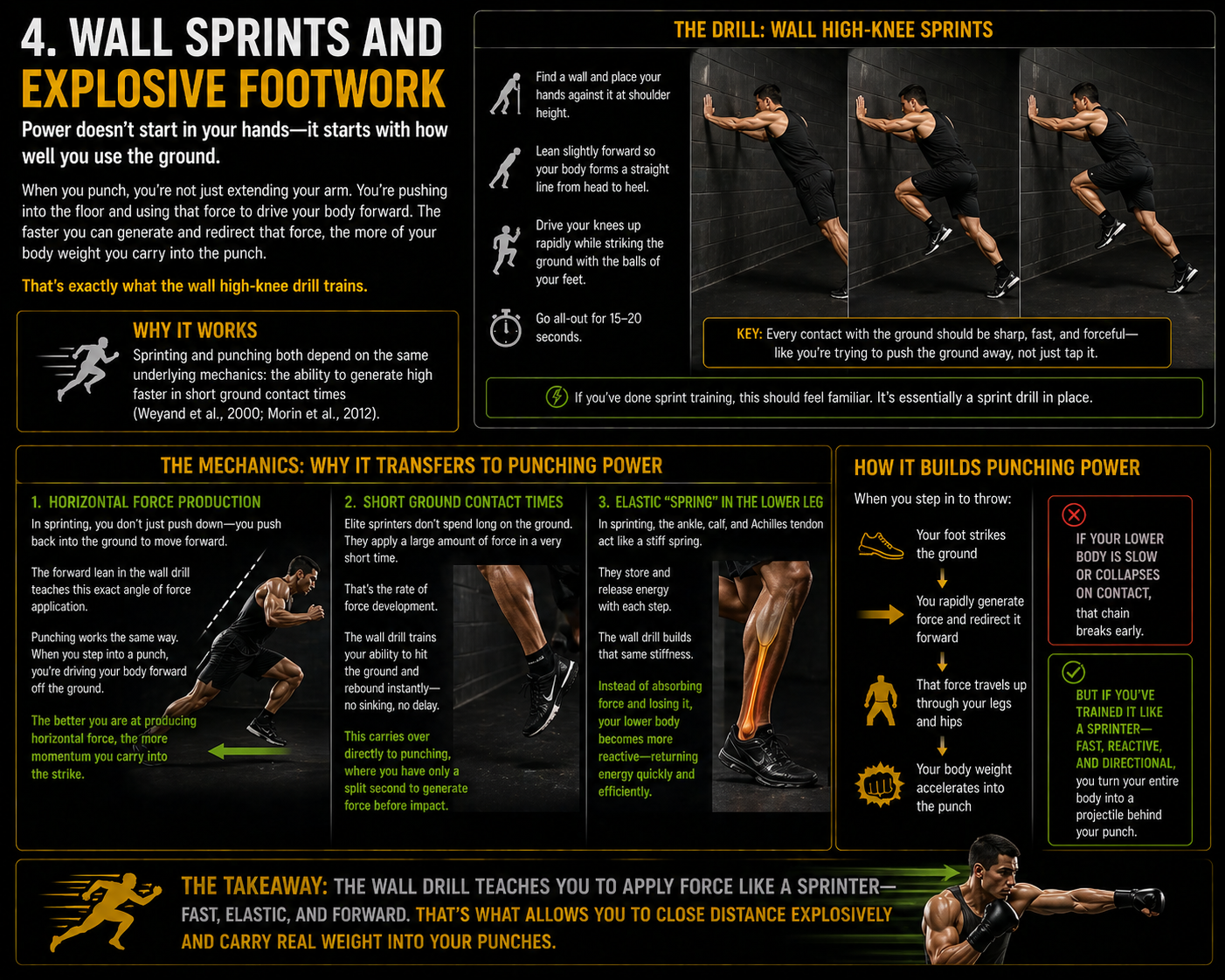
1. Horizontal force production
In sprinting, you don’t just push down—you push back into the ground to move forward. The forward lean in the wall drill teaches this exact angle of force application.
Punching works the same way. When you step into a punch, you’re driving your body forward off the ground. The better you are at producing horizontal force, the more momentum you carry into the strike.
2. Short ground contact times
Elite sprinters don’t spend long on the ground. They apply a large amount of force in a very short time.
That’s the rate of force development. The wall drill trains your ability to hit the ground and rebound instantly—no sinking, no delay. This carries over directly to punching, where you have only a split second to generate force before impact.
3. Elastic “spring” in the lower leg
In sprinting, the ankle, calf, and Achilles tendon act like a stiff spring. They store and release energy with each step.
The wall drill builds that same stiffness. Instead of absorbing force and losing it, your lower body becomes more reactive—returning energy quickly and efficiently. That’s what gives you that explosive “pop” when you step into a punch.
So what does this mean for your punching power?
When you step in to throw:
- Your foot strikes the ground
- You rapidly generate force and redirect it forward
- That force travels up through your legs and hips
- Your body weight accelerates into the punch
If your lower body is slow or collapses on contact, that chain breaks early.
But if you’ve trained it like a sprinter—fast, reactive, and directional—you turn your entire body into a projectile behind your punch.
The wall drill teaches you to apply force like a sprinter—fast, elastic, and forward. That’s what allows you to close distance explosively and carry real weight into your punches.
The Power Punching Blueprint
There are more drills than just the ones I give in the Power Punching Blueprint. If you found these useful, then you need to check out the Power Punching Blueprint. The creator graciously contributed to this article.
Learn more hereStrength and Conditioning for Knockout Power
Traditional strength training and bodybuilding—slow, controlled reps designed to build muscle—have limited carryover to punching power.
Force depends on how much mass you move and how quickly you accelerate it.
In punching, your mass is mostly fixed. You’re not gaining 50 pounds overnight. So once you’ve built a solid strength base, the only way to increase force is to improve acceleration.
Now layer in power:
Power is how quickly you apply that force. That’s what separates a hard punch from a knockout punch.
(Fighting physics note) Power: How Fast You Deliver Force—and How That Becomes Damage
Power is what determines how quickly your body can generate and deliver force into a punch. If momentum is what you carry into the strike, and force is what shows up at impact, then power is the rate at which you turn that built-up motion into something violent.
In simple terms, power is force multiplied by velocity. This means it’s not enough to be strong—you have to be fast. The faster you can move your hand while maintaining structure, the more rapidly you can deliver force into the target.
But power by itself doesn’t tell the full story. To understand what actually causes damage, you have to connect power to impulse.
Impulse is the change in momentum during impact. It’s what determines how much you actually move or disrupt your opponent when you land a punch. And here’s where the relationship becomes clear: power is what allows you to build high momentum quickly, and impulse is what happens when that momentum is abruptly stopped and transferred into the target.
A powerful punch, then, is not just one that generates force—it’s one that generates force quickly enough to create high velocity, which builds momentum, which is then converted into a large impulse at impact.
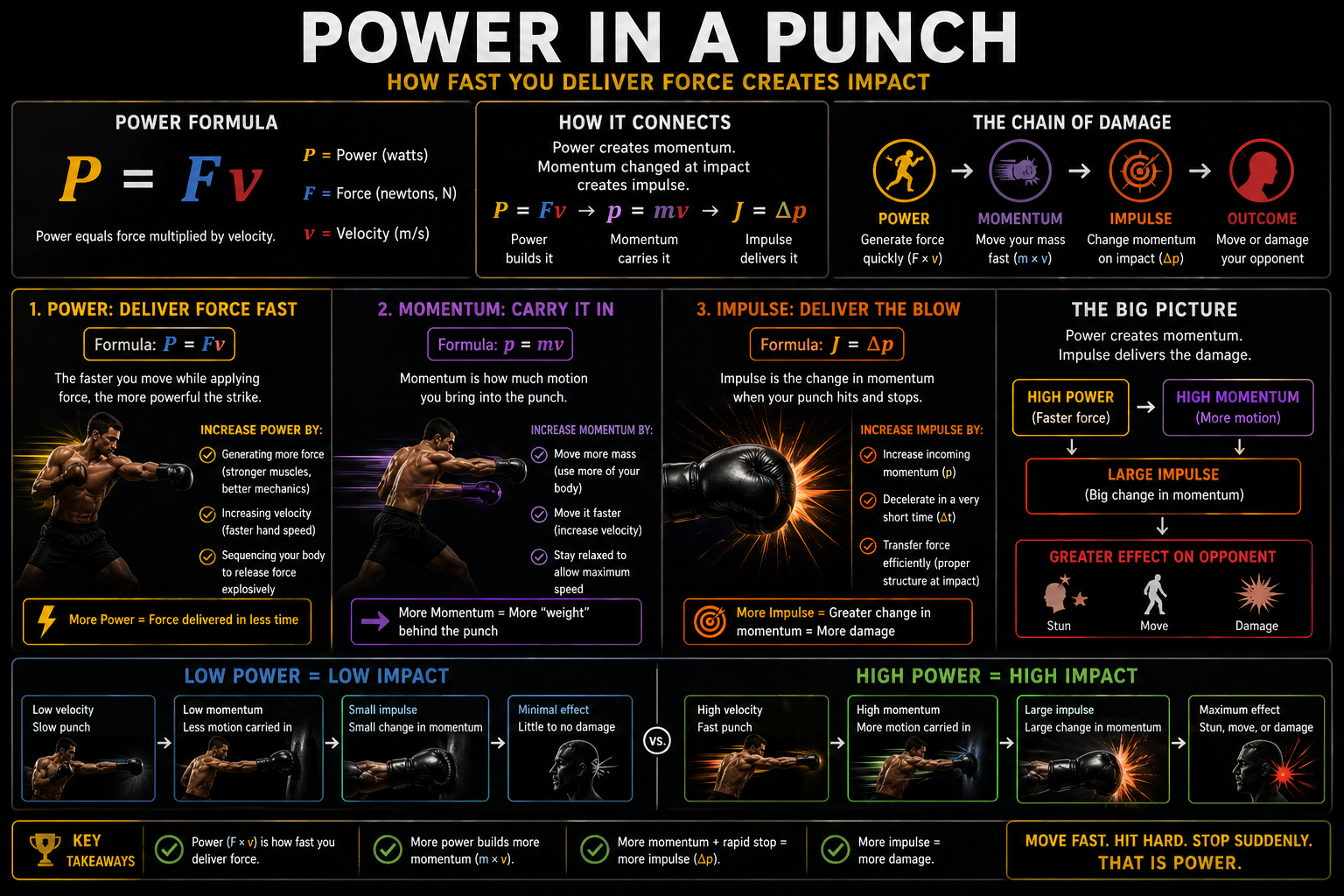
This is why speed is so critical. Increasing your velocity does two things at once. First, it increases your power, because you are delivering force more quickly. Second, it increases your momentum, because momentum depends directly on velocity. When that faster-moving fist collides and decelerates, the larger change in velocity produces a larger change in momentum—and therefore a greater impulse.
In other words, power sets the stage for impulse.
This also explains why slow, grinding punches lack effectiveness. You may be applying force, but you’re doing it too gradually. The velocity is low, the momentum is limited, and the resulting impulse is small. In contrast, a fast, well-timed punch generates force rapidly, carries significant momentum, and then stops suddenly on impact. That sudden, violent transfer is what creates damage.
Technique determines whether this chain holds together. If you are tense too early, you reduce velocity and limit power. If you are too loose at impact, the structure collapses and the momentum you created never fully transfers. But when everything is timed correctly—when you stay relaxed to build speed and then briefly stiffen at impact—you maximize power on the way in and impulse at the moment of contact.
In practical terms, power is how quickly you can bring force to the fight, and impulse is how effectively that force is delivered when it lands. The most dangerous punches are not just strong—they are fast enough to build momentum and precise enough to transfer it instantly.
Two fighters can be equally strong, but the one who can generate force faster and transfer it cleanly through the body will hit harder.
That’s why you need ballistic training—exercises that force you to move explosively, not grind slowly. Explosive and plyometric training have been shown to improve power output and movement velocity (Newton & Kraemer, 1994; Cormie et al., 2011).
Because once you’re strong enough, the limiting factor becomes:
How fast can you turn that strength on—and how well can you transfer it?
Beyond a certain threshold, improvements in performance depend more on the rate of force development than maximal strength (Aagaard et al., 2002; Cormie et al., 2011).
1. Medicine Ball Rotational Throws
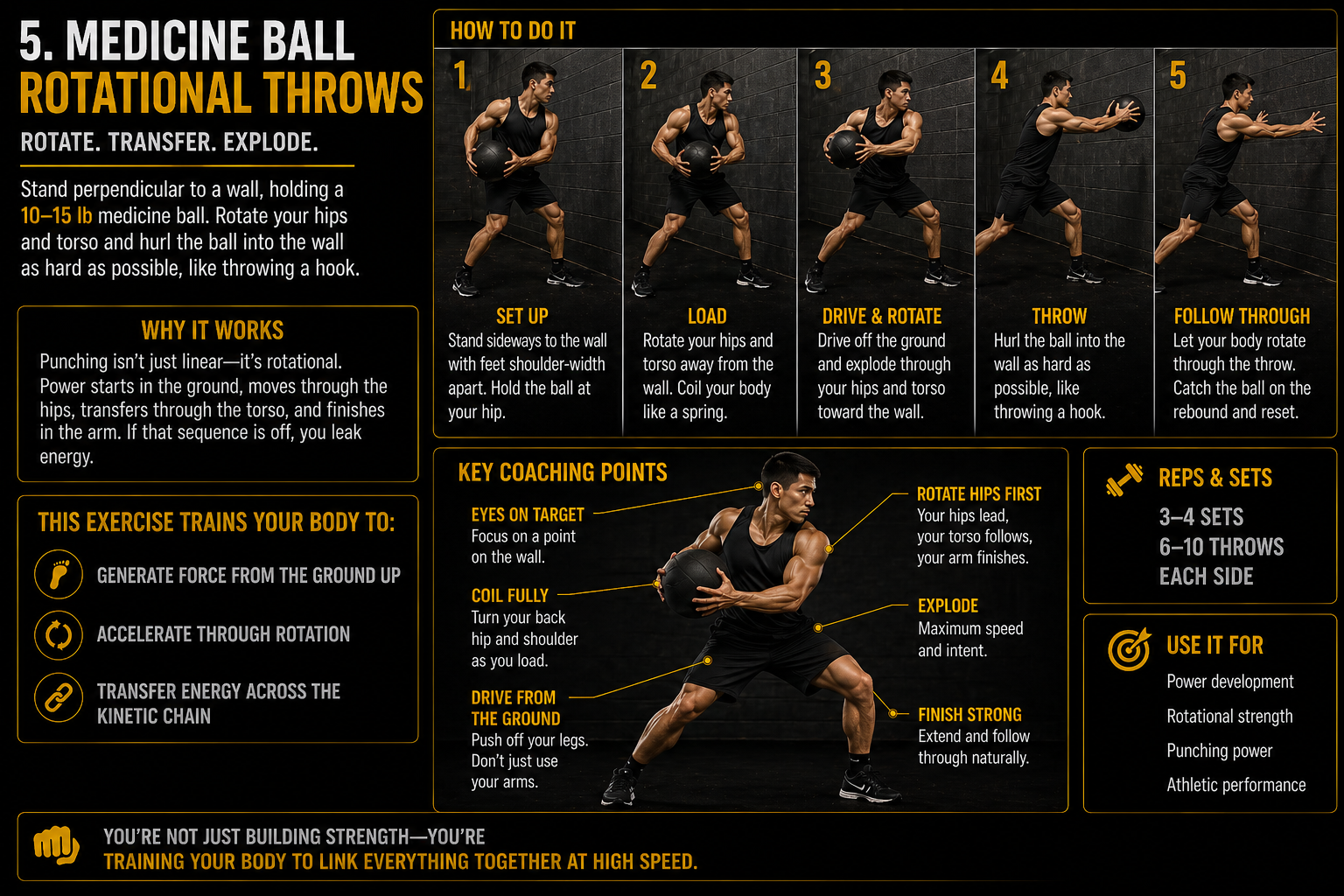
Stand perpendicular to a wall, holding a 10–15 lb medicine ball. Rotate your hips and torso and hurl the ball into the wall as hard as possible, like throwing a hook.
This is one of the best exercises for developing rotational power and sequencing.
Punching isn’t just linear—it’s rotational. Power starts in the ground, moves through the hips, transfers through the torso, and finishes in the arm. If that sequence is off, you leak energy.
Medicine ball throws train your body to:
- Generate force from the ground up
- Accelerate through rotation
- Transfer energy across the kinetic chain
You’re not just building strength—you’re training your body to link everything together at high speed.
2. Plyometric Push-Ups
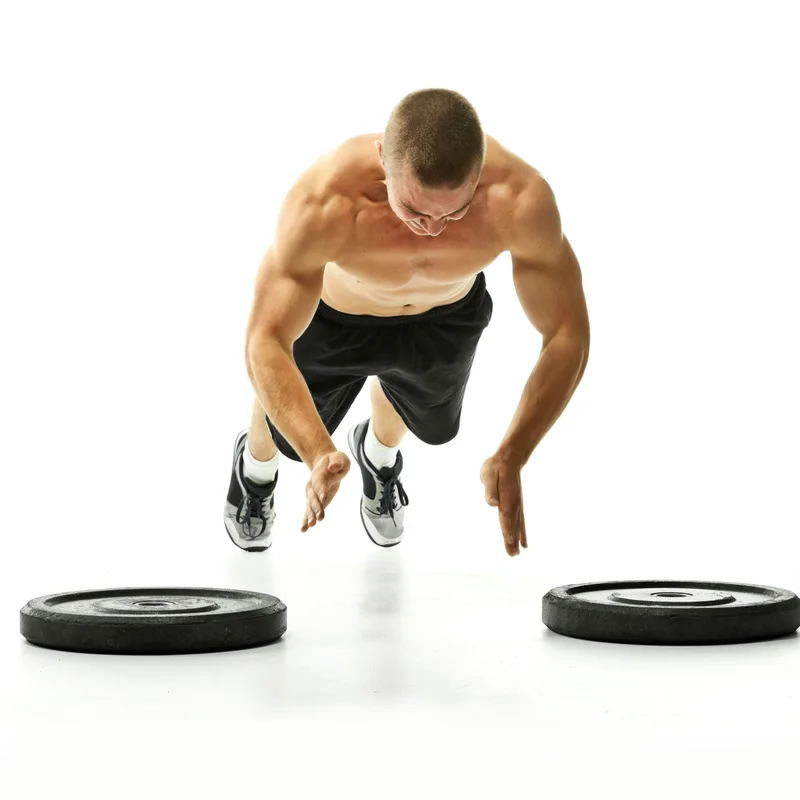
Perform explosive push-ups where the hands leave the ground on every repetition. More advanced variations can include clapping push-ups or reactive plyometric push-ups.
This exercise develops one of the most important qualities in punching power:
Rate of force development (RFD).
In boxing, and all combat sports, force alone is not enough. A punch happens far too quickly for maximal strength to fully develop. What matters is how rapidly the nervous system can recruit muscle fibers and produce force.
Explosive plyometric push-ups address this problem directly. A punch may involve more than your arm, but it still involves your arm.
During the movement, the chest, shoulders, triceps, serratus anterior, and core must contract with enough speed and force to project the body off the ground. This teaches the nervous system to rapidly recruit high-threshold motor units, especially fast-twitch muscle fibers responsible for explosive movement.
Plyometric training like this improves:
- explosive upper-body force production
- neuromuscular firing speed
- fast-twitch fiber recruitment
- reactive force production
- stretch-shortening cycle efficiency
- upper-body acceleration capacity
One of the most important adaptations comes from the rapid transition between eccentric loading and concentric contraction.
As the body lowers toward the floor, muscles rapidly lengthen under tension. This stores elastic energy and activates stretch reflex mechanisms. The faster the body can reverse direction, the more force can be expressed explosively during the upward phase.
This is part of the stretch-shortening cycle that contributes to the “snap” seen in fast punches.
Biomechanically, explosive push-ups also teach the body to project force through the upper body while maintaining trunk stiffness and scapular control. The serratus anterior plays a major role here, helping stabilize and protract the shoulder blade during explosive extension, similar to the final phase of a punch.
The goal is not fatigue or slow grinding repetitions. Every rep should be fast, violent, and explosive. Once speed drops significantly, stop.
Slow push-ups can build muscle and general strength.
Explosive push-ups train the nervous system to express force rapidly, which is far closer to the demands of punching.
3. The Landmine Press
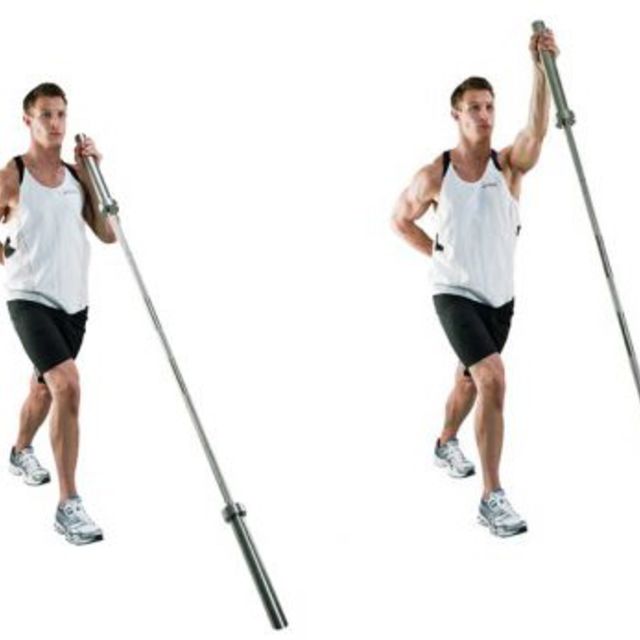
With one end of a barbell anchored, press the opposite end forward and upward from a boxing stance while rotating through the hips and pivoting the rear foot.
This exercise is one of the most punch-specific pressing movements you can perform because it trains the body to produce force in the same forward direction as a punch.
Traditional strength exercises often develop force vertically. While that can improve general athleticism, punching requires the body to project force horizontally and rotationally. The landmine press bridges that gap by combining linear force production with rotational mechanics.
As the rear foot pivots and the hips rotate, force travels upward through the legs, across the torso, and finally through the shoulder and arm into the bar. This closely mirrors the kinetic chain of a straight punch.
The movement reinforces several important qualities for punching power:
- forward force projection
- hip-to-shoulder sequencing
- rotational coordination
- lower-to-upper body force transfer
- stabilization during rotation
- explosive extension through the shoulder
One of the biggest benefits of the exercise is that it teaches the arm to stay connected to the rotation of the torso instead of pressing independently.
The angled pressing path of the landmine also naturally encourages scapular movement and serratus anterior activation. This is important because the serratus helps protract the shoulder blade during the final phase of a punch, contributing to reach, force transfer, and shoulder stability.
Biomechanically, the movement trains the body to accelerate force forward while remaining balanced and structurally connected. The rear foot pivot teaches rotational release through the hips, while the core learns to stabilize and transmit force efficiently during explosive movement.
The key is to avoid treating the movement like a slow bodybuilding press. The goal is explosive intent while maintaining posture and balance. Drive from the floor, rotate through the hips, brace the core, and let the arm transfer the force rather than generate it independently.
4. Landmine Rotations
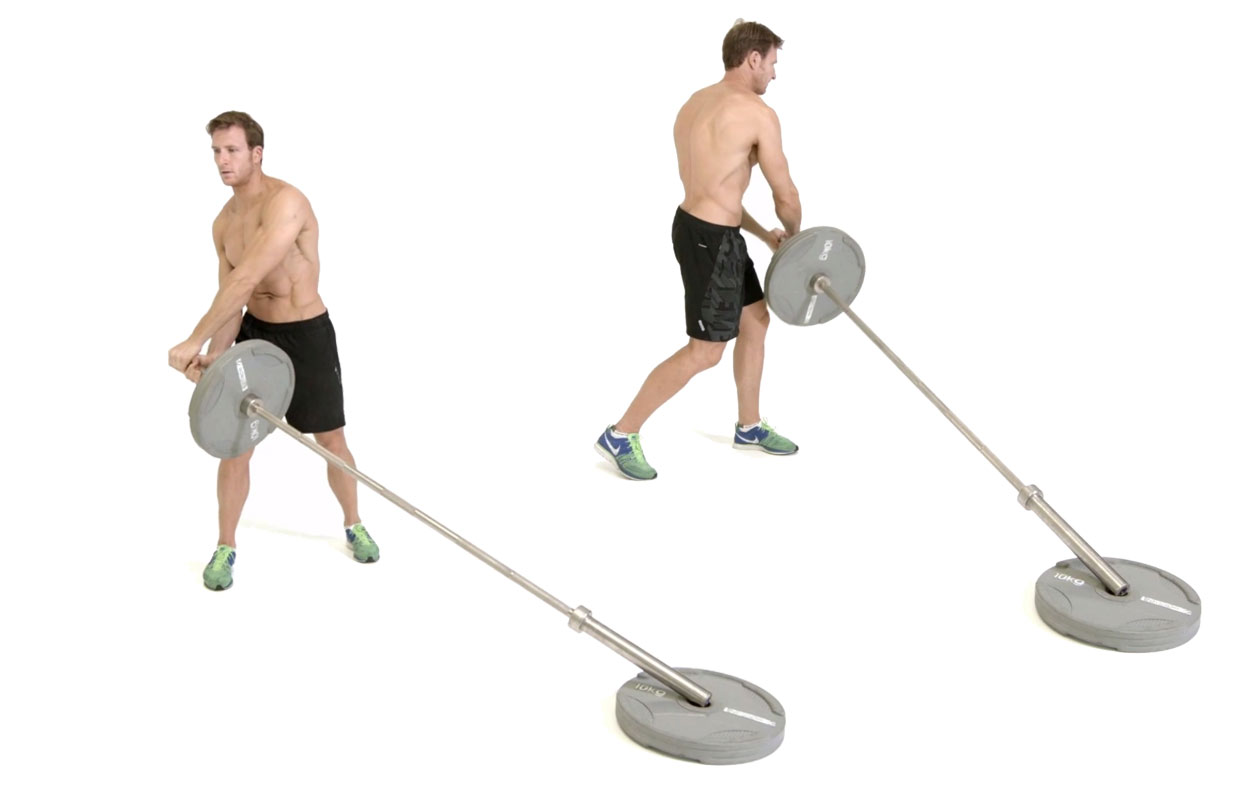
Few exercise train rotation of the hips and torso better than landmine rotations.
As you rotate the bar from one side of the body to the other, the exercise forces the body to rapidly load, reverse direction, and transfer force across the torso. This closely mirrors the mechanics of throwing punches while helping fighters get a feel for the muscles involved in the proper biomechanics of a punch.
One of the biggest benefits of the movement is how it trains the obliques. Despite how important they are for punching power, many fighters are not a aware of what it feels like to activate these muscles during a punch.
During a punch, one side of the torso stretches while the other side contracts explosively. This creates a stretch-shortening cycle across the core, allowing elastic energy to contribute to rotational speed and force.
The landmine rotation reinforces this same pattern.
As the torso rotates:
- the hips initiate movement
- the obliques transfer force
- the deep core stabilizes the spine
- the shoulders and serratus anterior finish the motion
- The elbow is fixed, force you to learn what muscles to engage in your core for punching
This teaches the body to function as a connected kinetic chain instead of isolated muscles working independently.
The exercise also improves rotational deceleration and stabilization. This is important because your body will only move as fast and as powerfully as it can control safely. Better deceleration allows you to stop and reverse rotational movement more efficiently, improving the transition between punches (Harper et al., 2022).
In boxing, that faster shift from contraction to reloading helps make combinations quicker, smoother, and more explosive.
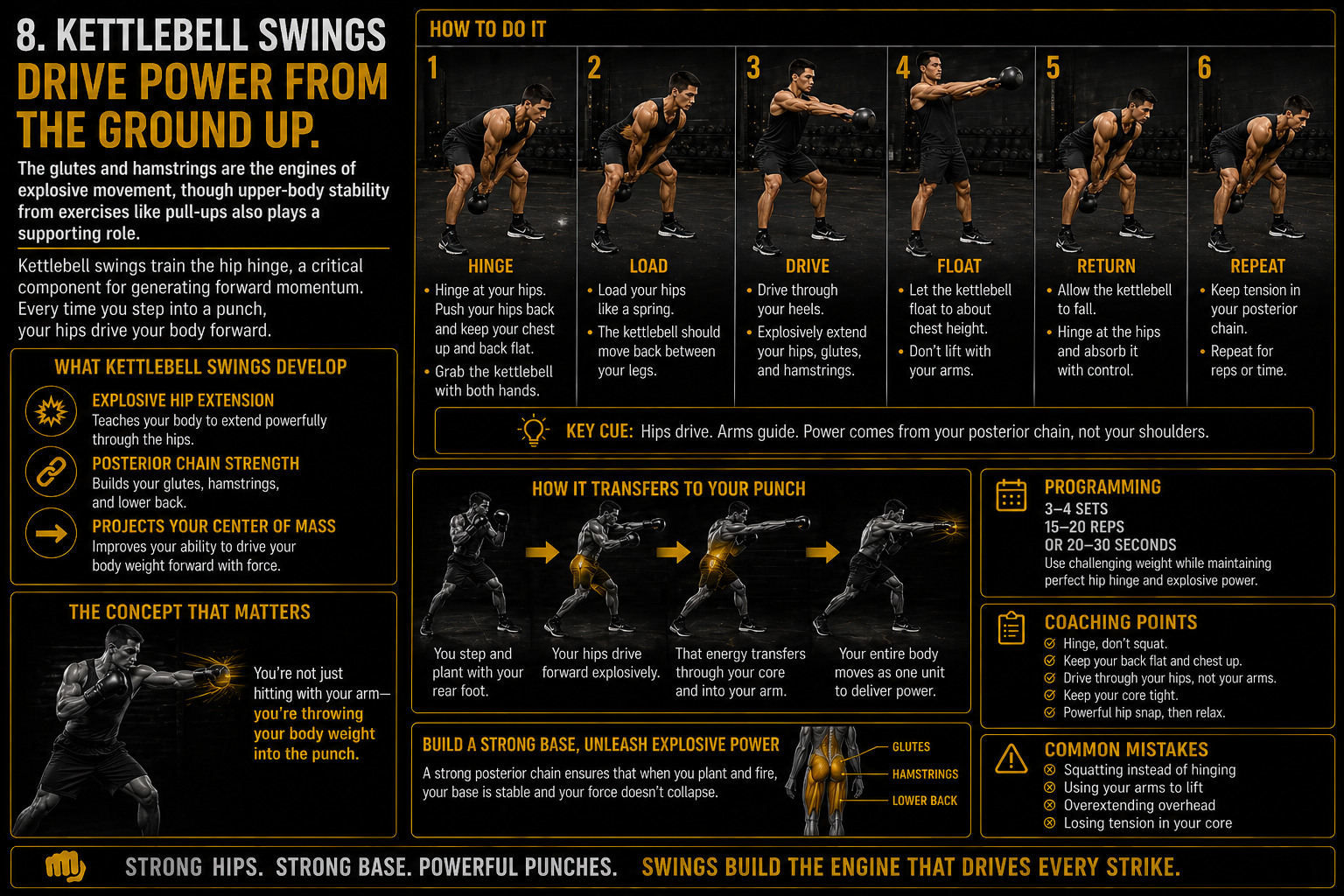
5. Kettlebell Swings (Posterior Chain Power)
The glutes and hamstrings are the engines of explosive movement, though upper-body stability from exercises like pull-ups also plays a supporting role.
Kettlebell swings train the hip hinge, a critical component for generating forward momentum. Every time you step into a punch, your hips drive your body forward.
Swings develop:
- Explosive hip extension
- Posterior chain strength (glutes, hamstrings, lower back)
- The ability to project your center of mass forward
They also reinforce a critical concept:
You’re not just hitting with your arm—you’re throwing your body weight into the punch.
A strong posterior chain ensures that when you plant and fire, your base is stable and your force doesn’t collapse.
How does all of this contribute to punching power
Each of these exercises targets a different piece of the same system:
- Medicine ball throws → rotational acceleration and sequencing
- Plyometric push-ups → upper-body rate of force development
- Landmine press → directional force and full-body coordination
- Kettlebell swings → lower-body power and force generation
Together, they train the three real drivers of punching power:
- Acceleration (how fast you can generate force)
- Velocity (how fast your body and fist are moving)
- Sequencing (how efficiently force travels through your body)
Because at a certain point, more strength doesn’t matter.
What matters is how fast you can use it—and how cleanly you can deliver it.
That’s what turns strength into knockout power.
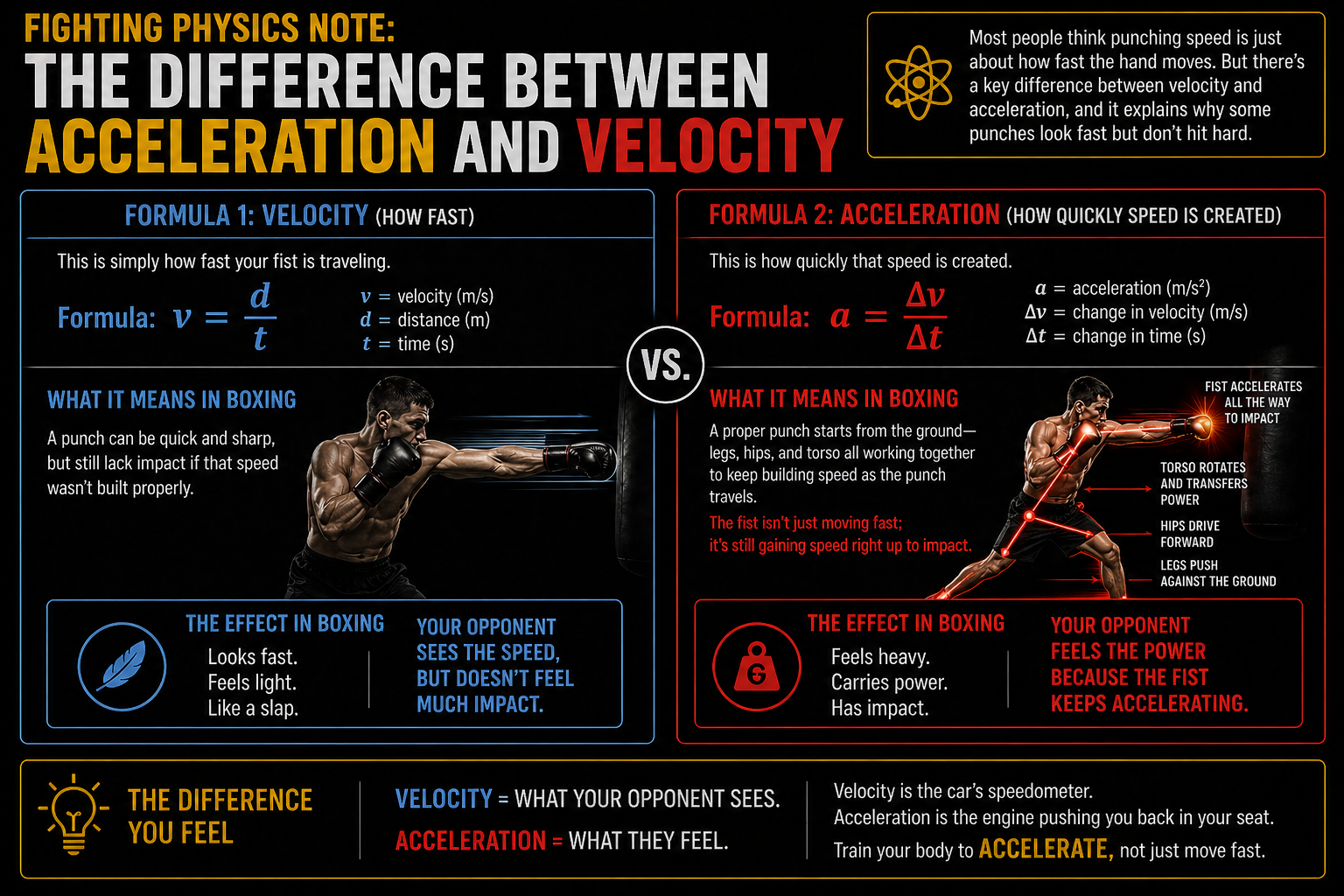
(Fighting Physics Note) The Difference Between Acceleration and Velocity
Most people think punching speed is just about how fast the hand moves. But there’s a key difference between velocity and acceleration, and it explains why some punches look fast but don’t hit hard.
Velocity is simply how fast your fist is traveling. A punch can be quick and sharp, but still lack impact if that speed wasn’t built properly.
Acceleration is how quickly that speed is created. This is where real power comes from. A proper punch starts from the ground—legs, hips, and torso all working together to keep building speed as the punch travels. The fist isn’t just moving fast; it’s still gaining speed right up to impact.
That’s the difference you feel. A punch with velocity alone feels like a slap. A punch with strong acceleration feels heavy.
Think of it this way: Velocity is what your opponent sees. Acceleration is what they feel.
Common Mistakes That Drain Your Power
Even the strongest athletes can be “weak” punchers if they fall into these common traps.
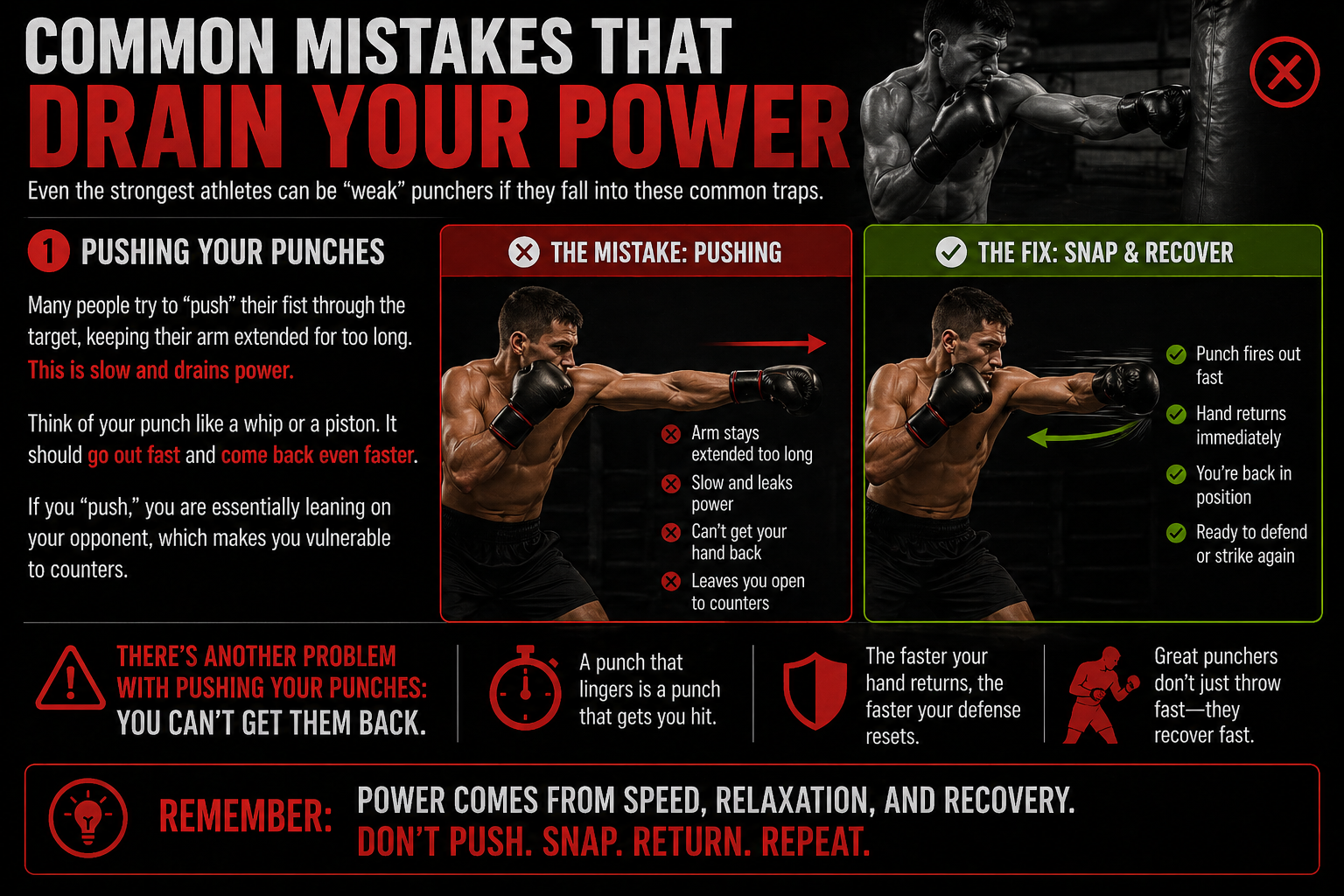
Pushing Your Punches
Many people try to “push” their fist through the target, keeping their arm extended for too long. This is slow and drains power. Think of your punch like a whip or a piston. It should go out fast and come back even faster. If you “push,” you are essentially leaning on your opponent, which makes you vulnerable to counters.
There’s another problem with pushing your punches: you can’t get them back.
A punch that lingers is a punch that gets you hit. The faster your hand returns, the faster your defense resets.
Great punchers don’t just throw fast—they recover fast.
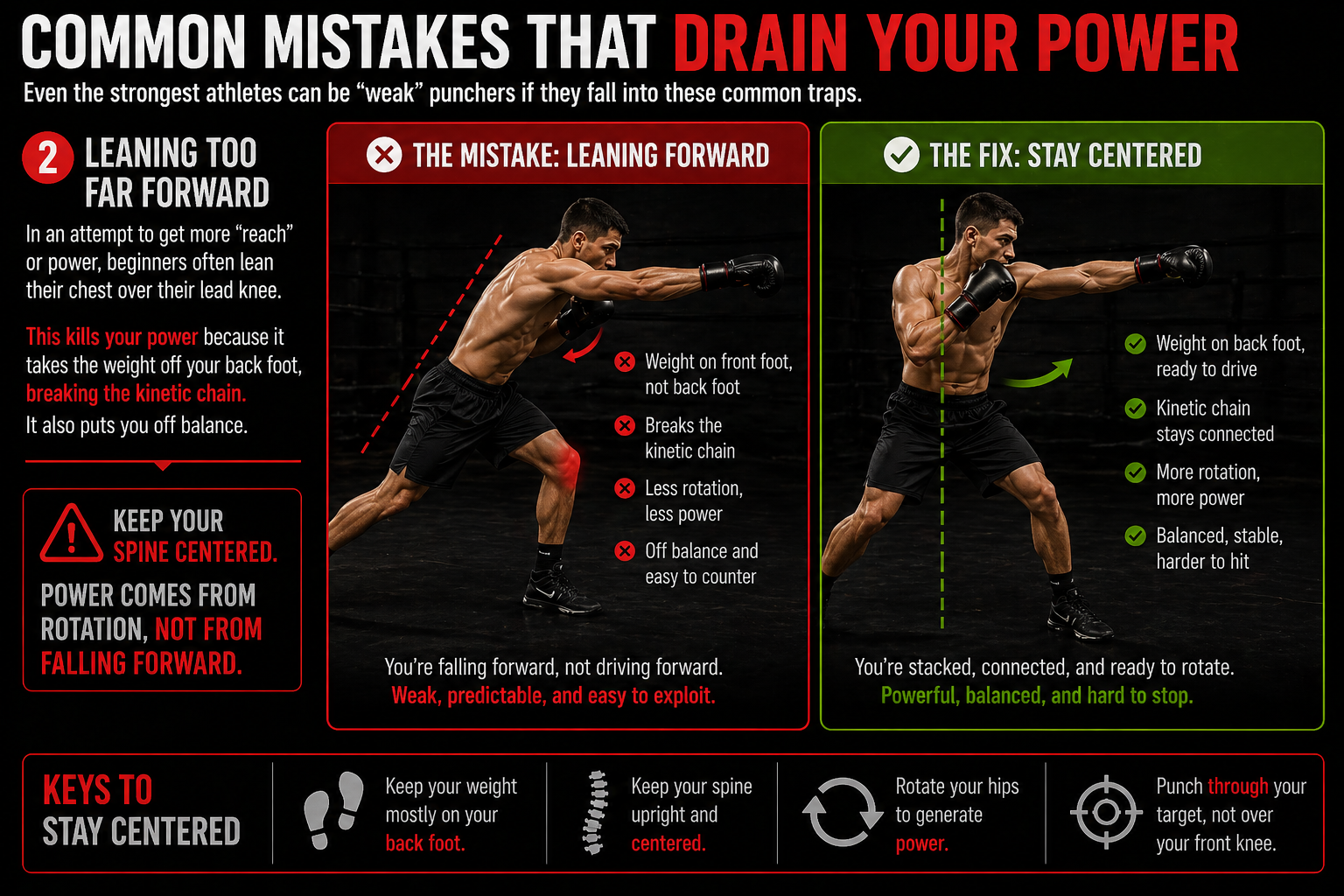
Leaning Too Far Forward
In an attempt to get more “reach” or power, beginners often lean their chest over their lead knee.
This kills your power because it takes the weight off your back foot, breaking the kinetic chain. It also puts you off balance. Keep your spine centered.
Power comes from rotation, not from falling forward.
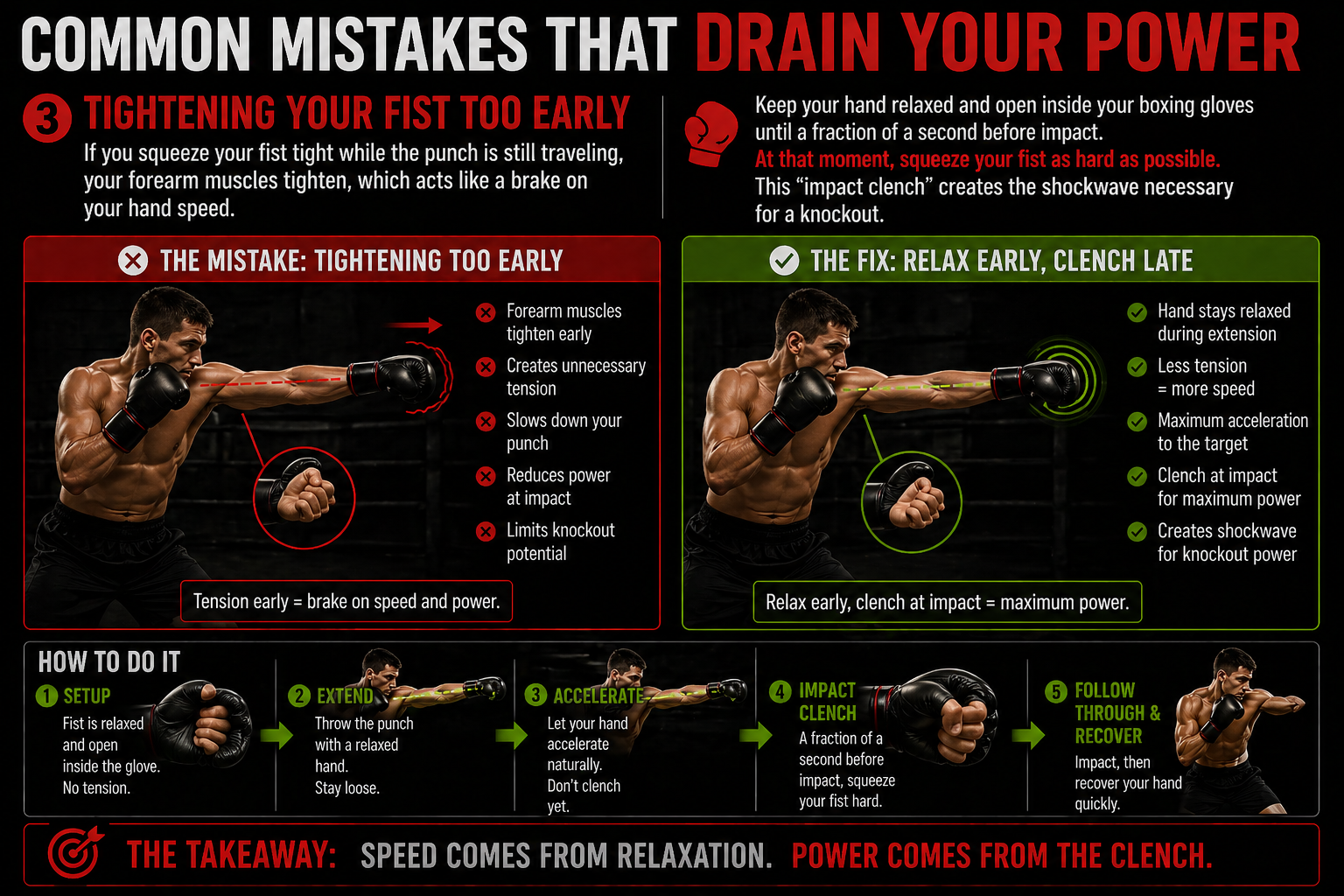
Clenching Your Fists Too Early
If you squeeze your fist tight while the punch is still traveling, your forearm muscles tighten, which acts like a brake on your hand speed.
Keep your hand relaxed and open inside your boxing gloves until a fraction of a second before impact. At that moment, squeeze your fist as hard as possible. This “impact clench” creates the shockwave necessary for a knockout.
If you remember nothing else, remember this:
Punching power = Leg drive + rotation + timing
Miss one of those, and the punch loses its edge.
Get all three working together, and even a light punch starts to feel heavy.
Your Roadmap to a Heavier Hand
Increasing your punching power isn’t about trying harder—it’s about moving better.
The hardest punchers aren’t the strongest guys in the room. They’re the ones who can coordinate their legs, hips, and upper body into a single, fluid motion. They use the ground, transfer energy through their core, and release it at the exact right moment.
Punching power isn’t a strength problem—it’s a coordination problem. Coordinated sequencing of body segments is a key determinant of force production in complex athletic movements (Bernstein, 1967; Zatsiorsky & Kraemer, 2006).
Master the sequence. Master the timing.
And when everything fires at once, that’s when your punches stop feeling like effort and start transmitting more energy in a shorter amount of time.
Frequently asked questions about punching harder
How do you punch harder in boxing?
Punching harder comes from using your entire body, not just your arms. Power is generated from the ground through your legs, transferred through your hips and core, and delivered through your arm. The key factors are leg drive, rotation, and timing—not just muscle strength.
What muscles make you punch harder?
The most important muscles for punching power are the glutes, hamstrings, and core. These muscles generate and transfer force. The arms mainly deliver the punch—they don’t create most of the power.
Why do skinny boxers hit harder than muscular guys?
Punching power depends more on coordination, speed, and technique than muscle size. Fighters who efficiently transfer force through the kinetic chain generate more effective mass and impact—even if they’re smaller.
Does lifting weights help punching power?
Weight training helps build a strength base, but it has limited carryover to punching power if done slowly. Explosive, ballistic training is more effective because punching requires speed and rapid force production.
What is the kinetic chain in punching?
The kinetic chain is the sequence of movements that transfers energy from the ground through your body into your punch. It starts at the feet, moves through the legs and hips, rotates through the torso, and finishes with the arm.
How do you use your legs to punch harder?
You punch harder by pushing into the ground with your back foot, driving your body forward, and rotating your hips. This generates ground reaction force that travels through your body into the punch.
What is effective mass in punching?
Effective mass is the amount of your body weight that is actually moving into the punch at impact. The more of your body you align and transfer into the strike, the harder it hits.
How important is hip rotation in punching power?
Hip rotation is critical. It converts force from the legs into rotational momentum, which accelerates the upper body and increases punch speed and impact.
Why is speed more important than strength for punching?
Speed increases momentum and impulse at impact. Since momentum depends on velocity, faster punches create greater force when they collide with the target.
How do you increase punching speed and power at the same time?
Focus on explosive training, relaxation during movement, and proper timing. Stay loose while accelerating, then briefly stiffen at impact to transfer force efficiently.
What is impulse in punching and why does it matter?
Impulse is the change in momentum during impact. A faster punch creates a larger change in velocity when it stops, which produces a greater force on contact.
What is the stretch-shortening cycle in punching?
The stretch-shortening cycle is when muscles briefly pre-stretch before contracting. This allows them to produce more force and increases the explosiveness of a punch.
How does ground reaction force affect punching power?
When you push into the ground, the ground pushes back with equal force. This ground reaction force is the starting point of punching power and drives energy through the body.
Why does timing matter more than effort in punching?
A perfectly timed punch allows force from the legs, hips, and arms to arrive together. Poor timing causes energy leaks, reducing the effectiveness of the strike.
Why do some punches feel “heavy” even if they’re not fast?
“Heavy” punches come from high effective mass—when more of the body is behind the punch—not just speed alone.
What are the best exercises to increase punching power?
The most effective exercises include medicine ball rotational throws, plyometric push-ups, resistance band shadowboxing, kettlebell swings, and explosive sprint drills.
Do resistance bands help punching power?
Yes. Resistance bands provide variable resistance, allowing you to stay relaxed during acceleration and apply force at the end of the punch—matching real punching mechanics.
How does the double-end bag improve punching power?
It improves timing, accuracy, and rate of force development by forcing you to strike moving targets under time constraints.
How do wall sprints help punching power?
Wall sprints train explosive force production, short ground contact time, and forward force application—key components of stepping into powerful punches.
Are plyometrics good for boxing?
Yes. Plyometric exercises improve rate of force development and explosive power, which directly translates to faster and harder punches.
Why does my punch feel weak even though I’m strong?
Because strength alone isn’t enough. Weak punches usually come from poor coordination, lack of rotation, or failure to use the legs.
Does clenching your fist early make punches weaker?
Yes. Clenching early creates tension that slows your hand speed. The fist should only tighten at the moment of impact.
Why does leaning forward reduce punching power?
Leaning forward shifts your center of mass outside your base of support, reducing stability and breaking the kinetic chain.
What does “pushing your punches” mean?
It means extending your arm slowly instead of snapping it. This reduces speed, force, and recovery time.
What are the three keys to punching power?
Punching power comes down to leg drive, rotation, and timing.
What’s the difference between force and momentum in punching?
Momentum is what you carry into the punch (mass × velocity). Force is what happens when that motion stops at impact.
What makes a punch knock someone out?
Knockouts happen when a punch delivers high impulse—rapid force applied in a very short time—often combined with rotational movement of the head.
References
Aagaard, P., Simonsen, E. B., Andersen, J. L., Magnusson, P., & Dyhre-Poulsen, P. (2002). Increased rate of force development and neural drive of human skeletal muscle following resistance training. Journal of Applied Physiology, 93(4), 1318–1326.
Atha, J., Yeadon, M. R., Sandover, J., & Parsons, K. C. (1985). The damaging punch. British Medical Journal, 291(6511), 1756–1757.
Barley OR, Doherty CS, Scanlan M, Vial S, Wilson C, et al. Exploratory Analysis of Fight-Ending Punches in the Ultimate Fighting Championship™ Mixed Martial Arts Promotion. International Journal of Sports Science & Coaching. 2025;20(1). doi:10.1177/17479541241296615.
Bernstein, N. A. (1967). The coordination and regulation of movements. Pergamon Press.
Cheraghi, M., Agha Alinejad, H., Arshi, A. R., & Shirzad, E. (2014). Kinematics of straight right punch in boxing. Annals of Applied Sport Science, 2(2), 39–50.
Cormie, P., McGuigan, M. R., & Newton, R. U. (2011). Developing maximal neuromuscular power. Sports Medicine, 41(1), 17–38.
Ellenbecker TS, Davies GJ. Closed kinetic chain exercise: A comprehensive guide to multiple joint exercises. Human Kinetics; 2001.
Filimonov, V. I., Koptsev, K. N., Husyanov, Z. M., & Nazarov, S. S. (1985). Boxing: Means of increasing strength of the punch. Strength & Conditioning Journal, 7(6), 65–66.
Harper DJ, McBurnie AJ, Santos TD, Eriksrud O, Evans M, Cohen DD, Rhodes D, Carling C, Kiely J. Biomechanical and Neuromuscular Performance Requirements of Horizontal Deceleration: A Review with Implications for Random Intermittent Multi-Directional Sports. Sports Medicine. 2022;52(10):2321-2354. doi:10.1007/s40279-022-01693-0. PMID: 35643876; PMCID: PMC9474351.
Lenetsky, S., Harris, N., & Brughelli, M. (2013). Assessment and contributors of punching forces in combat sports athletes: Implications for strength and conditioning. Strength & Conditioning Journal, 35(2), 1–7.
Morin, J. B., Bourdin, M., Edouard, P., Peyrot, N., Samozino, P., & Lacour, J. R. (2012). Mechanical determinants of 100-m sprint running performance. European Journal of Applied Physiology, 112(11), 3921–3930.
Newton, R. U., & Kraemer, W. J. (1994). Developing explosive muscular power. Strength & Conditioning Journal, 16(5), 20–31.
Putnam, C. A. (1993). Sequential motions of body segments in striking and throwing skills. Journal of Biomechanics, 26, 125–135.
Smith, P. K., & Hamill, J. (1986). The effect of punching glove type and skill level on momentum transfer. Journal of Human Movement Studies, 12, 153–161.
Stewart, C., Cornett, R., Baker, J. S., Gu, Y., Dutheil, F., & Ugbolue, U. C. (2025). The role of lower limb kinetics in boxing punches and the impact of fatigue on biomechanical performance. Bioengineering, 12(12), 1355.
Walilko, T. J., Viano, D. C., & Bir, C. A. (2005). Biomechanics of the head for Olympic boxer punches to the face. British Journal of Sports Medicine, 39(10), 710–719.
Weyand, P. G., Sternlight, D. B., Bellizzi, M. J., & Wright, S. (2000). Faster top running speeds are achieved with greater ground forces. Journal of Applied Physiology, 89(5), 1991–1999.
Whiting, W. C., Gregor, R. J., & Finerman, G. A. (1988). Kinematic analysis of human upper extremity movements in boxing. American Journal of Sports Medicine, 16(2), 130–136.
Zatsiorsky, V. M., & Kraemer, W. J. (2006). Science and practice of strength training. Human Kinetics.